
CONTENTS
- 1. The Client Who Sought Assistance

- 2. Indecent Act by Compulsion Explained by the Daejeon Criminal Attorney
- - Sentencing Standards for Indecent Act by Compulsion Explained by the Daejeon Criminal Attorney
- 3. The Defense Undertaken for the Client
- 4. The Judgment the Attorney Secured for the Client

1. The Client Who Sought Assistance
The client who sought assistance explained that he faced the risk of a custodial sentence over an indecent act by compulsion.
The client asked that the custodial sentence be defended against, and the account the attorney reviewed was as follows.
The client explained that on the day of the incident he had a drink with a female colleague at work with whom he was on friendly terms.
As they shared the worries that arise in working life, they drank beyond their usual limit.
The client explained that, as he left the bar to walk the colleague home after the gathering ended, he impulsively kissed her on the cheek.
The next day the colleague asked him to take care that nothing like this happened again, and the client apologized at once.
Afterward, the colleague reported the incident to the company and the police, and the client came to face the risk of a custodial sentence over this matter.
2. Indecent Act by Compulsion Explained by the Daejeon Criminal Attorney

The charge against the client was an indecent act by compulsion, which is the offense of committing an indecent act against a person through assault or intimidation.
In determining whether an indecent act by compulsion is committed, the Supreme Court treats a sudden indecent act itself as assault or intimidation, applying the charge of indecent act by compulsion even where there was no assault or intimidation.
An indecent act by compulsion is punishable under the Criminal Act at the following level.
▲Criminal Act Article 298 (Indecent Act by Compulsion)
 Sentencing Standards for Indecent Act by Compulsion Explained by the Daejeon Criminal Attorney
The attorney examined the sentencing standards for indecent act by compulsion. The Sentencing Commission sets a baseline of imprisonment from 6 months to 2 years for the 🔗crime of indecent act by compulsion.
From there, imprisonment of not more than 1 year applies where mitigating factors are present, and imprisonment from 1 year and 6 months to 3 years applies where aggravating factors are present. The mitigating and aggravating factors were as follows.
▲Mitigating Factors
If the degree of the indecent act was slight
If the victim does not wish for punishment
If substantial efforts to repair the harm, including a deposit, have been made
If the defendant shows genuine remorse
If there is no prior criminal record
▲Aggravating Factors
If the victim was vulnerable to the offense
If the offense was committed continuously and repeatedly against multiple victims
If the offense was committed in a planned manner
If the offense was committed by exploiting a relationship of personal trust
3. The Defense Undertaken for the Client
The attorney undertook the client's defense by raising the mitigating factors reviewed above.
The client is a first-time offender with no prior criminal record and no investigative history
The client's offense was merely impulsive, and there is no likelihood of reoffending
The client only kissed the victim on the cheek and committed no other indecent act
4. The Judgment the Attorney Secured for the Client
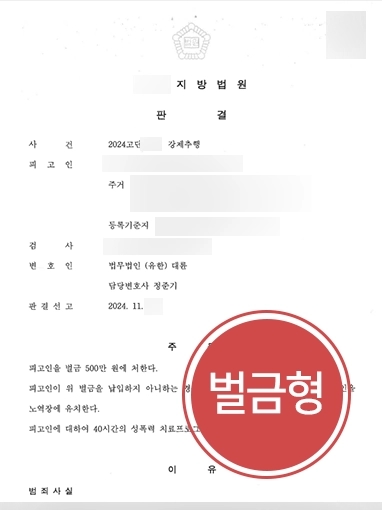
The court, having heard the attorney, issued a fine in the client's case.
The client faced the risk that a custodial sentence of imprisonment from 6 months to 2 years might be imposed for this matter.
Because the attorney drew on experience to raise mitigating factors in the client's defense, the client was able to escape that risk.
If one is charged with a sexual offense such as indecent act by compulsion, responding quickly from the stage of the police investigation can help lead to a favorable outcome.
If you are in a situation similar to that of the client in this case and facing such a risk, you are welcome to obtain a 🔗attorney referral and request a consultation.
This content is based on actual case studies of Daeryun Law LLC with some adaptations, and the copyright belongs to our firm.
Unauthorized reproduction, duplication, or distribution and other copyright infringements may result in legal action under applicable laws.