CONTENTS
- 1. The Client Who Requested Assistance With a Complaint for Unpaid Wages

- - How to Recover Overdue Wages
- 2. Litigation Assistance for the Complaint for Unpaid Wages
- 3. Result of the Complaint for Unpaid Wages: Success in Obtaining a Decision for Full Payment

1. The Client Who Requested Assistance With a Complaint for Unpaid Wages

This is the account of a client who requested assistance with a complaint for unpaid wages.
The client was in a situation where the employer had not paid wages amounting to 20 million won.
The client decided to recover the unpaid wages through a complaint for unpaid wages and sought out a labor attorney to request representation for the complaint.
 How to Recover Overdue Wages
Unpaid wages, as the term suggests, refers to wages whose payment is overdue or delayed.
It refers to an act in which an employer receives labor from an employee but does not pay the wages and other amounts that are the consideration for it.
For wages during employment (monthly salary, bonuses, other allowances, and the like), under the Labor Standards Act, wages are regarded as unpaid if payment is delayed by even one day from the wage payment date.
∙Labor Standards Act Article 43 (2): Wages shall be paid at least once a month on a fixed date.
Typical types of unpaid wages include simple nonpayment, nonpayment of allowances and the like, violation of the Minimum Wage Act, and violation of the obligation to settle unpaid amounts.
To resolve unpaid wages, one may use a petition or complaint, civil litigation, the simplified substitute payment, and other measures.
∙Petition/Complaint: An employee who has not been paid wages may request (petition) that the overdue wages be paid, or request (complaint) that the employer be punished for violating the Labor Standards Act.
To proceed alone without an attorney, you may file a petition for unpaid wages online through the Ministry of Employment and Labor's labor portal, or visit the customer support office of the labor office with jurisdiction over the location of the workplace for a preliminary consultation before filing a petition or complaint.
A labor inspector then requires the petitioner and the respondent to appear and conducts an investigation, and if the labor inspector's investigation confirms a violation of the law such as unpaid wages, a corrective instruction is issued to the business owner. If the violation is corrected, the case is closed, but if the corrective instruction is not complied with, the case is filed as a criminal matter, an investigation is commenced, and the case is referred to the prosecution.
A business owner with unpaid wages may be punished by imprisonment for not more than three years or a fine not exceeding 30 million won.
∙Civil Litigation: An employee who has not been paid wages may request (petition) that the overdue wages be paid, or request (complaint) that the employer be punished for violating the Labor Standards Act.
By filing a civil suit with the district court having jurisdiction over the location of the workplace or the employee's address and obtaining a final judgment, the employee can then carry out compulsory execution.
One point to note is that compulsory execution can only recover unpaid wages if the business owner has assets. In other words, it is important to identify the business owner's assets in advance and to obtain a provisional attachment.
∙Resolution in Case of Company Insolvency: This is a method by which unpaid wages can be resolved for an employee who, having been subject to industrial accident insurance and having operated a business for six months or more, retired from the relevant business or workplace within three years after the date falling one year before the declaration of bankruptcy, the decision to commence rehabilitation proceedings, or the date of the application for recognition of de facto insolvency (the retirement reference date).
The employee may file a claim with the head of the competent local labor office within two years from the date the company's insolvency is recognized.
This is a system under which, when an employee retires without having been paid wages, shutdown allowances, and retirement pay due to the company's insolvency, the State pays the unpaid wages and the like on behalf of the business owner.
∙Simplified Substitute Payment: This may be applied for when an employee, having not been paid wages and the like, retires from a business that has operated for six months or more as of the date of retirement and, within two years from the day after the retirement date, files a lawsuit and obtains a final judgment or the like.
If, within one year from the date the judgment becomes final, the employee files a claim for payment by attaching the judgment and other documents to the simplified substitute payment claim form, the employee may report the unpaid wages to the Ministry of Employment and Labor, obtain a certificate of unpaid amounts, file a lawsuit, and submit the simplified substitute payment claim form together with an authenticated copy of the judgment and other documents to the Korea Workers' Compensation and Welfare Service.
The employee may receive the unpaid amount out of the wages for the final three months, shutdown allowances, and the retirement benefits for the final three years. (Supported up to a maximum of 10 million won, with a 7 million won ceiling for wages/shutdown allowances and a 7 million won ceiling for retirement benefits and the like.)
2. Litigation Assistance for the Complaint for Unpaid Wages
For the complaint for unpaid wages, the labor attorney presented evidence that could clearly prove the existence of the unpaid wages.
First, the attorney calculated the amount of unpaid wages using the employment contract, which specified the wages, working hours, and allowances, and the pay statements for the salary received.
The attorney also presented the actual salary received through the bank account transaction records, proving the existence of the unpaid wages.
3. Result of the Complaint for Unpaid Wages: Success in Obtaining a Decision for Full Payment
As a result of the complaint for unpaid wages, the court ordered payment of the entire amount of unpaid wages together with an amount calculated at an annual rate of 20% until the date of full payment.
The client was able to be compensated for both the unpaid wages and the delay damages.
An unpaid wage problem is a critical situation for an employee, and trying to resolve it alone consumes a great deal of time and effort.
For that reason, gathering evidence and proceeding with litigation with the assistance of an attorney is more convenient and secure.
At Daeryun Law Firm, with the aim of "handling cases properly and concluding them quickly," an attorney provides a consultation as soon as an inquiry is received.
If you would like to quickly proceed with a 🔗claim for wages/retirement pay lawsuit like the one above, you may receive an 🔗attorney referral from Daeryun Law Firm.
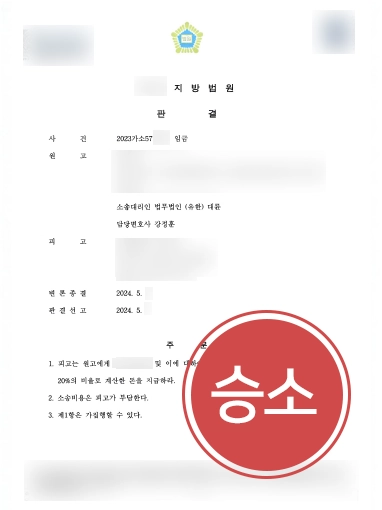
This content is based on actual case studies of Daeryun Law LLC with some adaptations, and the copyright belongs to our firm.
Unauthorized reproduction, duplication, or distribution and other copyright infringements may result in legal action under applicable laws.