
CONTENTS
- 1. The Client Who Requested a Response to the Unfair Dismissal Litigation

- - What Is Unfair Dismissal Litigation?
- 2. Unfair Dismissal Litigation, Assistance Toward Dismissal of the Final Appeal
- - Unfair Dismissal Litigation Strategy, Arguing the Dismissal Lacked a Valid Ground
- - Unfair Dismissal Litigation Strategy, Arguing the Dismissal Was Unfair as No Chance to Improve Was Given
- 3. Unfair Dismissal Litigation Result, Successful Dismissal of the Final Appeal

1. The Client Who Requested a Response to the Unfair Dismissal Litigation

This is the account of a client who requested a response to the unfair dismissal litigation.
The defendant's intervenor, refusing to accept the National Labor Relations Commission's ruling that the dismissal was unfair, had filed a final appeal against the client, who had been the worker, seeking to set aside the reexamination decision on the remedy for unfair dismissal.
The client requested a response to the unfair dismissal litigation.
 What Is Unfair Dismissal Litigation?
🔗Unfair dismissal means a dismissal without just cause.
If an employer dismisses a worker without just cause, the worker may apply to the Labor Relations Commission for a remedy.
The matters for which a remedy may be sought from the Labor Relations Commission for unfair dismissal include ▲where the dismissal was carried out without just cause, ▲where the requirements limiting dismissal for managerial reasons were not met, ▲where the dismissal violated a specific statutory ground prohibiting dismissal, ▲where the dismissal involved excessive disciplinary weighing despite there being no ground warranting dismissal, ▲where the dismissal violated the dismissal procedures set out in statute, a collective agreement, or work rules, and ▲where the dismissal was carried out during a period in which dismissal is not allowed.
The remedy procedure for unfair dismissal, through an application for remedy to the Labor Relations Commission and the filing of an administrative suit, proceeds in the order of application for remedy, investigation, examination, ruling, (reexamination or administrative litigation), confirmation, and conclusion.
An employer or a worker may, within 15 days from the date of service of the reexamination decision, file a suit under the Administrative Litigation Act against the National Labor Relations Commission's reexamination decision.
An employer or a worker who has a legal interest in seeking the revocation of the National Labor Relations Commission's reexamination decision may file a revocation suit against that reexamination decision.
In such a case, the revocation suit names the Chairperson of the National Labor Relations Commission as the defendant.
2. Unfair Dismissal Litigation, Assistance Toward Dismissal of the Final Appeal
The defendant's intervenor in the unfair dismissal litigation, refusing to accept the National Labor Relations Commission's ruling that the dismissal was unfair, had even filed a final appeal.
The client's attorney provided assistance toward the dismissal of the final appeal.
Unfair Dismissal Litigation Strategy, Arguing the Dismissal Lacked a Valid Ground
The defendant's intervenor, who filed the final appeal, argued that the client's frequent friction with coworkers showed the client's work attitude was poor and asserted this as one of the grounds for dismissal.
The client's attorney again argued that the employees who had worked with the client at the time had previously prepared and submitted statements to the effect that the client had worked diligently in the case on the application for remedy against unfair dismissal.
The attorney also argued that the client had previously reported the intervenor's representative and managing director on suspicion of occupational breach of trust, and emphasized that it was questionable whether the representative and managing director, who recorded the work attitude evaluations, could have given the client a fair assessment.
The attorney submitted as evidence a record showing that, after the client raised the suspicion of occupational breach of trust, the intervenor's representative and managing director gave the client a score far below the minimum.
Unfair Dismissal Litigation Strategy, Arguing the Dismissal Was Unfair as No Chance to Improve Was Given
The defendant's intervenor notified the client of dismissal on the ground that the client's work performance was poor.
On this point, the lower court held that "even if a worker's work performance is poor, dismissing the worker without affording an opportunity to improve, such as through training, is difficult to recognize as justified."
The client's attorney emphasized that, given the client had worked at the intervenor's company for more than 20 years, the company had a duty to consider the client by affording sufficient opportunity to improve where the client's work performance or ability was lacking, and argued that the lower court's judgment was justified.
3. Unfair Dismissal Litigation Result, Successful Dismissal of the Final Appeal
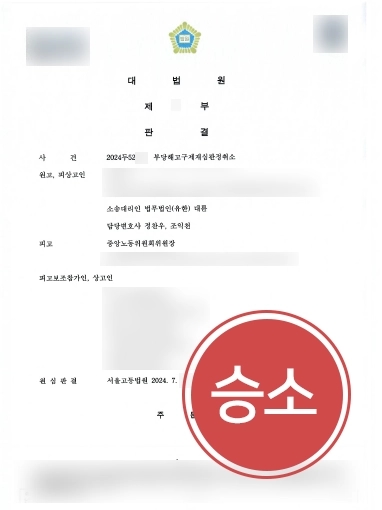
As a result of the unfair dismissal litigation, the Supreme Court held that "the appellant's grounds for the final appeal are without merit. The final appeal is dismissed."
The legal procedures related to unfair dismissal are an important process for protecting workers' rights.
Unfair dismissal litigation requires an understanding of various laws, including the Labor Standards Act, the Administrative Litigation Act, and the Labor Relations Commission regulations.
It is necessary to accurately determine whether a dismissal is unfair and to devise a litigation strategy that rebuts the other party's arguments.
Daeryun Law Firm jointly reviews and collaborates on cases with attorneys together with labor attorneys and other professionals within Daeryun, providing prompt solutions through a one-stop service.
If you are seeking 🔗an attorney regarding unfair dismissal litigation in a situation like the above, please reach out to Daeryun Law Firm.
This content is based on actual case studies of Daeryun Law LLC with some adaptations, and the copyright belongs to our firm.
Unauthorized reproduction, duplication, or distribution and other copyright infringements may result in legal action under applicable laws.