
CONTENTS
- 1. The Client Who Requested a Response to an Intellectual Property Infringement Suit

- - What Is Intellectual Property Infringement?
- - Points to Note in an Intellectual Property Infringement Suit
- 2. The Strategy for Defending the Intellectual Property Infringement Damages Suit
- 3. The Result of Responding to the Intellectual Property Infringement Suit: A 60% Reduction in Damages

1. The Client Who Requested a Response to an Intellectual Property Infringement Suit

This is the account of a client who requested a response to an intellectual property infringement suit.
The client was manufacturing and selling accessories and other items made with 3D printing as a side business.
The problem was that the simulation program the client used was not genuine.
As a result, Company A, which sells the program, filed a criminal complaint against the client and brought a claim for damages for intellectual property infringement.
The client requested a response to that intellectual property infringement damages suit.
 What Is Intellectual Property Infringement?
Intellectual property infringement refers to the act of using another person's intellectual property rights, such as patents, trademarks, utility models, designs, and copyrights, without permission.
Such conduct can hinder industrial development and cause harm to consumers.
The representative types of intellectual property infringement are as follows.
∙Copyright infringement: copying or uploading an image one does not own without permission
∙Trademark infringement and counterfeiting: using a trademark without authorization in a manner that can cause confusion as to the source of a product
∙Patent infringement: making, using, selling, or offering an invention or design without the permission of the patent holder
∙Right of publicity infringement: using an individual's name, likeness, or features without authorization in product listings, advertising, or other commercial activities
🔗Copyright infringement is punishable under the Copyright Act by imprisonment of up to five years or a fine of up to 50 million won.
🔗Trademark infringement and counterfeiting are punishable under the Trademark Act by imprisonment of up to seven years or a fine of up to 100 million won.
Patent infringement may also be punished under the Patent Act by imprisonment of up to seven years or a fine of up to 100 million won.
If a right of publicity is infringed, the injured party may claim as damages the amount it could have received had it sold the right commercially.
Points to Note in an Intellectual Property Infringement Suit
To proceed with an intellectual property infringement suit, one must clearly assert the cause of the infringement.
An unclear statement of claim can be a cause of delay in the litigation and a ground for rejection, and even if one prevails, compulsory execution may be impossible, which can waste time and money.
The plaintiff should keep this in mind and specify the subject of the requested injunction in concrete, individual, and factual terms.
For example, statements such as ‘the defendant must not infringe the plaintiff's patent or use the trademark’ are meaningless, and unclear terms such as ‘etc., and the like, all, related’ must not be used.
When seeking to prohibit the production, sale, or transfer of an item, one should specify, as concretely as possible through the product name, product photographs, product number, and product description, the item that the opposing party is actually producing and selling, so that the enforcement authority can identify the subject of compulsory execution without difficulty.
Let us look at how the defendant may respond.
It is important for the defendant to take a basic position suited to the situation among the following and to respond clearly: ▲challenging the lack of specificity in the statement of claim, ▲contesting whether the plaintiff's intellectual property rights can be protected, ▲denying the infringement, and ▲cases where conduct appears at first glance to be infringement but there are matters to raise in defense.
2. The Strategy for Defending the Intellectual Property Infringement Damages Suit
We undertook the defense to reduce the amount of the intellectual property infringement damages suit.
The client's attorney argued, in order to reduce the amount of that intellectual property infringement damages suit, that the client had not made unauthorized copies for the purpose of using the entire module of the program.
As the plaintiff argued, the program in this case is composed of several modules, and each module of the program has a separately calculated sale price and is sold individually.
However, the investigation and the statement of oral argument stated only that the client ‘installed and used Program A on a computer,’ and did not state, as the plaintiff argued, that the client ‘installed and used all of the individual modules of the program in this case.’
The attorney emphasized that the plaintiff was nonetheless calculating the plaintiff's damages on the basis of a sale price that included all of those modules and claiming damages from the client, and argued that the amount of damages was unjust.
3. The Result of Responding to the Intellectual Property Infringement Suit: A 60% Reduction in Damages
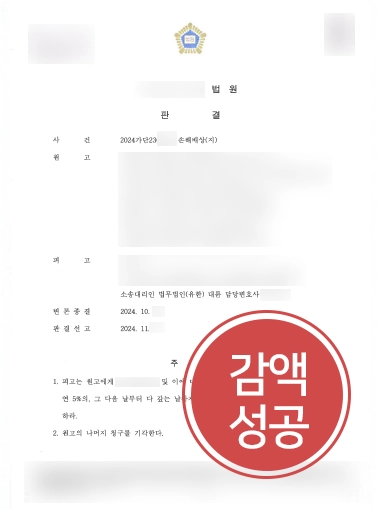
As a result of responding to the intellectual property infringement suit, the client was able to reduce the damages claimed by the plaintiff by 60%.
Intellectual property infringement litigation is a field that requires technical expertise and complex legal knowledge.
Intellectual property encompasses various fields, such as patents, trademarks, and designs, and because the technical characteristics differ for each field, establishing an effective response strategy with the help of an attorney experienced in this area can be helpful.
If you need to respond to an intellectual property infringement suit in a situation like the one above, you may 🔗consult an attorney at Daeryun Law Firm.
This content is based on actual case studies of Daeryun Law LLC with some adaptations, and the copyright belongs to our firm.
Unauthorized reproduction, duplication, or distribution and other copyright infringements may result in legal action under applicable laws.