
CONTENTS
- 1. How the Client Came to the Seocho Attorney

- - The Client's Situation
- - The Statutes Relevant to the Case as Explained by the Seocho Attorney
- 2. The Defense Advanced by the Seocho Attorney
- - The Seocho Attorney's Argument ① The Tenants Had No Intention to Renew
- - The Seocho Attorney's Argument ② The Client's Actual Residence
- 3. The Result of the Seocho Attorney's Assistance

1. How the Client Came to the Seocho Attorney

The client was in a bewildering situation in which the former tenants, who had moved out of the client's apartment several months earlier upon the expiration of their lease, suddenly filed a damages lawsuit.
The client therefore visited the Seocho office to obtain legal help.
 The Client's Situation
Three years ago, the client leased an apartment owned by the client and took on tenants.
As those tenants' lease was expiring and the client intended to live in the apartment, the client gave notice that renewal would be difficult and then actually moved into and resided in the apartment.
However, after the move, the client soon resigned from the new workplace and no longer had any reason to live in that area, so the client lived in the apartment only briefly and, six months later, took on yet another tenant.
Then the former tenants suddenly filed a damages lawsuit against the client, claiming that the client had violated the Housing Lease Protection Act.
The client therefore came to the Seocho attorney to obtain legal assistance.
The Statutes Relevant to the Case as Explained by the Seocho Attorney
Under the Housing Lease Protection Act, it is provided that “where a tenant requests a renewal of the contract within the period from six months to two months before the lease term ends, the landlord may not refuse without justifiable grounds.”
However, as in the client's situation, where the landlord or a person who is the landlord's lineal ascendant or descendant will actually reside in the housing, this is regarded as a justifiable ground on which the renewal of the lease may be refused.
For that reason, where a person, like the client, is sued for damages on the ground of having violated the Housing Lease Protection Act, that person must prove the fact of having actually resided in, or having intended to reside in, the housing.
To resolve such a 🔗lease dispute, one must gather evidence capable of proving the fact of actual residence and, through it, advance appropriate legal arguments, so the help of an attorney with abundant experience is needed.
2. The Defense Advanced by the Seocho Attorney
The Seocho attorney carefully gathered the lease contract the client had made with the tenants, the conversations exchanged regarding the renewal and its refusal, and the traces and circumstances of actual residence, and rebutted the plaintiffs' assertions.
The Seocho Attorney's Argument ① The Tenants Had No Intention to Renew
In fact, the tenants had never once expressed an intention to renew the contract until the client first conveyed, two months before the contract's expiration, that renewal would be difficult.
The Seocho attorney pointed out that the plaintiff tenants had no intention of exercising the right to request renewal in the first place, and emphasized that the client had not violated the Housing Lease Protection Act.
The Seocho Attorney's Argument ② The Client's Actual Residence
The tenants assert that the client refused to renew the contract on the pretext of actual residence in the apartment and then did not reside there, but the client filed a move-in report after the tenants moved out and resided there for about two months.
The Seocho attorney emphasized that the plaintiffs' assertions had a weak basis and that the client had exercised a legitimate refusal to renew the lease contract.
3. The Result of the Seocho Attorney's Assistance
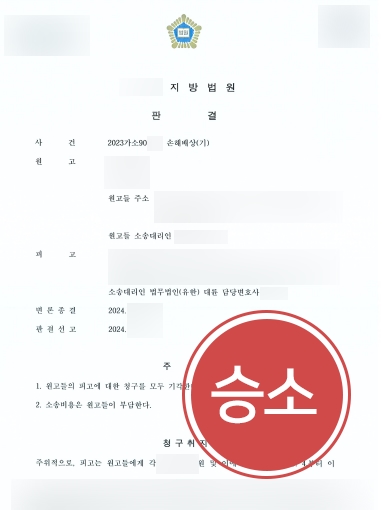
The court, accepting the Seocho attorney's argument, recognized that the client had not violated the Housing Lease Protection Act and ruled, “All of the plaintiffs' claims against the defendant are dismissed.”
If You Have Been Sued for Damages for Violation of the Lease Protection Act
Under the Housing Lease Protection Act, a tenant's request to renew a lease contract must be protected, but it is not the case that a landlord may refuse a renewal contract unconditionally in every case.
Accordingly, if the purpose is for a lineal ascendant or descendant, including the landlord, to actually reside in the housing, the request for renewal may be legitimately refused, and a damages claim arising from this can be defended against.
However, contesting whether the Housing Lease Protection Act has been violated requires specialized legal knowledge and abundant related experience, so the assistance of an attorney is more important than anything else.
At Daeryun Law Firm, attorneys with diverse experience in lease disputes work to establish the optimal strategy tailored to the client's case.
If you would like a consultation, please obtain one through a 🔗legal consultation booking.
This content is based on actual case studies of Daeryun Law LLC with some adaptations, and the copyright belongs to our firm.
Unauthorized reproduction, duplication, or distribution and other copyright infringements may result in legal action under applicable laws.