
CONTENTS
- 1. The Client Who Consulted the Corporate Attorney

- 2. Goods Payment Explained by the Corporate Attorney
- - The Goods Payment Lawsuit Procedure Explained by the Corporate Attorney
- 3. The Goods Payment Lawsuit Filed by the Corporate Attorney
- - The Defendant's Argument in the Corporate Attorney's Case
- - The Corporate Attorney's Rebuttal of the Defendant's Argument
- 4. The Judgment Led by the Corporate Attorney

1. The Client Who Consulted the Corporate Attorney
The client who consulted the corporate attorney operated a small company engaged in the manufacture and sale of automobile parts.
The defendant in this case was engaged in the manufacture and sale of automobiles, and the client had been supplying parts to the defendant company.
Later, as operating the company became difficult, the client transferred the authority to operate the client's company to the defendant company, and the defendant agreed to acquire the client's company.
However, separate from the acquisition of the company, there was an outstanding goods payment that the defendant had not made to the client.
The defendant argued that, because it had already taken over the operating authority and because the written undertaking to pay for the goods did not bear its seal, it had no obligation to pay.
The client explained that he had continued to do business with the defendant and that, even when the seal had been omitted in accordance with past practice, payment had always been made.
The client consulted the corporate attorney, stating that the amount the defendant had not paid was about 60 million won and asking for help in recovering it.
2. Goods Payment Explained by the Corporate Attorney
The client explained that he was not being paid for goods by the defendant company.
A goods payment refers to the amount received in return for supplying goods.
If, like the client, you have supplied goods but have not been paid, you may file a goods payment lawsuit.
 The Goods Payment Lawsuit Procedure Explained by the Corporate Attorney
A goods payment lawsuit may be filed according to the procedure below.
First, to file a goods payment lawsuit, you must file a complaint, and this complaint must be accompanied by evidence that the supply of goods was completed, such as the contract, transaction records, delivery slips, and invoices.
After the defendant submits an answer, the court serves a copy of that answer.
After the copy of the answer is served, the case proceeds through preparatory briefs and the trial, and the court's judgment is then issued.
If the defendant still does not pay even after the judgment, the payment can be recovered through compulsory execution proceedings, such as by attaching the other party's property.
A goods payment lawsuit can be seen as a contest of evidence, and it is difficult for an individual to prepare and submit legally effective evidence.
If, like the client in this case, you are about to file a goods payment lawsuit, it is recommended to seek the assistance of a corporate attorney.
3. The Goods Payment Lawsuit Filed by the Corporate Attorney
The corporate attorney filed a complaint, arguing as follows in order to recover the client's goods payment.
An employee of the defendant company prepared the written undertaking to pay the goods payment, and because that undertaking has legal effect, the defendant must pay in accordance with it.
The Defendant's Argument in the Corporate Attorney's Case
The defendant, having received the corporate attorney's complaint, sent an answer containing the following arguments.
All goods payments other than the amount stated in the undertaking have already been paid in full.
The Corporate Attorney's Rebuttal of the Defendant's Argument
The corporate attorney rebutted the defendant's argument as follows and demanded payment of the goods payment.
Under the corporate transfer and acquisition agreement, the client transferred a bank account in the client's name to the defendant company.
The defendant argues that it paid the amount into the account in the client's name, but that account can no longer be used by the client.
4. The Judgment Led by the Corporate Attorney

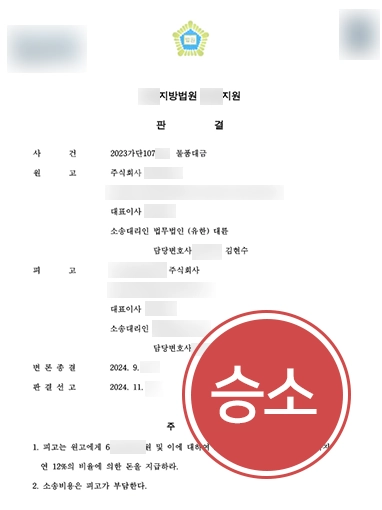
The court, having heard the corporate attorney's arguments, issued a judgment ordering the defendant to pay the client the entire amount of about 60 million won that the client had claimed.
In addition, the court ordered the defendant to bear all of the costs incurred in this lawsuit.
With the corporate attorney's assistance, the client was able to recover not only the full 🔗goods payment but also the litigation costs.
As in this case, when a legal dispute arises between businesses, the time required can become very long and affect daily life.
You may seek a corporate attorney to handle your case and protect your daily life. A corporate attorney can develop a strategy suited to the case and work toward a favorable outcome.
This content is based on actual case studies of Daeryun Law LLC with some adaptations, and the copyright belongs to our firm.
Unauthorized reproduction, duplication, or distribution and other copyright infringements may result in legal action under applicable laws.