CONTENTS
- 1. The Client Who Requested a Response to a Trademark Infringement Lawsuit

- - Trademark Infringement Lawsuit, What Is a Suit for the Existence of Prior-Use Rights?
- 2. Assistance in Responding to the Trademark Infringement Lawsuit
- - Response to the Trademark Infringement Lawsuit 1. Arguing That the Conduct Was a Violation of the Trademark Right
- - Response to the Trademark Infringement Lawsuit 2. Arguing That a Prior-Use Right Could Not Be Recognized
- 3. Result of the Assistance in the Trademark Infringement Lawsuit, the Claim Successfully Dismissed

1. The Client Who Requested a Response to a Trademark Infringement Lawsuit

This is the account of a client who requested a response to a trademark infringement lawsuit.
The client had been served with a suit for confirmation of the existence of prior-use rights filed by the plaintiff.
To protect his trademark right, the client needed the plaintiff's claim to be dismissed.
A Daeryun attorney examined the client's trademark infringement lawsuit in detail and set out a response strategy.
 Trademark Infringement Lawsuit, What Is a Suit for the Existence of Prior-Use Rights?
Article 103 of the Patent Act is a provision that protects a person who used a particular invention 'in good faith' before a patent application, allowing that person to continue using it even after the invention is registered as a patent, and this is called a prior-use right.
A prior-use right may be held by a person who, without knowledge of the patent-applied invention, independently practiced the invention, or who learned of or received the invention from the inventor and was preparing for or carrying out a business.
For a prior-use right to be established, the practice or preparation in Korea, and the time of use of the invention, must precede the patent application.
Temporary use is not recognized as conferring the right, and it is recognized only where the invention was used in good faith.
The right may be exercised only within the scope of the invention and business purpose that the prior user was practicing, and it is not recognized where the business purpose is changed.
In other words, a prior-use right is a system that ensures that a person who legitimately used or was preparing an invention before the patent application can maintain the right within a certain scope even after the patent right for that invention is registered.
Here, having used the invention 'in good faith' means that the user did not know of the invention at the time of the patent application and legitimately used it without any improper intent.
To prove this, the user must demonstrate records of use of the invention, evidence of the time of use, and lack of awareness of the patented invention.
Because the burden of proof rests entirely on the user when asserting a prior-use right, the user must prove that the invention was independently developed, or that the process of learning of the invention was lawful and in good faith.
2. Assistance in Responding to the Trademark Infringement Lawsuit
To respond to the trademark infringement lawsuit, the attorney gathered evidence rebutting the plaintiff's argument and set out a response.
Response to the Trademark Infringement Lawsuit 1. Arguing That the Conduct Was a Violation of the Trademark Right
For the 🔗trademark infringement lawsuit, the attorney emphasized the plaintiff's conduct in violation of the trademark right.
The plaintiff used the trademark online without any permission from the client, while selling the same goods.
Whether trademarks are similar must be determined by observing the compared trademarks objectively, as a whole, and separately in terms of appearance, name, and concept, according to whether there is a likelihood of confusion or mistake in trade.
The attorney argued that the plaintiff used the client's trademark as it was, that it was clearly identical to the registered trademark at issue under ordinary trade practice, and that its name could also be regarded as identical to the registered trademark at issue.
Response to the Trademark Infringement Lawsuit 2. Arguing That a Prior-Use Right Could Not Be Recognized
To respond to the trademark infringement lawsuit, the attorney argued that a prior-use right could not be recognized.
For a prior-use right to be recognized, the following must be established: ▲there must be no purpose of unfair competition; ▲the person must be one who uses a trademark identical or similar to another's registered trademark on goods identical or similar to its designated goods, and who has continuously used it in Korea since before the other person's trademark application; and ▲the person must be one who uses, as a trademark and in accordance with commercial practice, a means of indicating the identity of his own personality, such as his name or trade name.
The plaintiff, however, took ideas and business methods obtained while working at the client's company and used them to establish his own company.
In addition, the plaintiff did not use the trade name before the date of the client's trademark application; rather, only after the client filed the trademark application did the plaintiff change the company's trade name to that word.
The attorney handling the trademark infringement lawsuit emphasized that the plaintiff's deliberate conduct should be regarded, from the very time of its use, as negating the requirements of a prior-use right against the trademark right.
3. Result of the Assistance in the Trademark Infringement Lawsuit, the Claim Successfully Dismissed
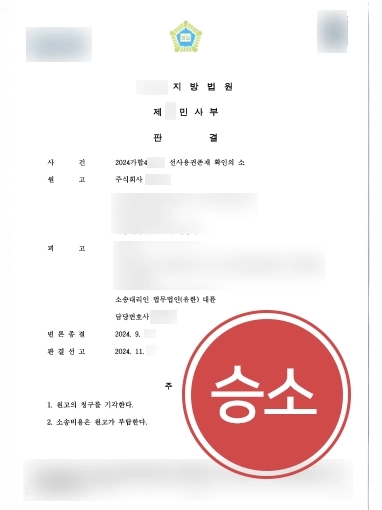
As a result of the assistance in the trademark infringement lawsuit, the plaintiff's claim was dismissed, and the client was able to protect the right to the trademark.
The court held, “The plaintiff's use of the trade name should be assessed as infringing the trademark rights of each registered trademark at issue, so the plaintiff's argument is without merit.”
A trademark infringement lawsuit requires interpretation of various precedents and legal principles under the Trademark Act, and securing key evidence to lead the litigation.
Drawing on a litigation database, Daeryun Law Firm quickly derives a response method suited to the client's situation.
If you need help with a trademark infringement lawsuit as described above, you may request a 🔗attorney referral from Daeryun Law Firm.
This content is based on actual case studies of Daeryun Law LLC with some adaptations, and the copyright belongs to our firm.
Unauthorized reproduction, duplication, or distribution and other copyright infringements may result in legal action under applicable laws.