
CONTENTS
- 1. The Client Who Requested a Response to the Lawsuit for Return of Unjust Enrichment

- - What Is a Lawsuit for Return of Unjust Enrichment?
- - Precedent Related to a Lawsuit for Return of Unjust Enrichment
- 2. Assistance for Responding to the Lawsuit for Return of Unjust Enrichment
- - Strategy for the Lawsuit for Return of Unjust Enrichment, Explaining the Relationship Between the Client and the Plaintiff
- 3. Result of the Assistance With the Lawsuit for Return of Unjust Enrichment, Success in Having the Claim Dismissed

1. The Client Who Requested a Response to the Lawsuit for Return of Unjust Enrichment

This is the account of a client who requested a response to a lawsuit for the return of unjust enrichment.
The client was suddenly faced with a lawsuit for the return of unjust enrichment from a former romantic partner.
A Daeryun attorney closely examined the background of the client's lawsuit for the return of unjust enrichment and undertook the response.
 What Is a Lawsuit for Return of Unjust Enrichment?
🔗A lawsuit for the return of unjust enrichment is a lawsuit that legally demands the return of profit from a person who has gained profit by using another person's property or services without a legal cause.
A lawsuit for the return of unjust enrichment is a type of lawsuit that arises in various areas of everyday life.
The important point in a lawsuit for the return of unjust enrichment is that one must prove that, beyond the other party having gained profit, harm was caused through the use of one's own property or real estate.
If another person gained profit by using one's property or real estate but no harm was caused to oneself, the fact of unjust enrichment may not be established.
In other words, in order to file a lawsuit for the return of unjust enrichment, the following requirements must be met: ▲there is no legal cause, ▲a loss is incurred by oneself, ▲the other party gains profit, and ▲there is a causal relationship between the two.
Precedent Related to a Lawsuit for Return of Unjust Enrichment
A Lawsuit for Return of Unjust Enrichment, a Precedent on the Legal Status of a Third Party
A management company that carried out renovation work approved by a local government completed the work and donated it for public use even after receiving a notice rejecting the design change and the cost increase.
The merchants' association that bore the construction costs (the independent party intervenor) claimed against the local government for the return of unjust enrichment or for reimbursement of costs as a manager of affairs.
Article 261 of the Civil Act recognizes a right to claim the return of unjust enrichment in certain situations, but the requirements of Article 261 alone are not sufficient, and the general requirements for unjust enrichment must be met.
In other words, a party claiming a loss must prove whether its loss is at a level that can be claimed for return under the doctrine of unjust enrichment.
In principle, performance between contracting parties cannot constitute unjust enrichment unless the contractual relationship has been lawfully nullified.
In addition, even if contractual performance provides a benefit to a third party, this does not create a right to claim the return of unjust enrichment directly against the third party.
Liabilities and rights under a contract arise only between the contracting parties.
The Supreme Court determined that the movable property in question belonged to the management company, and that the independent party intervenor had no right to claim the return of unjust enrichment against the local government for it.
This emphasized that, for a claim for the return of unjust enrichment to be established, the relationship of ownership and the attribution of rights must be clearly proven.
The independent party intervenor cannot claim the return of unjust enrichment against the local government, and the relevant portion of the judgment of the court below was reversed and remanded because it was based on a mistaken premise.
This precedent shows that, when asserting a claim for the return of unjust enrichment in the context of contractual and ownership relationships, the relationship of rights between the contracting parties and a third party must be made clear.
2. Assistance for Responding to the Lawsuit for Return of Unjust Enrichment
The attorney undertook assistance for responding to the lawsuit for the return of unjust enrichment.
The attorney explained the relationship between the client and the plaintiff and the background of the case, and devised a response strategy.
Strategy for the Lawsuit for Return of Unjust Enrichment, Explaining the Relationship Between the Client and the Plaintiff
The client and the plaintiff were in a romantic relationship and had been living together at the client's home.
The plaintiff, whose financial circumstances had worsened, proposed living together to the client, and the client accepted.
The plaintiff agreed to pay the client the amount remaining from the plaintiff's salary after the plaintiff's own use, under the heading of rent, living expenses, and the like.
The client's attorney argued that the money the plaintiff paid to the client was paid under the heading of rent and living expenses, and that it was therefore not a benefit the client obtained from the plaintiff's property and services without a legal cause.
3. Result of the Assistance With the Lawsuit for Return of Unjust Enrichment, Success in Having the Claim Dismissed
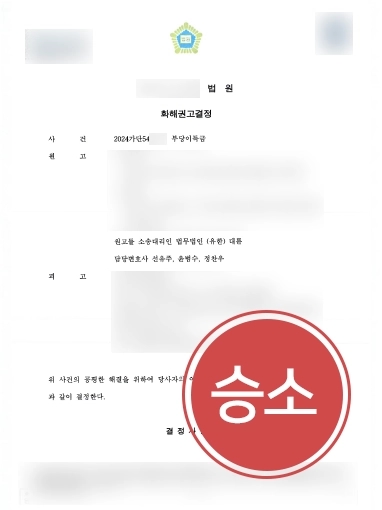
As a result of the assistance with the lawsuit for the return of unjust enrichment, it was possible to have all of the plaintiff's claims dismissed.
The outcome of a lawsuit for the return of unjust enrichment depends on the determination of whether unjust enrichment exists.
It is recommended to carefully review, together with an attorney, whether the requirements for filing the lawsuit have been met, to explore the possibility that the claim may be dismissed, and to argue that the plaintiff's claim is without merit by securing objective evidence.
Daeryun Law Firm predicts the course of a client's case through machine learning software based on the cases it has handled and the wide range of lower court judgments it has independently obtained, and presents tailored strategies.
If you need help with a lawsuit for the return of unjust enrichment in a situation such as the above, you may receive a 🔗attorney referral from Daeryun Law Firm.
This content is based on actual case studies of Daeryun Law LLC with some adaptations, and the copyright belongs to our firm.
Unauthorized reproduction, duplication, or distribution and other copyright infringements may result in legal action under applicable laws.