
CONTENTS
- 1. Incheon Criminal Attorney | Case Details

- - Incheon Criminal Attorney | Client Served as a Construction Site Manager
- - Incheon Criminal Attorney | Accused of Preparing a False Transaction Statement by Inflating Construction Payments
- - Incheon Criminal Attorney | Accused by the Victim on Suspicion of Fraud
- 2. Incheon Criminal Attorney | The Client's Case as Reviewed by the Incheon Attorney
- - Incheon Criminal Attorney | What Is the Crime of Fraud?
- - Incheon Criminal Attorney | What Are the Elements of the Crime of Fraud?
- 3. Incheon Criminal Attorney | Details of the Assistance
- - Incheon Criminal Attorney | The Conduct Did Not Meet the Elements of the Crime of Fraud
- - Incheon Criminal Attorney | There Was No Intent to Commit Fraud
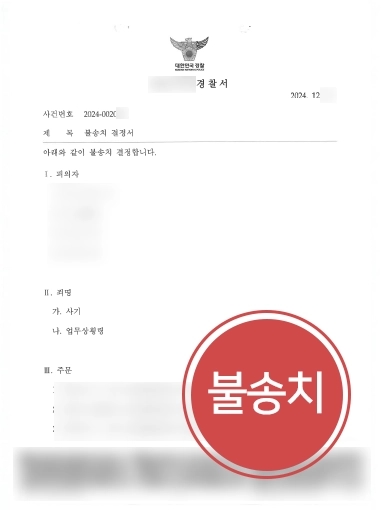
- 4. Incheon Criminal Attorney | Client Receives a Disposition of No Suspicion of Crime and Non-Referral

1. Incheon Criminal Attorney | Case Details

The attorney noted that the complex legal issues that arise on construction sites often cause misunderstanding and distrust among the parties involved in the project.
In particular, matters relating to construction payments and costs can later develop into serious legal issues, such as liability for construction delays, so it can be helpful to consult an Incheon attorney promptly at the early stage of a case.
 Incheon Criminal Attorney | Client Served as a Construction Site Manager
The client served as the site manager of a large construction site and was responsible for the progress and management of the construction work.
In particular, as the site manager, the client carried out various roles, including ordering materials, managing the work schedule, and billing for payments, and was responsible for the overall operation of the site.
The case arose while the client was serving as the site manager.
The client came under suspicion of deceiving the victim and causing loss by billing the trust company (the victim) for construction payments at an amount inflated beyond the actual costs.
Incheon Criminal Attorney | Accused of Preparing a False Transaction Statement by Inflating Construction Payments
The client explained that the problem arose during the course of the construction work.
The victim claimed that the transaction statement the client submitted included excessive payments.
The victim suspected that the client had intentionally inflated the amount and prepared the statement falsely.
On this basis, the victim filed a criminal complaint against the client for the crime of fraud.
Incheon Criminal Attorney | Accused by the Victim on Suspicion of Fraud
The client explained that, because they had billed exactly the payment that had been requested, they had not submitted any false materials.
The client also explained that, although it was true that the client had prepared the transaction statement as described above and billed the victim to resolve outstanding receivables from another construction site and had received construction payments, this had been done because there had been the victim's implied consent in the past.
This was because the victim had a history of having already approved similar amounts in past transactions and of having impliedly consented by paying them.
The client turned to an Incheon attorney and requested assistance to resolve this complex case involving the inflation of construction payments at a construction site.
2. Incheon Criminal Attorney | The Client's Case as Reviewed by the Incheon Attorney
The attorney reviewed the transaction statement that the client was alleged to have submitted as false material and examined whether the client had in fact deceived the victim and obtained money.
Incheon Criminal Attorney | What Is the Crime of Fraud?
The attorney explained that the crime of fraud, with which the client was charged, is as follows.
Attorney: Under Article 347 of the Criminal Act, a person who deceives another and obtains the delivery of property or acquires a pecuniary benefit may be punished by imprisonment for not more than 10 years or by a fine not exceeding 20 million won. The same punishment applies to a person who, by such means, causes a third party to receive the delivery of property or to acquire a pecuniary benefit. Attorney: The crime of fraud requires an act of deception. It is committed when there is also an act that induces a mistake, a disposal act by the deceived party, and the delivery of property or the acquisition of a pecuniary benefit. The client may have a chance of obtaining a disposition of no suspicion of crime only by proving that at least one of these elements is absent.What is the crime of fraud that the client is charged with?
How should the client prove innocence of the fraud charge?
Incheon Criminal Attorney | What Are the Elements of the Crime of Fraud?
The attorney explained that the subject of the crime of fraud is a natural person. This is understood to include a juristic person as well.
For the crime of fraud to be established, the following elements must be satisfied.
First, an act of deception
There must be an act in which the client deceives the victim and distorts or conceals the facts. For example, falsely preparing a transaction statement to inflate the payment falls under this.
Second, financial loss
It must be proven that the victim actually suffered financial loss as a result of the act of deception.
If the victim paid an excessive amount, this becomes an important element in establishing the crime of fraud.
Third, intent of unlawful acquisition
It is necessary to prove whether the client had the intent to acquire property unlawfully.
If the client inflated the amount through a simple mistake, the crime of fraud may not be established.
Accordingly, the attorney and the client had to prove that no act of deception or financial loss had occurred. They also had to argue that there had been no intent of unlawful acquisition.
3. Incheon Criminal Attorney | Details of the Assistance
To assist the client, the attorney presented the following pleadings.
Incheon Criminal Attorney | The Conduct Did Not Meet the Elements of the Crime of Fraud
The attorney argued that the client's conduct did not meet the elements of the crime of fraud.
The attorney emphasized that the client had no intent to deliberately deceive the victim or to make an unlawful acquisition.
In the crime of fraud, property means another person's property, and property of one's own that is in another person's possession does not become an object of the crime of fraud. (Supreme Court, Judgment of May 9, 2012, 2010Do17192)
Therefore, the attorney established that, because the construction payments that the client was alleged to have falsely inflated and obtained were not themselves the property of the victim, the conduct did not meet the elements of the crime of fraud.
Incheon Criminal Attorney | There Was No Intent to Commit Fraud
The client proved that, in preparing the transaction statement, the client had no intent to bill an excessive amount and that the victim had in fact impliedly consented to it.
Accordingly, the client proved that the client had no intent to deliberately deceive the victim.
4. Incheon Criminal Attorney | Client Receives a Disposition of No Suspicion of Crime and Non-Referral
With the attorney's assistance, the client received a disposition of non-referral on the ground of no suspicion of crime for the fraud charge.
The police found that there was insufficient basis for the fraud charge against the client, and, having confirmed that the victim's implied consent had existed, notified that the case had been concluded with a disposition of non-referral.
With the attorney's assistance, the client cleared the fraud charge and was able to return to the construction site.
If you have been booked on a criminal charge over a construction-payment matter arising at a construction site, as in this case, you may turn to an 🔗Incheon attorney and respond promptly.
This content is based on actual case studies of Daeryun Law LLC with some adaptations, and the copyright belongs to our firm.
Unauthorized reproduction, duplication, or distribution and other copyright infringements may result in legal action under applicable laws.