
CONTENTS
- 1. The Client Referred to a Gangneung Attorney

- 2. Assistance for the Client Who Sought a Gangneung Attorney
- - Defense Strategy, Argument That It Was a Legitimate Exercise of a Right
- - Defense Strategy, Argument That the Conduct Did Not Create Anxiety
- 3. The Client Who Sought a Gangneung Attorney, Successful Conclusion With Non-Prosecution

1. The Client Referred to a Gangneung Attorney

The client, who was referred to a Gangneung attorney, was the subject of complaints for coercion and for violation of the Act on Promotion of Information and Communications Network Utilization and Information Protection.
The client requested help from an attorney experienced in this area to defend against the complaints.
 Circumstances of the Client's Case as Understood by the Gangneung Attorney
The client, who resides in Gangneung, operated a small online shopping mall.
The client came into a minor dispute with the complainant, the representative of a business partner, and demanded that the complainant post a public apology on the company's social media account.
When the complainant refused several times, the client sent text messages such as, "If I report you, you will go to prison and your company will immediately go under."
The complainant then filed a criminal complaint against the client on charges including coercion and violation of the Information and Communications Network Act.
Penalty Level for the Client's Case as Explained by the Gangneung Attorney
1. Coercion
Coercion is an offense committed when a person, through assault or intimidation, obstructs another's exercise of a right or compels another to perform an act that the person has no obligation to perform.
The "act that the person has no obligation to perform" referred to in coercion means compelling another to do something despite the absence of any legal or contractual obligation to do so.
If a person compels another to perform an act that the other was already obligated to perform under law or contract, coercion is not constituted even if assault or intimidation occurs in the process.
If a person performs an act required by law through assault or intimidation, only the offense of assault or intimidation is constituted, and coercion is not constituted.
If coercion is found, a person may be punished by imprisonment for up to five years or a fine of up to 30 million won.
The intimidation referred to in coercion must be more than a mere threat; it must rise to a level that the other party could perceive as something that may actually occur.
2. Network Act
This Act was enacted to promote the use of information and communications networks, to protect the personal information of those who use information and communications services, and to create an environment in which information and communications networks can be used soundly and safely.
Article 44-7 of the Information and Communications Network Act prohibits the distribution of information that repeatedly sends to another person any code, words, sound, images, or video that arouses fear or anxiety.
A violation of this provision may result in imprisonment for up to one year or a fine of up to 10 million won.


2. Assistance for the Client Who Sought a Gangneung Attorney
The attorney undertook the defense of the client.
Defense Strategy, Argument That It Was a Legitimate Exercise of a Right
The Gangneung attorney argued that the client's conduct was not coercion but a legitimate exercise of a right.
In fact, the complainant had first sent a text message stating, "I would like to visit you in person and apologize."
The Gangneung attorney emphasized that the complainant had voluntarily expressed an intention to apologize and argued that the request for an apology was an exercise of a right rather than coercion.
Defense Strategy, Argument That the Conduct Did Not Create Anxiety
The complainant claimed that the client had sent text messages several times for the purpose of creating anxiety.
However, most of the text messages the client sent were exchanged in the course of resolving the incident and reaching a settlement.
The Gangneung attorney emphasized that the client had sent the text messages for legitimate reasons and argued that this was not conduct that created anxiety.
3. The Client Who Sought a Gangneung Attorney, Successful Conclusion With Non-Prosecution
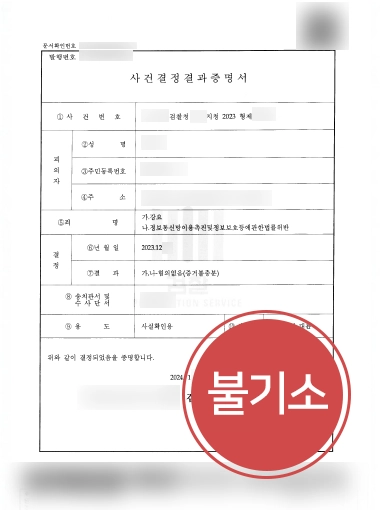
As a result of the defense, the client received a decision of no suspicion of crime and successfully concluded the matter with non-prosecution.
For this client's case, the key issue was proving that the alleged offense was not constituted under the applicable legal standards.
At Daeryun Law Firm, attorneys experienced in this area organize the facts of a case in legal terms and present interpretations suited to each legal principle in providing a defense.
If you are looking for an 🔗attorney recommendation in the city of Gangneung, please visit the Daeryun Law Firm 🔗Gangneung Attorney office.
This content is based on actual case studies of Daeryun Law LLC with some adaptations, and the copyright belongs to our firm.
Unauthorized reproduction, duplication, or distribution and other copyright infringements may result in legal action under applicable laws.