
CONTENTS
- 1. The Client Who Requested Assistance With Compulsory Execution Against Real Estate

- 2. Why Lawful Examination of Evidence Is Needed for Compulsory Execution Against Real Estate
- - Methods of Property Inquiry for Compulsory Execution
- 3. Conducting Evidence Collection for Compulsory Execution Against Real Estate
- - Evidence Collection Assistance 1. Identifying the Debtor's Business
- - Evidence Collection Assistance 2. Inquiry Into Public Data and Official Records
- 4. Compulsory Execution Against Real Estate: Proceeding With the Execution Through Evidence Collection

1. The Client Who Requested Assistance With Compulsory Execution Against Real Estate

This is the account of a client who requested assistance from the evidence investigation center in connection with compulsory execution against real estate.
The client had lent 100 million won to a friend but had been unable to recover the remaining 70 million won in debt.
To make matters worse, the friend had been avoiding the client's contact and had disappeared since six months earlier.
The client decided to pursue compulsory execution against real estate in order to recover the debt.
For this, the client needed a list of the friend's property and similar information.
The client entrusted the case to Daeryun Law Firm, which provides a one-stop legal service ranging from evidence collection to litigation response.


2. Why Lawful Examination of Evidence Is Needed for Compulsory Execution Against Real Estate
To proceed with compulsory execution against real estate, the other party's property must be accurately identified.
This is because the core of compulsory execution is recovering a claim through attachment, auction, and similar measures directed at the other party's property.
However, there are many cases in which the other party hides property or deliberately disposes of it, so an examination of evidence is needed to uncover it.
If an individual investigates the other party's property without restraint, there is a risk of using unlawful methods.
Because collecting evidence by unlawful methods can give rise to legal problems, it is most important to collect evidence by lawful methods.
 Methods of Property Inquiry for Compulsory Execution
For compulsory execution against real estate, verifying the property is a critical procedural step.
Property verification can largely be carried out through three methods: a statement of property, a property inquiry, and a credit inquiry.
1. The Statement of Property System
A creditor who has secured a title of execution may apply to the court for a statement of property based on information about the creditor, the debtor, and the case.
In that case, the debtor must personally prepare a list of property covering all areas, including real estate and claims.
2. Property Inquiry
A property inquiry may be applied for after a statement of property has been made.
Unlike a statement of property, a property inquiry is a system that compulsorily inquires into the debtor's property.
3. Credit Inquiry
This is a procedure for identifying the debtor's bank accounts, cards, and similar assets based on a credit inquiry made on the strength of a title of execution.
3. Conducting Evidence Collection for Compulsory Execution Against Real Estate
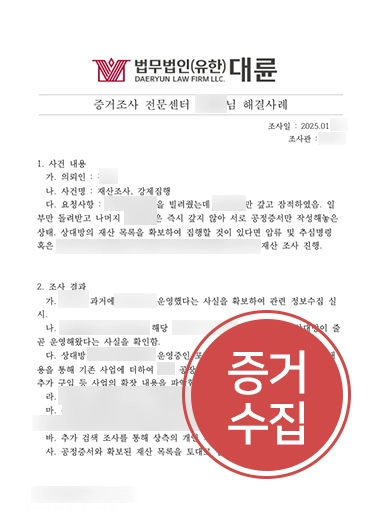
The collection of evidence for compulsory execution against real estate was undertaken.
Evidence Collection Assistance 1. Identifying the Debtor's Business
Through close consultation with the client, Daeryun Law Firm confirmed that the debtor had operated a hair salon in the past and set out to collect related information.
Daeryun confirmed that the debtor had continued to operate the hair salon up to the present.
It was also able to confirm that the debtor had expanded the hair salon, hired staff, and purchased new equipment.
Daeryun then identified the address of the expanded business and the business registration number.
Evidence Collection Assistance 2. Inquiry Into Public Data and Official Records
For compulsory execution against real estate, the Daeryun evidence investigation center examined official records and set out to verify the debtor's property information.
1. Checking the Real Estate Registry
To ascertain whether there was any real estate held in the other party's name, the court's internet registry office was checked.
Through this, the history of ownership changes and whether any mortgage to secure a maximum amount had been established were confirmed.
2. Checking the Commercial Registry and Business Information
Through the debtor's commercial registry extract, the debtor's shareholdings, corporate assets, and similar information were confirmed.
In addition, the center set out to identify business-related property through National Tax Service and local tax payment records.
4. Compulsory Execution Against Real Estate: Proceeding With the Execution Through Evidence Collection
This was the account of a client who requested property verification and evidence collection for compulsory execution against real estate.
The Daeryun evidence investigation center (a cooperating provider) secured a notarial deed and a list of property and handed them over, and based on these the client is currently proceeding with the compulsory execution against real estate.
Through 🔗examination of evidence and digital forensics support at its offices nationwide, Daeryun Law Firm provides real-time, nationwide coordinated response ranging from evidence collection to trial advocacy.
If you are in a situation where you need evidence collection for a lawsuit, please reach out to Daeryun Law Firm, which provides a one-stop service ranging from evidence collection to trial advocacy.
This content is based on actual case studies of Daeryun Law LLC with some adaptations, and the copyright belongs to our firm.
Unauthorized reproduction, duplication, or distribution and other copyright infringements may result in legal action under applicable laws.