
CONTENTS
- 1. Occupational Embezzlement | Circumstances of the Allegation

- - What Is a Request for Formal Trial?
- 2. Occupational Embezzlement | Issues in the Case
- - Embezzlement Even Without an Acquired Amount?
- 3. Occupational Embezzlement | Defense Strategy
- - Strategy ① A Simple Omission
- - Strategy ② No Prior Reports
- - Strategy ③ The Relationship With the Complainant
- 4. Occupational Embezzlement | Acquittal

1. Occupational Embezzlement | Circumstances of the Allegation
The client, who became caught up in an occupational embezzlement matter, was the manager of a telecommunications company branch and managed the company's overall sales operations.
After leaving the company, however, the client was accused of having stored a mobile phone worth several hundred thousand won at market value, received from a customer for use in secondhand resale when changing devices, then selling it to another dealer at his own discretion, and embezzling the proceeds without handing them over.
Omitting the purchase amount of several hundred thousand won was a clear mistake, but afterward the former branch owner filed a complaint with the police accusing the client of occupational embezzlement.
The client had received a summary order imposing a fine of several hundred thousand won through 🔗summary indictment, but because it was a mistake and he felt wronged, he requested an attorney consultation.
The criminal attorney who conducted the consultation determined that there was sufficient room to contest this case for an acquittal, decided to request a formal trial, and assisted the client.
 What Is a Request for Formal Trial?
A summary order is a trial procedure in which the court, without a formal trial, reviews only the investigation records and imposes a property penalty such as a fine, a minor fine, or confiscation.
In relatively minor cases, the matter may be concluded by a summary order.
If there is an objection to the summary order, a formal trial may be requested.
In this case, the request for formal trial may be filed with the court that issued the summary order within seven days of receiving it.
If the seven-day period for requesting a formal trial has passed, or if a withdrawal or dismissal of the request has been confirmed, the summary order has the same effect as a final judgment, so you should keep the filing period in mind.
2. Occupational Embezzlement | Issues in the Case
🔗Occupational embezzlement refers to unlawfully taking property of the State or another person in breach of an occupational duty.
In this case, the issue is whether the person intentionally embezzled the property with an intent of unlawful acquisition, or failed to return it despite a demand for its return.
Under Article 356 of the Criminal Act, a person who commits occupational embezzlement is punishable by imprisonment for not more than ten years or a fine of not more than thirty million won.
Whereas simple embezzlement carries imprisonment for not more than five years or a fine of not more than fifteen million won, this imposes punishment that is twice as heavy by simple calculation.
In this case, suspension of qualifications may be imposed concurrently, and a person may be subject to suspension of qualifications for not more than ten years.
If a person embezzles five hundred million won or more, the Act on Aggravated Punishment of Specific Economic Crimes applies, and imprisonment for a definite term of not less than three years is imposed without a fine.
If the amount exceeds five billion won, life imprisonment or imprisonment for not less than five years is imposed, and a fine of up to the amount of the gain is also imposed concurrently.
Embezzlement Even Without an Acquired Amount?
In the case of occupational embezzlement, the allegation may be recognized even where there is no actual loss, if there was an intent of unlawful acquisition.
In the case of embezzlement, it may also be recognized even where the embezzled money is restored to its original state after being used for personal purposes.
Moreover, even where the acquired amount is small, if it is less than one hundred million won the sentencing guidelines recommend a term of between four months and one year and four months, so a prompt response is needed.


3. Occupational Embezzlement | Defense Strategy

The attorney who took on the defense of the occupational embezzlement case established the following strategy.
Strategy ① A Simple Omission
The attorney emphasized that the amount omission that gave rise to this case was close to a simple omission caused by a mistake.
Most dealers, after receiving a customer's existing device, dispose of it to a secondhand dealer and return cash to the customer or apply it to the bill for the new mobile phone, returning the value to the customer in such ways.
Over several years of consistent work, the single instance of non-payment of several hundred thousand won was not for the purpose of unlawful acquisition, and the attorney emphasized that it was an omission caused by a mistake in handling the work.
Strategy ② No Prior Reports
In particular, over the client's roughly four years of work, this was the only instance in which a complaint was filed for failing to pay mobile phone sale proceeds.
The complainant, relying on the fact that the proceeds were not deposited into his own business account, presumed that the client had an intent to embezzle the sale proceeds and investigated the records of the past four years, but the attorney emphasized that nothing was found as a result.
Strategy ③ The Relationship With the Complainant
The former branch owner who filed the occupational embezzlement complaint against the client was not on good terms with the client.
The discord continued afterward, the client left the company, and the complaint was filed after the client had resigned.
Even an amount of several hundred thousand won is a crime if there was an intent to acquire it unlawfully, but this was a single mistake, and only a very small part of it had even entered the client's account.
In such cases it is common to prevent the customer from filing a complaint through the telecommunications company, yet the complainant even instructed the affected customer to file a complaint.
It was also revealed that the complainant had maliciously filed complaints against the client for interference with business and violation of the Employment Insurance Act.
The attorney again emphasized that, given the relationship between the complainant and the client, there was a possibility that the complainant had filed the complaint out of spite, even though the matter could have been resolved amicably with the client.
4. Occupational Embezzlement | Acquittal
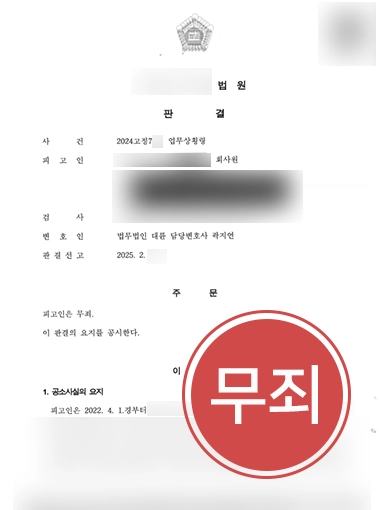
The judge who tried the offense acquitted the client.
In occupational embezzlement, an intent of unlawful acquisition means that a person who keeps the property of another, for the purpose of pursuing the benefit of oneself or a third party, disposes of the property of another that one keeps, in breach of an occupational duty, factually or legally as if it were one's own.
In occupational embezzlement, the prosecutor must prove that there was an act of embezzlement carried out to realize an intent of unlawful acquisition.
Strict proof to the degree that leaves room for reasonable doubt is also required.
If that is absent, even where there is a suspicion of guilt, the matter must be judged in favor of the defendant.
In the early stage of the case, this client did not pay it much mind, since the loss amounted to only several hundred thousand won.
When he came to face an outright guilty punishment through the summary order, however, he retained an attorney in order to overturn it.
If you have been accused of occupational embezzlement, like the client above, you should, regardless of the amount of loss, promptly seek a way to resolve the case through an attorney consultation.
If you would like a consultation regarding property crimes such as embezzlement and breach of trust, please request one from this firm.
We operate normally on weekends, public holidays, and substitute holidays to listen to the client's account.
This content is based on actual case studies of Daeryun Law LLC with some adaptations, and the copyright belongs to our firm.
Unauthorized reproduction, duplication, or distribution and other copyright infringements may result in legal action under applicable laws.