
CONTENTS
- 1. The Client's Situation

- - Unlawful Use of an Official Document: Understanding the Criminal Case Client's Matter
- - What Is Unlawful Use of an Official Document?
- 2. Criminal Case Attorney's Assistance to Defend the Client Against Punishment
- - Defense Against Punishment 1. Argument on the Circumstances of Issuance
- - Defense Against Punishment 2. The Circumstances of Parking in the Space Reserved for Persons with Disabilities
- - Defense Against Punishment 3. Argument That It Was Habitual Conduct
- 3. The Result of the Criminal Case Attorney's Assistance: The Case Concluded with Non-Prosecution

1. The Client's Situation
The client who requested a consultation with a criminal case attorney was facing an investigation by an investigative agency on a charge of unlawful use of an official document.
Because the client was working at a public enterprise, the client was very worried, since a sentence of a suspended sentence or heavier would lead to sanctions such as referral to the company's disciplinary committee.
The client entrusted the case to Daeryun Law Firm, where criminal attorneys with extensive practical experience develop tailored response strategies through accurate fact-finding and legal review.
 Unlawful Use of an Official Document: Understanding the Criminal Case Client's Matter
This is the case of the client.
Although the client was not a person with a disability, the client obtained a parking placard for vehicles used by persons with disabilities, attached it to the vehicle, and parked in a parking space reserved for persons with disabilities, which is how the incident arose.
Someone who saw this reported it, and the matter came to light.
The client became subject to an investigation by an investigative agency on the charge of unlawfully using a parking placard for spaces reserved for persons with disabilities, which is an official document.
What Is Unlawful Use of an Official Document?
Unlawful use of an official document refers to the crime of improperly using a document of a public official or public office.
The unlawful use referred to here means any act of using an official document for a purpose other than its original purpose.
It also applies where a person without authority exercises it as if authorized, or where even a person with authority uses it contrary to its proper use.
Unlawful use of an official document is strictly prohibited under Article 230 of the Criminal Act in order to protect the authority of and trust in official documents.
A violation may be punished by imprisonment with or without labor for up to two years, or a fine of up to five million won.
Representative examples of unlawful use of an official document are as follows.
| -Presenting another person's driver's license as if it were one's own -Using a forged official document -Unlawfully using a disability parking placard to park in a space reserved for persons with disabilities |


2. Criminal Case Attorney's Assistance to Defend the Client Against Punishment
The criminal case attorney set out to establish a defense strategy to protect the client against punishment.
In particular, because a criminal punishment of a suspended sentence or heavier could result in the client being referred to the workplace disciplinary committee, the attorney provided assistance aimed at a lighter outcome than that.
Defense Against Punishment 1. Argument on the Circumstances of Issuance
The criminal attorney in charge first explained the circumstances of the issuance in order to defend against punishment.
The client lives while caring for a father who has been assessed with a grade 3 brain lesion disability.
The client uses a vehicle for the purpose of taking the father to the hospital.
Recently, however, that vehicle was in an accident and was taken in for repairs.
The client then rented a replacement vehicle from the repair shop.
In this process, the parking placard for vehicles used by persons with disabilities that had been placed on the front of the client's own vehicle came to be placed on the front of the rental vehicle.
Defense Against Punishment 2. The Circumstances of Parking in the Space Reserved for Persons with Disabilities
On the day of the incident, the client visited a supermarket to prepare dinner.
Just as the client had always done when visiting the supermarket with the father, the client unconsciously parked in the supermarket's space reserved for persons with disabilities, which led to the offense in this case.
Defense Against Punishment 3. Argument That It Was Habitual Conduct
The criminal attorney representing the client argued that the act of parking in the space reserved for persons with disabilities arose not from intent but from habitual conduct.
The client has been caring for a father assessed with a brain lesion disability for more than fifteen years.
Having used the vehicle while supporting the father for fifteen years, the client also parked in that space out of habit on the day of the incident.
The criminal case attorney argued that the client had not acted intentionally and requested leniency.
3. The Result of the Criminal Case Attorney's Assistance: The Case Concluded with Non-Prosecution
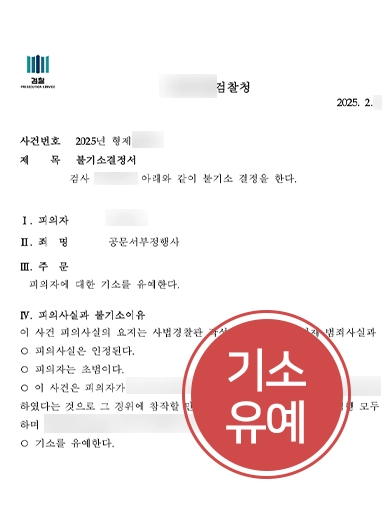
As a result of the criminal case attorney's defense, the client received a decision of suspension of indictment and succeeded in concluding the case.
The client explained, "I had only parked out of habit and did not know it was such a serious criminal offense. I was really worried that I might receive a severe criminal punishment. Thanks to the attorney, I was able to resolve the case quickly."
Unlawfully using a disability parking placard may be taken lightly, but you should keep in mind that this is an act in violation of the Criminal Act called unlawful use of an official document, and that it may be punished severely.
If you face the risk of criminal punishment in a situation like the above, we hope you will turn to Daeryun Law Firm, where criminal attorneys provide one-stop legal services from the investigation stage through the trial stage.
This content is based on actual case studies of Daeryun Law LLC with some adaptations, and the copyright belongs to our firm.
Unauthorized reproduction, duplication, or distribution and other copyright infringements may result in legal action under applicable laws.