
CONTENTS
- 1. The Client Who Sought Out an Insurance Attorney

- - Identifying the Circumstances of the Multiple Charges, Including Insurance Fraud
- - Establishment and Level of Punishment for Insurance Fraud
- 2. Insurance Attorney's Defense to Resolve the Client's Injustice
- - Insurance Fraud Defense 1. Arguing That It Was Negligence in Driving
- - Insurance Fraud Defense 2. Arguing That the Accidents Were the Fault of the Other Parties
- 3. Insurance Attorney's Assistance Leads to a Not Guilty Verdict for the Client

1. The Client Who Sought Out an Insurance Attorney
This is the account of the client who requested assistance from an insurance attorney.
The client was facing trial on charges of violation of the Special Act on Prevention of Insurance Fraud, special assault, and special destruction of property.
The client explained that the charges were highly unjust and requested a defense.
Daeryun Law Firm assembled a team of criminal attorneys with professional knowledge of insurance-related statutes and precedents and took on the client's defense.
 Identifying the Circumstances of the Multiple Charges, Including Insurance Fraud
The insurance attorney set out to identify the facts of the multiple charges through a close consultation with the client.
The insurance company claimed that the client had repeatedly caused traffic accidents on purpose in order to defraud it of insurance proceeds.
The circumstances of the charges at issue in this case were as follows.
1. Special Assault and Special Destruction of Property
While driving, the client deliberately rammed the victim's passenger car using the client's own vehicle, a dangerous object.
In doing so, the client assaulted the victim while carrying a dangerous object, the automobile, and at the same time caused damage requiring substantial repair costs to the victim's passenger car.
2. Violation of the Special Act on Prevention of Insurance Fraud
As set out above, after deliberately causing the traffic accident, the client filed an insurance claim as though the accident had occurred through negligence.
In this way, the client deceived the victim's insurance company and obtained insurance proceeds.
Establishment and Level of Punishment for Insurance Fraud
Insurance fraud means the act of deceiving an insurer as to the occurrence, cause, or content of an insured event in order to claim insurance proceeds.
The Special Act on Prevention of Insurance Fraud was enacted to protect the rights and interests of policyholders, the insured, and other interested parties, and to contribute to the sound development of the insurance industry and the promotion of public welfare, by setting out matters concerning the investigation, prevention, and punishment of insurance fraud.
A distinctive feature is that, with respect to the investigation and prevention of insurance fraud and the punishment of those who commit it, this Act applies in priority over other statutes.
If a person obtains insurance proceeds through an act of insurance fraud, or causes a third party to obtain insurance proceeds, that person may be punished by imprisonment for up to 10 years or a fine of up to 50 million won.
If a person commits insurance fraud habitually, the sentence may be increased by one half, and attempts are also punishable.
If the gain from insurance fraud is at least 500 million won but less than 5 billion won, the punishment is imprisonment for at least 3 years; if it is 5 billion won or more, the punishment is life imprisonment or imprisonment for at least 5 years.


2. Insurance Attorney's Defense to Resolve the Client's Injustice

The insurance attorney set out to assist the client in resolving the injustice.
To prove that the accidents were not intentional, the insurance attorney requested a digital analysis report, an accident research report, and an appraisal by the National Forensic Service, and built the defense strategy around these.
Insurance Fraud Defense 1. Arguing That It Was Negligence in Driving
The insurance company claimed that the client had deliberately caused multiple traffic accidents and intentionally obtained proceeds.
The attorney handling the client's case submitted the dashcam footage as evidence and rebutted the claim, arguing that the accidents were not intentional.
The dashcam footage in fact showed that the client recognized the other party's vehicle, sounded the horn, and slowed down.
The attorney argued that, although it was true that the client recognized the other party's vehicle yet, unwilling to yield, was negligent in failing to drive defensively, this was no more than negligence in driving and the client had not intentionally caused the accident.
The insurance attorney argued, citing court precedent on the failure to drive defensively as evidence, that the client could not be found guilty.
Even if a person has a driving habit or tendency of not driving defensively, judging this as a matter of negligence or the like is a separate question. The mere act of failing to drive defensively cannot readily lead to an inference or finding that there was intent to defraud. The defendant is therefore not guilty.
Insurance Fraud Defense 2. Arguing That the Accidents Were the Fault of the Other Parties
The insurance company claimed insurance fraud on the ground that the client had been in several traffic accidents within a short period.
In response, the insurance attorney rebutted that the client had not intended insurance fraud but had unfortunately become involved in several accidents.
In fact, the traffic accidents in which the client was involved were all accidents in which the other parties were found to be 90 percent at fault.
The attorney argued that these were traffic accidents in which the other parties' fault was far greater, and rebutted the insurance company's claim that the client had intentionally caused the accidents to defraud it of insurance proceeds as unfounded.
3. Insurance Attorney's Assistance Leads to a Not Guilty Verdict for the Client
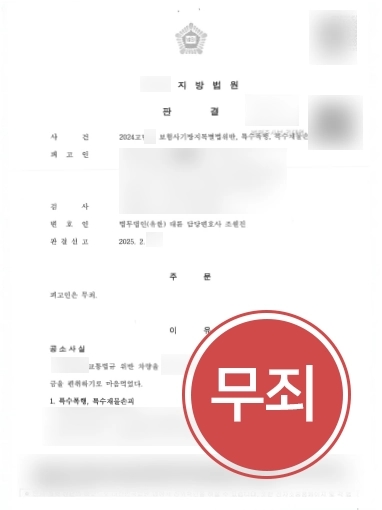
With the assistance of an insurance attorney, the client received a not guilty verdict and was able to clear the injustice against them.
In a case of insurance fraud, a guilty verdict can result in criminal punishment as well as civil liability for damages with respect to the insurance proceeds wrongfully obtained.
For this reason, if a person becomes involved in insurance fraud, taking an active response from the early stages of the investigation can be helpful.
At Daeryun Law Firm, an insurance attorney who has handled numerous insurance fraud cases draws on a database of past litigation to quickly develop a response suited to the client's situation and to act promptly.
This content is based on actual case studies of Daeryun Law LLC with some adaptations, and the copyright belongs to our firm.
Unauthorized reproduction, duplication, or distribution and other copyright infringements may result in legal action under applicable laws.