
CONTENTS
- 1. What Are the Details of the Case for the Client with a Prior Drunk Driving (DUI) Record

- 2. The Details of the Charge Against the Client with a Prior Drunk Driving (DUI) Record
- - Laws Related to Drunk Driving (DUI)
- - Aggravated Punishment for a Prior Drunk Driving (DUI) Record
- 3. The Assistance Provided to Defend Against Punishment for the Client with a Prior Drunk Driving (DUI) Record
- - The Client Deeply Regrets and Reflects on the Wrongdoing
- - The Client Is Making Sincere Efforts to Prevent Reoffending
- - Although There Is a Prior Drunk Driving Conviction, There Are Circumstances to Be Considered
- 4. A Fine Defended Through Legal Assistance for a Prior Drunk Driving (DUI) Record
- - If You Fear Imprisonment Due to a Prior Drunk Driving (DUI) Record

1. What Are the Details of the Case for the Client with a Prior Drunk Driving (DUI) Record

These are the circumstances of the client who came regarding a prior drunk driving record.
The client was an office worker at a logistics company and was attending a team dinner at the time of the incident.
After drinking during the dinner, he returned to the office and spent about four hours preparing meeting materials for a report to be submitted the next day. Believing that he had sobered up, he was driving home when he caused a minor collision.
In the police breath test conducted after the accident, the client registered an alcohol level at the level of drunk driving and faced the risk of an actual custodial sentence for drunk driving.
With four prior drunk driving records, the client was in a situation where it was difficult to avoid punishment.
Because a sentence of imprisonment would deal a serious blow to the family's livelihood, the client requested the assistance of a traffic accident attorney in order to defend against a sentence of imprisonment.
2. The Details of the Charge Against the Client with a Prior Drunk Driving (DUI) Record
A record of a prior drunk driving offense is a criminal history that remains after receiving legal punishment for drunk driving.
It is clearly recorded on a criminal record certificate and can operate as a disadvantage in various situations, such as employment and the issuance of overseas visas.
The punishment for drunk driving is as follows.
 Laws Related to Drunk Driving (DUI)
| Article 44 of the Road Traffic Act (Prohibition of Driving While Intoxicated) (1) No person shall drive a motor vehicle, tram, or bicycle while intoxicated. |
In addition, under Article 44 (4), a blood alcohol concentration of 0.03% or higher is regarded as constituting drunk driving.
| The standard for the state of intoxication in which driving is prohibited under paragraph (1) shall be a driver's blood alcohol concentration of 0.03 percent or higher. |
Aggravated Punishment for a Prior Drunk Driving (DUI) Record
Since the enactment of the Yoon Chang-ho Act in 2018, the standards for punishing and cracking down on drunk driving have been strengthened.
If drunk driving is caught two or more times, strong punishment may follow, and a driver with a record of two or more drunk driving offenses who again drives under the influence and causes an accident will find it difficult to avoid heavy punishment.
The levels of aggravated punishment set out in the 2025 amendment to the Road Traffic Act are as follows.
Simple Drunk Driving Detection | Sentence for One Drunk Driving Offense Within 10 Years
| Blood alcohol concentration of 0.03% to under 0.08% | Imprisonment of up to 1 year Fine of up to 5 million won |
| Blood alcohol concentration of 0.08% to under 0.2% | Imprisonment of 1 to 2 years Fine of 5 million to 10 million won |
| Blood alcohol concentration of 0.2% or higher | Imprisonment of 2 to 5 years Fine of 10 million to 20 million won |
When a Drunk Driving Accident Occurs
| When injury is caused | Imprisonment of 1 to 15 years or a fine of 10 million to 30 million won |
| When a fatal accident occurs | Life imprisonment or imprisonment of 3 years or more |


3. The Assistance Provided to Defend Against Punishment for the Client with a Prior Drunk Driving (DUI) Record

The arguments made to prevent the punishment of the client with a prior conviction for drunk driving are as follows.
The Client Deeply Regrets and Reflects on the Wrongdoing
The client argued that, with a repentant heart for his wrongdoing, he writes a daily diary of repentance each day expressing his remorse.
He stated that, through daily transcription of the Bible, he is seeking to repent his wrongdoing by the power of religion and to strengthen his resolve to prevent reoffending, and he submitted a written pledge and a letter of reflection in which he vowed to eradicate drunk driving and to abide by the law.
In addition, he submitted dozens of handwritten 🔗drunk driving petitions written by his wife, family, and coworkers, requesting that consideration be given to the fact that his social ties are strong enough that the likelihood of reoffending is low, and that he is reflecting deeply, to the extent of stating that he will devote himself to preventing reoffending for the sake of his family.
The Client Is Making Sincere Efforts to Prevent Reoffending
The traffic accident attorney requested leniency on the ground that the client had sold the vehicle registered in the spouse's name as a preventive measure so as not to repeat the same mistake.
The attorney also requested that consideration be given to the fact that, in order to address the drinking problem that was the fundamental cause of the drunk driving, the client had recognized and become aware that there was a problem with his own alcohol use habits and was consistently attending hospital treatment in order to cope appropriately with stress.
The attorney argued that the client, in order to more substantively correct his conduct related to this drunk driving, was completing the mandatory education of the Korea Road Traffic Authority and had separately completed private education as well, and that through his active response and efforts he was sincerely repenting of his wrongdoing.
Although There Is a Prior Drunk Driving Conviction, There Are Circumstances to Be Considered

Because the client had four prior convictions for drunk driving, the traffic accident attorney presented arguments aimed at obtaining as lenient a disposition as possible.
The attorney requested leniency on the grounds that all of the client's prior sentences had been fines, that more than 10 years had passed since the date the drunk driving sentence became final, which is the period for aggravated punishment in cases of repeat drunk driving, and that, since the previous fine sentence, the client had diligently used designated drivers and taxis whenever he needed to travel.
4. A Fine Defended Through Legal Assistance for a Prior Drunk Driving (DUI) Record
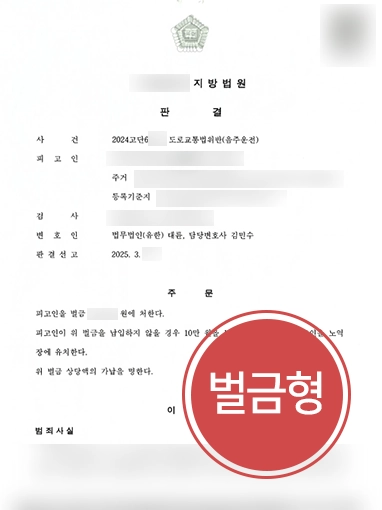
Accepting the argument of the drunk driving attorney, who provided assistance in defending against punishment based on prior drunk driving convictions, the court rendered a judgment imposing a fine.
The client had a high likelihood of receiving a sentence of imprisonment due to numerous prior convictions for the same type of offense, but with the attorney's assistance the case could be concluded.
If You Fear Imprisonment Due to a Prior Drunk Driving (DUI) Record
The sentences for drunk driving offenses are becoming heavier, and for a third or subsequent drunk driving offense it has become difficult to avoid aggravated punishment.
Drunk driving also falls under the 🔗12 categories of gross negligence in traffic accidents, so it may be punishable by imprisonment without labor for up to 5 years or a fine of up to 20 million won, making the assistance of a traffic accident specialist attorney critical.
Drunk driving cases are decided by considering comprehensive factors such as the scale of harm, whether an accident occurred, the blood alcohol concentration, and the driving distance, so we hope you resolve the matter with the assistance of a 🔗traffic accident attorney at Daeryun LLC, which has extensive experience handling drunk driving cases.
This content is based on actual case studies of Daeryun Law LLC with some adaptations, and the copyright belongs to our firm.
Unauthorized reproduction, duplication, or distribution and other copyright infringements may result in legal action under applicable laws.