
CONTENTS
- 1. Bank Account Attachment | Case Background

- - The Client's Account
- - Case Timeline
- - The Creditor's Misunderstanding
- 2. Bank Account Attachment | Case Review
- - An Argument Based on Precedent
- 3. Bank Account Attachment | Substance of the Assistance
- 4. Bank Account Attachment | Defense Against a Custodial Sentence With Acquittal on All Counts

1. Bank Account Attachment | Case Background

The client, whose bank account had been attached and who had been criminally accused, explained that the client had been receiving demands to repay money borrowed for living expenses and, while diligently repaying it, had been criminally accused.
The complainant alleged that the client had hidden assets for the purpose of evading compulsory execution and had filed an individual rehabilitation petition by falsely understating income, asserting charges of the crime of evasion of compulsory execution and violation of the Debtor Rehabilitation Act.
Since the client was currently barely making a living, earning the minimum wage through part-time work, the client sought out a Daeryun Law Firm attorney to request help in defending against the criminal trial.
 The Client's Account
The client received about 30 million won from a coworker with whom he had previously lived together, in the name of a jeonse deposit and living expenses.
Because it was money used while living together without a clear awareness that it was ‘borrowed money,’ the client did not even recognize an obligation to repay it.
Afterward, when the complainant (the creditor) attached the client's bank account and attempted compulsory execution, the client for the first time came to recognize that it was ‘money to be repaid (a debt).’
The client had been diligently repaying the amount over about two years, working part-time jobs with the will to repay 100% of it, but he was suddenly subjected to a criminal complaint.
The serious charge of abusing the rehabilitation procedure through concealment of assets and understatement of income had been raised.
Case Timeline
The attorney sought to organize the timeline of the case to explain the reason the client came to be the subject of a criminal complaint.
Timeline |
During cohabitation, received and used about 30 million won under the name of jeonse funds and living expenses (part of it was a joint expenditure) ↓ Two years after the cohabitation ended, came to recognize the debt upon hearing from the complainant about an attachment of a bank account ↓ Maintained a livelihood by sending part of the money earned from part-time work to an acquaintance's account ↓ Repaid diligently, but when it became too much to bear, used the individual rehabilitation system ↓ Received a decision to commence rehabilitation proceedings from the court ↓ The rehabilitation decision was finalized ↓ Was subjected to a criminal complaint on charges of evasion of compulsory execution and violation of the Debtor Rehabilitation and Bankruptcy Act ↓ Requested a response from a Daeryun Law Firm attorney
|
The Creditor's Misunderstanding
Most people undergoing the individual rehabilitation procedure often receive their wages using a bank account in another person's name.
This is not an intentional or malicious effort to deceive creditors, but rather one of the means by which debtors with poor credit make a living.
In particular, because most people who have applied for individual rehabilitation are not in a financial position to pursue their own gain, there is no realistic reason to find that they had the intent to evade compulsory execution.
For this reason, cases sometimes arise in which creditors mistakenly believe that the debtor has concealed assets.
2. Bank Account Attachment | Case Review

The Daeryun Law Firm attorney who took on the case of the client whose account had been attached and who had filed an individual rehabilitation petition identified the issues and then sought to argue for the client's acquittal.
Issue | Content |
Whether assets were concealed | Determined that assets had been concealed, based on the fact that the client transferred wages to another person's account immediately after receiving them → Need to argue that the transfer was the sharing of living expenses for the purpose of subsistence and was a realistic means of living, not title trust or intentional concealment |
Whether wages were understated | The client reported a smaller amount than the actual wages when filing for rehabilitation → Argue that the split payment of wages was due to the company's internal wage payment structure |
Abuse of the rehabilitation procedure | Intentionally abused the rehabilitation procedure by understating the asset list submitted to the rehabilitation court → All assets were reported transparently, and a portion was repaid through the rehabilitation procedure |
An Argument Based on Precedent
The Daeryun Law Firm attorney organized the client's situation clearly by citing the following precedents and rebutted the prosecution's arguments.
Category | Related content |
Supreme Court 2017Do6229 decision | Where an account used to receive wages constituting an attachment-prohibited claim (wages of 1.85 million won or less) is attached, even if the debtor receives wages through another, non-attached account, this cannot be regarded as the crime of evasion of compulsory execution |
The client's wages fall within attachment-prohibited claims Transferring them to an account in another's name was also for the purpose of subsistence, not for the purpose of evading compulsory execution | |
Supreme Court 2000Do1447 decision | A transfer of property made by genuine intent, even if made for the purpose of evading compulsory execution, does not constitute "false transfer or concealment" |
Transferring money to the account of the client's acquaintance was a transfer made by genuine intent for the purpose of living expenses and supports that it was not false concealment | |
Supreme Court 2010Do1189 en banc decision | The mere fact that property was concealed cannot give rise to a presumption that there was a "purpose of evading compulsory execution" |
Whether the client intended to hide assets cannot be concluded from the mere act of remittance alone |
3. Bank Account Attachment | Substance of the Assistance
For the client, who had been criminally accused while the client's bank account was attached, the attorney assisted the client through the following arguments.
Assistance | Details |
Submission of materials evidencing income flow and living circumstances | From the early stage of the investigation, submitted materials regarding the client's income flow and living circumstances to prove the economic hardship |
Transfer details to an account in an acquaintance's name Assertion of the purpose of use | Organized the details of transfers made to an account in an acquaintance's name to assert that the purpose was use as living expenses Denied any intent to conceal property |
Confirmation of the fact of repayment performed within the rehabilitation procedure Ascertaining the deposit and salary flow | Transparently reconstructed the fact that repayment was performed within the rehabilitation procedure and the deposit and salary flow to prove faithful performance |
Absence of intent | In the course of the trial, emphasized the client's sincerity, hardship in living, and absence of intent to fully rebut the charge |


4. Bank Account Attachment | Defense Against a Custodial Sentence With Acquittal on All Counts

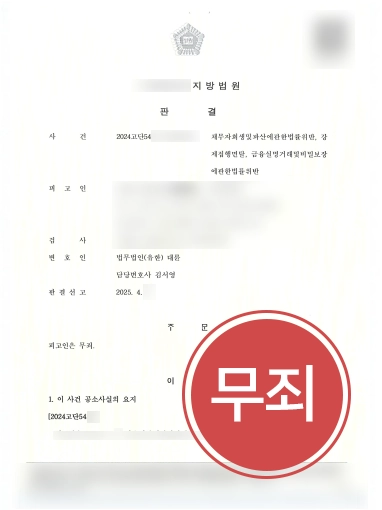
Thanks to the assistance of the attorney who took on the case of the client, who had been criminally charged with his account attached, the client was acquitted on all charges, including evasion of compulsory execution and violation of the Debtor Rehabilitation and Bankruptcy Act.
It was a case in which a criminal record could have remained because of the inability to repay debts, but the client's difficult livelihood and the sincerity of his rehabilitation were recognized, and he was able to avoid punishment.
In this way, with accurate legal responses and appropriate assistance from a legal professional, you may be able to clear yourself of an unjust charge.
If you are currently in a similar situation, please review your circumstances through a 🔗debt attorney legal consultation appointment.
Daeryun, the ninth-ranked law firm in Korea (based on 2025 National Tax Service value-added tax filings), provides tailored legal services.

This content is based on actual case studies of Daeryun Law LLC with some adaptations, and the copyright belongs to our firm.
Unauthorized reproduction, duplication, or distribution and other copyright infringements may result in legal action under applicable laws.