
CONTENTS
- 1. Service Member Complaint: The Client Who Requested a Defense

- - Background of the Military Indecent Act by Compulsion Case
- 2. The Anticipated Level of Punishment for the Client Accused in a Service Member Complaint
- - Grounds for Disqualification of a Service Member
- 3. The Specialized Lawyer Who Took On the Response to the Service Member Complaint
- - Handling the Settlement With the Victim
- - Completion of a Sexual Offense Recidivism Prevention Education Program
- - Petitions for Leniency From Acquaintances
- - Maintaining the Livelihood of the Client's Family
- 4. Result of the Response to the Service Member Complaint
- - If You Are Involved in a Military Indecent Act by Compulsion Case

1. Service Member Complaint: The Client Who Requested a Defense

This is the account of a client who came to the firm's attorney after facing the risk of losing his job because of a complaint filed against him as a service member.
The client was a career service member, and he stated that a complaint had been filed against him on a charge of indecent act by compulsion against military personnel.
Out of fear that his pension, severance pay, and other benefits upon retirement might be affected, the client requested help in obtaining the lowest possible disposition.
To respond to the complaint, the firm's military criminal law attorney, criminal law attorney, and sex crime attorney set about reviewing the client's case.
 Background of the Military Indecent Act by Compulsion Case
The client, who was working as a career soldier and was the subject of a complaint, was talking with the soldiers during work and mentioned that his stubble was very rough.
One of the soldiers told him to rub it against the soldier's own chin to see how rough it was, and the client followed and rubbed his cheek against the soldier's chin.
While doing so, a female noncommissioned officer who was unable to join the conversation came into the client's view, and this officer was around the age of the client's daughter.
In order to encourage this officer to also take part in the conversation, the client quietly approached and rubbed his cheek against the officer's chin.
The officer was startled, so the client apologized repeatedly for surprising her, and about one year later the officer quit her job and filed a complaint against the client on the charge of indecent act by compulsion against military personnel, leading to this case.
2. The Anticipated Level of Punishment for the Client Accused in a Service Member Complaint
The client who was subject to a complaint as a military member faced a charge of indecent act by compulsion against military personnel.
🔗The crime of indecent act by compulsion refers to a crime of committing an indecent act against a person by unlawful means such as assault or intimidation.
According to Supreme Court precedent, the assault or intimidation that is an element for establishing the crime of indecent act by compulsion is recognized if it makes resistance difficult, even without an exercise of physical force.
Moreover, a surprise indecent act itself is regarded as assault or intimidation, and the crime of indecent act by compulsion is recognized.
Under the Criminal Act, an indecent act by compulsion is punishable by imprisonment for up to 10 years or a fine of up to 15 million won.
However, the situation is different when a complaint has been filed.
Under the Military Criminal Act, where an indecent act is committed against a military civilian employee, a military member on active duty, an officer, a warrant officer, or a noncommissioned officer, the offender is subject to imprisonment for a definite term of at least one year without the option of a fine.
For this reason, the client was very afraid that he might receive an actual custodial sentence on the charge of indecent act by compulsion against military personnel, which has no upper limit on the sentence.
Grounds for Disqualification of a Service Member
Under the Military Personnel Management Act, a person who has committed a sex crime and been sentenced to a fine of 1 million won or more, where that sentence has become final and three years have not yet passed, falls under the grounds for disqualification as a serviceperson.
Accordingly, if the client were sentenced to a fine of 1 million won or more for a sex crime under the Act on Special Cases concerning the Punishment of Sexual Crimes, the client could not only be stripped of the client's status as a serviceperson but could also be deprived of all future benefits such as a pension.


3. The Specialized Lawyer Who Took On the Response to the Service Member Complaint
To protect the daily life of the client, who had been charged with an indecent act by compulsion against military personnel, the specialized attorney decided to request leniency on the basis that, although the client fully acknowledged the alleged facts of this case and was remorseful, there were grounds that warranted consideration in sentencing.
Handling the Settlement With the Victim
The attorney first set about acting on the client's behalf in reaching a settlement with the victim in this case.
The victim was refusing all communication with the client, so the attorney conveyed an expression of apology to the victim's counsel and set about negotiating the settlement amount.
In response, the victim accepted the client's apology and expressed the intention not to seek punishment of the client.
Completion of a Sexual Offense Recidivism Prevention Education Program
The specialized attorney recommended that the client complete a recidivism prevention education program for sexual offenses and obtain a certificate of completion, so that it could serve as a ground for mitigation.
After completing the recidivism prevention education program for sexual offenses, the client examined his own gender sensitivity and showed a resolve never to reoffend.
The specialized attorney submitted the client's certificate of completion and requested that it be appropriately reflected in sentencing.
Petitions for Leniency From Acquaintances
The attorney provided the client with guidelines for letters of appeal and recommended that the client obtain letters of appeal for leniency from acquaintances.
The client's coworkers and family members wrote letters of appeal stating that they would watch over the client so that the client would not reoffend, and requesting leniency on this one occasion.
The attorney submitted these letters of appeal and requested that leniency, such as a suspension of indictment, be granted to the client.
Maintaining the Livelihood of the Client's Family
The specialized attorney emphasized that the client's family depended solely on the client's salary to make a living.
The client's family members are unemployed, and the client alone is responsible for their livelihood.
The attorney requested leniency, arguing that if the client were sentenced to a fine of one million won or more, it would pose a serious risk not only to the client but also to the livelihood of the family.
4. Result of the Response to the Service Member Complaint

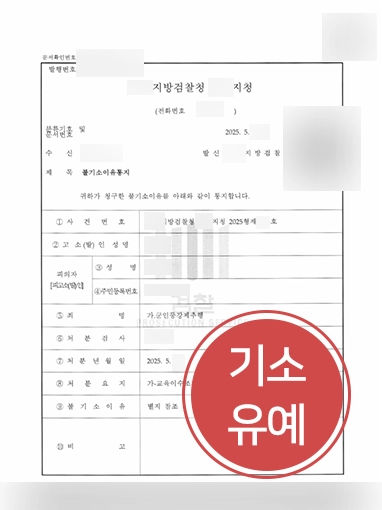
As a result of the attorney responding to the police and prosecution questioning on the client's behalf, the client was able to conclude the complaint case against the service member with a suspension of indictment.
The prosecution issued a decision to suspend the indictment on the condition that the client complete education to prevent reoffending of sexual violence crimes, taking into account that the alleged facts were recognized but that the client was showing remorse and that the victim did not wish the client to be punished.
The client will be able to avoid indictment itself if he completes the education to prevent reoffending of sexual violence crimes and does not reoffend in the future.
If You Are Involved in a Military Indecent Act by Compulsion Case
When a person is charged while holding the status of a service member, the risk of criminal punishment as well as risks to livelihood such as disciplinary action and removal from position may arise, so a specialized attorney must be retained early to respond.
This firm has criminal law attorneys, military criminal attorneys, and sex crimes attorneys collaborate in an integrated manner on cases involving complaints against service members to prepare a response strategy suited to the client.
If you are in crisis after a complaint has been filed against you as a service member, please proceed with this firm's 🔗Legal Consultation Booking now.


Watch related video content
for this case study.

[Law Class] I am a forcible molester?! How to respond to unfair sexual assault charges
This content is based on actual case studies of Daeryun Law LLC with some adaptations, and the copyright belongs to our firm.
Unauthorized reproduction, duplication, or distribution and other copyright infringements may result in legal action under applicable laws.