
CONTENTS
- 1. The Client Who Came to the Startup Law Attorney

- - The Circumstances of the Case as Identified by the Startup Attorney
- - Examining the Main Types of Startup Litigation
- 2. Startup Law Attorney, Assistance to Obtain Dismissal of the Suit
- - Startup Attorney, the Conclusion of the Consulting Contract Itself Is Not Recognized
- - Startup Attorney, Denying the Grant of Authority and the Failure to Meet the Requirements of Apparent Authority
- 3. Startup Legal Advisory Outcome, All Claims Dismissed on Appeal as Well

1. The Client Who Came to the Startup Law Attorney

This is the account of a client who came to a startup law attorney.
The client who came to the startup specialist attorney was the CEO of a startup operating a construction and equipment company.
The client was in a situation where he had recently been served with a lawsuit seeking payment of service fees amounting to 400 million won by a plaintiff who operates a project brokerage company.
The client, greatly flustered by the plaintiff's lawsuit, wished to request the help of a startup specialist attorney.
In particular, the client wanted a law office where consultation was available at any convenient time, and chose Daeryun LLC, which has a 365-day, 24-hour emergency consultation system.
 The Circumstances of the Case as Identified by the Startup Attorney
The core of this service fee litigation was the consulting contract said to have been prepared in the names of the plaintiff and the client.
The problem, however, was that the person appearing as the party who concluded this contract was not the client but a third party, Mr. A.
Mr. A was not an employee of the client's company but an external advisor who had indirect dealings in some business.
Mr. A affixed a seal in the client's name to prepare the contract, and as a result the service fee payment litigation was filed.
Examining the Main Types of Startup Litigation
Startups frequently experience complex contract structures and agency relationships in the course of rapid growth and collaboration with external experts.
In this process, a startup may come to bear unnecessary legal liability due to a contract concluded by a third party other than the representative, and civil lawsuits in which whether authority of representation was granted and whether apparent authority is established become matters in dispute are frequent in particular.
The client in this case also had to prove that the client was not a party to the conclusion of the contract and that the requirements for the grant of authority of representation and the establishment of apparent authority were not satisfied.
The main types of litigation that startups frequently experience are as follows.
▶Equity dispute litigation
▶Litigation related to investment agreements
▶Intellectual property infringement litigation
▶Labor and employment litigation
▶Contract dispute litigation


2. Startup Law Attorney, Assistance to Obtain Dismissal of the Suit
The startup law attorney provided assistance to have the plaintiff's claim for service fees dismissed.
The plaintiff's arguments are as follows.
The plaintiff took the view that the consulting contract in this case had been validly concluded between the client and A.
A used a seal in the client's name, and the plaintiff argued that this was possible because A had been granted comprehensive authority of agency by the client.
Accordingly, the logic was that the client, as the principal, must bear liability for A's contractual acts.
The plaintiff argued that, even if there had been no express authority of agency, if the client had given A an appearance that could be mistaken for that of an agent, and a third party such as the plaintiff had concluded the contract in reliance on this, the client must bear liability for apparent authority.
-Circumstances in which A received money from the client and paid the amount to subcontractors
-The fact that A kept and used the client's seal
Startup Attorney, the Conclusion of the Consulting Contract Itself Is Not Recognized
The startup attorney pointed out that it was unclear whether a contract had actually been concluded between A and the plaintiff, and that even if a document existed, its content was not based on the client's intent.
This is because A was not an executive or employee of the client's company and had not been delegated any authority to conclude a contract by the client.
The startup attorney argued that even if the client's seal was affixed to the contract, if there is no reasonable explanation of its circumstances or legitimacy, the very formation of the contract cannot but be doubted.
In addition, the attorney pointed out that the consulting contract in this case was a copy and that, although the client disputed the existence of the original and the authenticity of its formation, the plaintiff was not submitting the original.
-The telephone number is likewise not stated
-The client's corporate seal certificate is not attached
Startup Attorney, Denying the Grant of Authority and the Failure to Meet the Requirements of Apparent Authority
The startup attorney argued that the client had never delegated to A the authority to conclude a contract, and that this consulting contract was no more than a unilateral act of A, unrelated to the client.
In addition, with respect to apparent authority liability, the attorney emphasized that, unless the possibility of the existence of basic authority is presupposed, having the principal bear legal liability based solely on a third party's mistaken belief does not satisfy the requirements for the establishment of apparent authority under the Civil Act.
The startup attorney pointed out that A's use of the seal was without the client's implicit permission or subsequent ratification, and that, on the contrary, there was a possibility that A had used it without authorization.
In addition, the attorney argued that the fact that the client went to the construction site was merely part of routine site inspections related to performance of the contracting agreement, and had nothing to do with the conclusion of the consulting contract.
3. Startup Legal Advisory Outcome, All Claims Dismissed on Appeal as Well

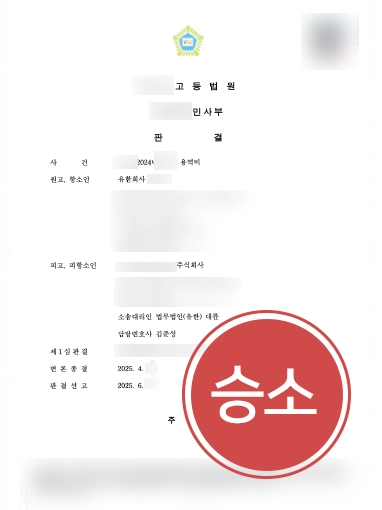
As a result of the startup law attorney's assistance, the court ruled to dismiss all of the plaintiff's claims.
The plaintiff appealed the first-instance judgment, but the appellate court likewise found the first-instance determination proper and dismissed the appeal.
This case is one in which the firm prevented the risk that a startup would nearly bear legal liability due to a third party's unilateral preparation of a contract without any express conclusion of a contract.
A startup must thoroughly verify the genuineness of the conclusion of a contract and the existence of authority, whether between agents, external collaborators, or even co-founders.
In addition, care is needed so that apparent factors arising in matters such as seal management, the use of business cards, and the receipt of emails do not expand into issues of apparent agency.
When such a dispute arises, the assistance of an attorney specializing in startups, who accurately sets the legal response logic at an early stage and designs a structured rebuttal to the opposing party's assertions, is crucial.
For startups, Law Firm Daeryun provides legal services responding to all litigation in which a startup may become involved, including ▲advisory on incorporation and articles of association ▲advisory on investment agreements and dispute response ▲advisory on equity and shareholder agreements ▲protection of intellectual property rights and response to infringement ▲drafting of contracts and advisory on transaction law.


Watch related video content
for this case study.

Transaction checklist provided by a startup lawyer
This content is based on actual case studies of Daeryun Law LLC with some adaptations, and the copyright belongs to our firm.
Unauthorized reproduction, duplication, or distribution and other copyright infringements may result in legal action under applicable laws.