
CONTENTS
- 1. The Client Who Needed a Defense Against Division of Inherited Property

- - What Is an Adjudication on Division of Inherited Property?
- - What Is a Special Benefit in Inherited Property?
- 2. Response Strategy for Defending Against Division of Inherited Property
- - The Inheritance Attorney's Assistance 1: Proving the Existence of an Agreement on Division of Inherited Property Made During the Decedent's Lifetime
- - The Inheritance Attorney's Assistance 2: Defending Against the Special Benefit and Unjust Enrichment Arguments
- - The Inheritance Attorney's Assistance 3: Pursuing a Preliminary Counterclaim for Contributory Share in Parallel
- 3. Dismissal of the Claim for Division of Inherited Property: Successful Defense
- - An Inheritance Dispute Requiring an Active Response
- - Daeryun's Case Handling System

1. The Client Who Needed a Defense Against Division of Inherited Property

The client who requested a consultation regarding division of inherited property was the eldest son who had wholeheartedly supported his father for several years, including hospital treatment, nursing care, and living expenses, during the period when his father was battling cancer.
Recognizing this devotion of the client, the father organized the method of dividing the inherited property during his lifetime and prepared a written confirmation signed by both the client and his younger brother.
However, after the father's death, the younger brother suddenly filed for adjudication on the division of inherited property and raised an issue.
The brother argued that the client had used without authorization the cash withdrawn from the account in the father's name, and also demanded division of the inherited property, claiming that the vehicle and cash previously gifted to the client were likewise a ‘special benefit.’
Bewildered by the brother's unexpected argument, the client requested an attorney's help in order to protect the inherited property.
 What Is an Adjudication on Division of Inherited Property?
In the client's case, with the passing of his father, he was in a situation of becoming a joint heir together with his younger sibling.
Once inheritance commences, under Article 1013 of the Civil Act, joint heirs may divide the inherited property by agreement at any time.
However, where agreement on the division of the inherited property among the heirs is not reached or fails to be established, a claim for division of the property may be filed with the court under Article 269 of the Civil Act.
Civil Act, Article 269 (Method of Partition)
② Where the property cannot be partitioned in kind, or where partition is likely to cause a significant decrease in its value, the court may order an auction of the property.
What Is a Special Benefit in Inherited Property?
In the division of inherited property, special benefits can be a central issue.
A special benefit means a gift made during life or a testamentary gift that one of the co-heirs received from the decedent, and its value is deducted from that heir's share of inheritance.
However, Supreme Court precedent provides that whether a benefit is a special benefit is to be determined not by a simple gift but according to the following criteria.
Supreme Court Decision of December 8, 1998, 97Meu513, 520, 97Seu12
In this case as well, the claimant (the younger sibling) argued that the vehicle and cash that the client received were a special benefit.
The Gangneung inheritance specialized attorney established a strategy to rebut this by arguing that the property in question related to the father's hospital expenses, living costs, and the like, and therefore did not meet the requirements for a special benefit.


2. Response Strategy for Defending Against Division of Inherited Property
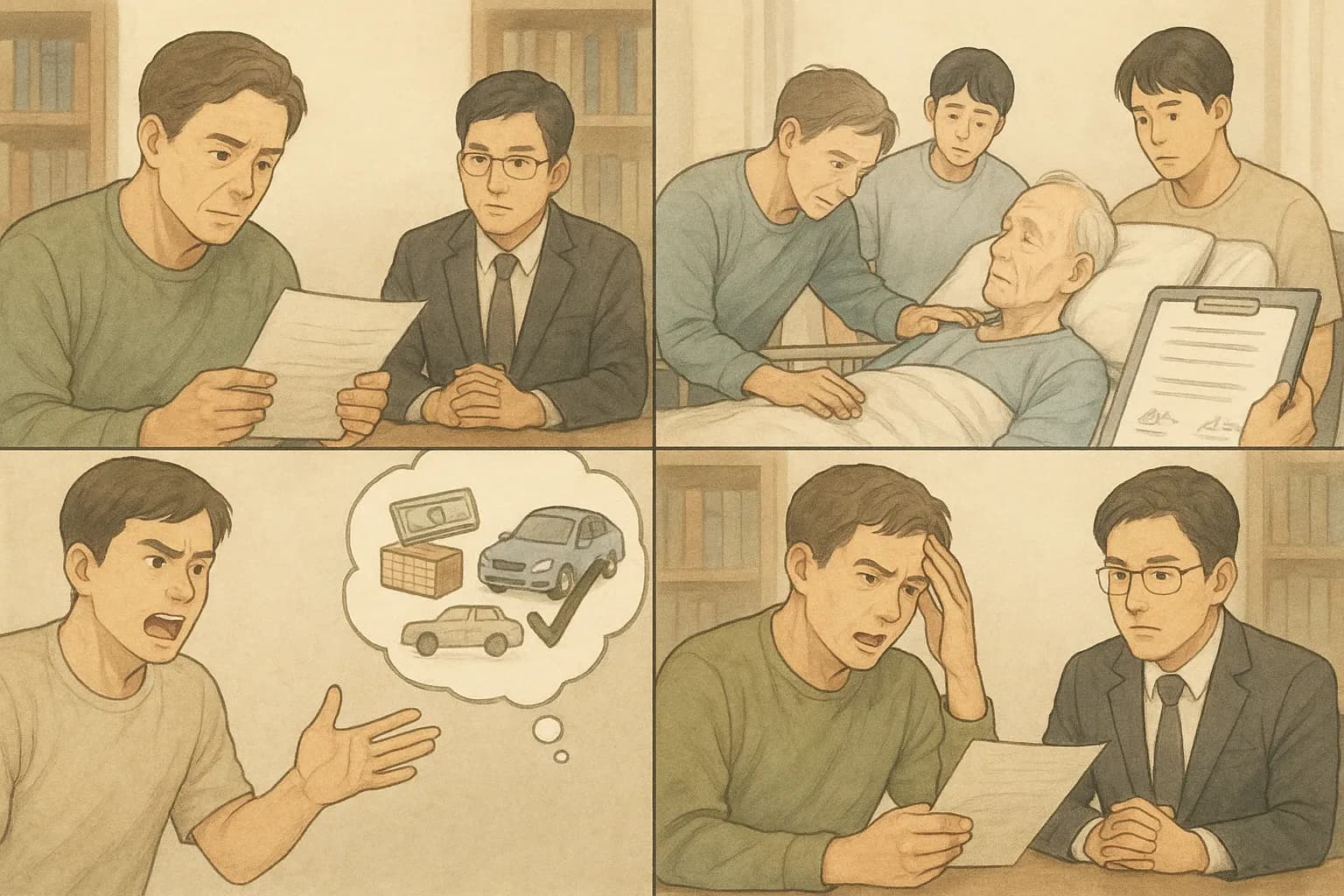
In the adjudication on the division of inherited property, the inheritance attorney constructed a multilayered and comprehensive defense argument that went beyond merely rebutting the assertions of the petitioner (the client’s biological younger sibling).
The Inheritance Attorney's Assistance 1: Proving the Existence of an Agreement on Division of Inherited Property Made During the Decedent's Lifetime
The written confirmation prepared during the father's lifetime included the phrase “the commercial building shall belong to the eldest son (the client).”
Regarding this, all parties had completed their handwritten signatures.
In addition, on the grounds that the claimant reconfirmed by text message that he “would follow the father's wishes” after the father's death, the attorney strongly argued that an agreement on the division of inherited property had been reached.
The Inheritance Attorney's Assistance 2: Defending Against the Special Benefit and Unjust Enrichment Arguments
The claimant asserted that the vehicle and cash that the client received as a gift during the decedent's lifetime should be regarded as a special benefit.
The inheritance attorney demonstrated that, since this property was all used for legitimate purposes such as business succession, support for living expenses, and payment of medical expenses, it could not be regarded as a special benefit.
The Inheritance Attorney's Assistance 3: Pursuing a Preliminary Counterclaim for Contributory Share in Parallel
The client had operated his father's shop without pay for a long period and had borne medical expenses and the like.
Accordingly, the inheritance attorney filed, in the alternative, an adjudication on the contributory portion as well, on the ground that even if the court were to recognize the division of inherited property, the client's contribution should be taken into account.
Supreme Court Decision of November 25, 2014, 2012Seu156, 157
3. Dismissal of the Claim for Division of Inherited Property: Successful Defense

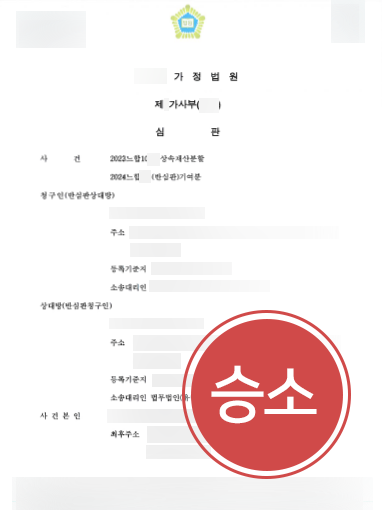
Accepting the inheritance attorney's arguments in the adjudication on division of inherited property, the court dismissed the claimant's division claim in its entirety for the following reasons.
▷ No other inherited property of the decedent existed
▷ The intent of sole ownership of the commercial building was clear
In addition, since the division of inherited property claim was dismissed, the court concluded the adjudication without ruling on the conditional counter-adjudication claim regarding the contributory portion.
An Inheritance Dispute Requiring an Active Response
This case was not a simple dispute over inheritance shares, but a case in which complex issues were intertwined, such as the lifetime division agreement, the special benefit and contributory portion, and grounds for disqualification from inheritance.
In this way, inheritance disputes often cannot be resolved by legal provisions alone.
Because verbal agreements among family members and various circumstances are intertwined, the lifetime intention, the records of property management, and the validity of a prior agreement must be comprehensively proven.
Therefore, when an inheritance dispute arises or one is sued, it is wise to receive the assistance of an inheritance attorney.
Daeryun's Case Handling System
Daeryun, Korea's 9th-ranked law firm (based on 2025 National Tax Service value-added tax filings), operates a dedicated consultation attorney system so that the nature of a case can be quickly grasped, and assigns a specialist attorney according to the type of case.
The firm also responds as a team rather than alone, and supplements its strategy in real time through continuous case monitoring.
Even after a case concludes, it supports a practical return to daily life through ongoing tailored follow-up management.
If an inheritance dispute arises and you are in a situation requiring legal assistance, please feel free at any time to entrust your case through 🔗legal consultation booking.
Related News


Watch related video content
for this case study.

Case studies on understanding inheritance and gift taxes and utilizing the family business succession system
This content is based on actual case studies of Daeryun Law LLC with some adaptations, and the copyright belongs to our firm.
Unauthorized reproduction, duplication, or distribution and other copyright infringements may result in legal action under applicable laws.