
CONTENTS
- 1. The Client Who Needed to Petition for Dementia Guardianship

- - The Aunt Who Needed a Guardian Due to Dementia Symptoms
- 2. Reviewing the System Related to Dementia Guardianship
- - The Role of the Guardian
- 3. Strategy for Commencing Dementia Guardianship
- - Proving the Ward's Dementia and the Need for Guardianship
- - Proving the Eligibility of a Foreign Guardian
- 4. Granting the Commencement of Dementia Guardianship and the Appointment of a Guardian
- - If the Appointment of an Adult Guardian Is Needed

1. The Client Who Needed to Petition for Dementia Guardianship

This is a case in which a client who requested a legal consultation to appoint a dementia guardian, with the assistance of a family law attorney, succeeded in the commencement of adult guardianship and the appointment of a guardian.
 The Aunt Who Needed a Guardian Due to Dementia Symptoms
This is the account of a client who came to a family law attorney.
The client's aunt had been showing symptoms of senile dementia for several years and had continued to receive hospital treatment.
Recently her cognitive function had declined to the point that she could not even recognize the faces of her siblings or her niece or nephew.
The hospital was also preparing a dementia grade diagnosis, and the possibility of admission to a care facility was being discussed.
In particular, the aunt was living alone without children after a divorce, and her siblings were also elderly or had difficulty moving about, so they were unable to serve as a guardian.
For this reason, the client, who held foreign nationality while residing in Korea, wished to become the aunt's guardian and requested assistance from a family law attorney.


2. Reviewing the System Related to Dementia Guardianship
A guardian for dementia refers to a guardian appointed by the court to support an adult (the ward) whose decision-making capacity has declined due to causes such as dementia.
The guardian makes decisions for the management of the ward's property and the protection of the ward's personal affairs, and assists in the use of necessary legal and social welfare services.
Under Article 9 of the Civil Act, if an adult who needs assistance with the handling of affairs due to causes such as dementia requires protection and support, a claim for adjudication to commence adult guardianship may be filed with the Family Court.
Civil Act, Article 9 (Adjudication to Commence Adult Guardianship)
② The Family Court shall consider the intent of the person concerned when rendering an adjudication to commence adult guardianship.
The Role of the Guardian
An adult guardian appointed to support a ward whose decision-making capacity has declined due to conditions such as dementia may represent the ward in legal acts and may revoke them.
The matters a guardian may handle are as follows, and they may vary depending on the type of guardianship and the scope of the guardian's authority.
Property Management | Management, preservation, and disposal of real estate |
Management of deposits, insurance, and the like | |
Management of regular income and expenditures | |
Purchase and sale of goods, and the conclusion, modification, and termination of service contracts | |
Safekeeping and management of movable property, certificates, and important documents | |
Acts under public law (such as tax filings) | |
Acceptance, qualified acceptance, or renunciation of inheritance, and consultation on the division of inherited property | |
Personal Protection | Medical acts : medical acts such as treatment, hospitalization, and surgery |
Housing-related acts : arranging, changing, or disposing of living space, admission to or discharge from a facility, and the like | |
Use of social welfare services : application for welfare benefits, receipt and management of welfare benefits, use of welfare services, and the like | |
Management of social relationships : education, rehabilitation, employment, and the like | |
Other support for daily living |
3. Strategy for Commencing Dementia Guardianship
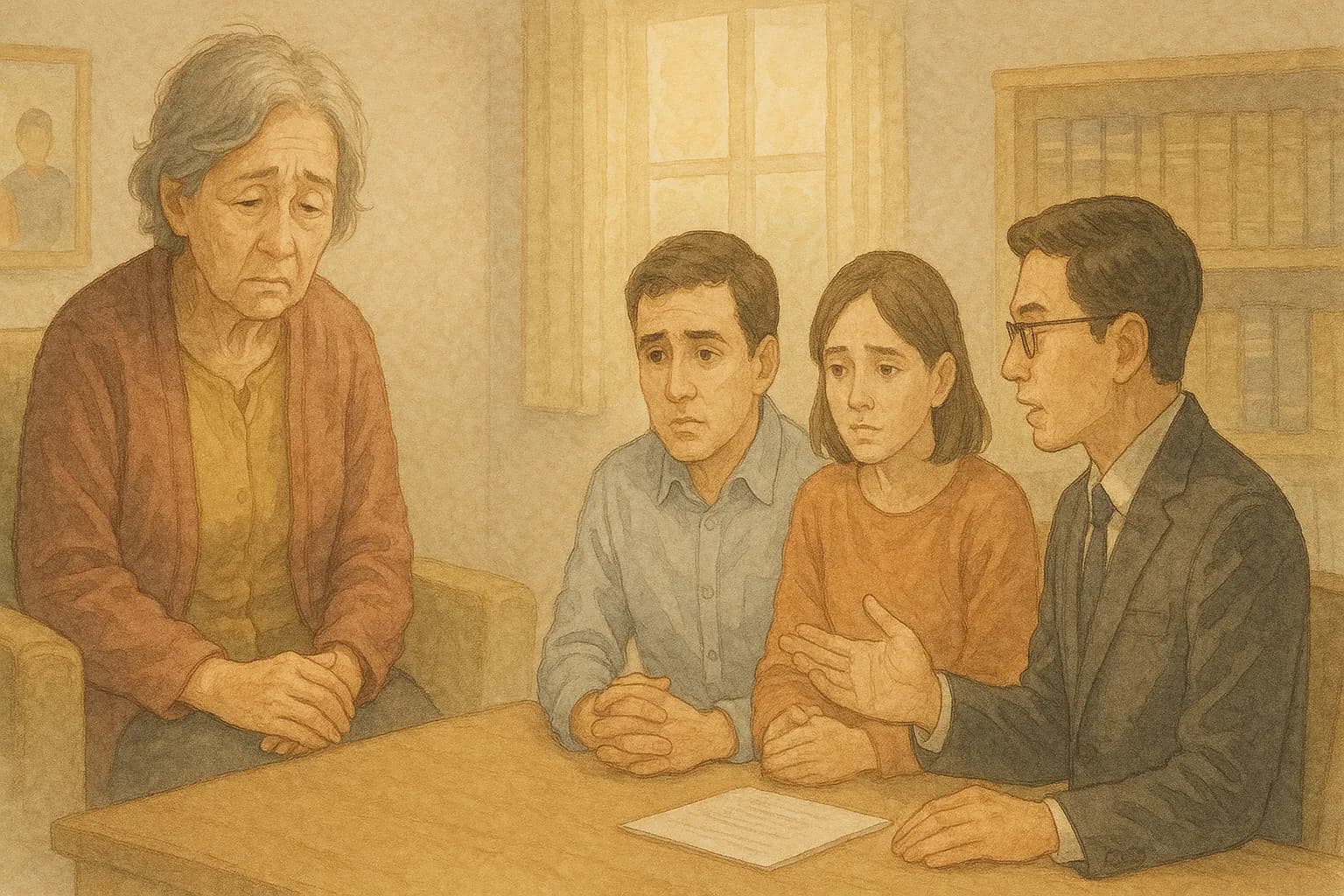
To enable the client to be appointed as the dementia guardian, the two issues the inheritance attorney had to address most intensively were the following.
∙ The eligibility of the guardian
In particular, although a foreign national can legally become a guardian, factors such as actual residence in the country and the substance of the protective activity serve as key elements in determining a guardian's eligibility.
Accordingly, the family attorney designed the case with the following strategy and proved it to the court for the appointment of the guardian.
Proving the Ward's Dementia and the Need for Guardianship
The ward (the client's aunt) had a long history of dementia treatment and had recently reached a state in which even simple communication was difficult.
As a result, she was at a level where it was hard for her to handle financial management or daily affairs on her own.
The family attorney established, through medical records and an opinion letter, the ward's decline in cognitive ability and loss of judgment, and proved the client's long-term record of protection and the need for admission to a care facility, thereby emphasizing the urgency and effectiveness of commencing guardianship.
In addition, clearly stating that the issuance of a diagnosis certificate was scheduled, the attorney requested an adjustment of the procedural schedule in light of matters such as the timing for submitting the medical opinion letter, so that the petition could proceed in a stable manner.
Proving the Eligibility of a Foreign Guardian
The client held the nationality of another country, but is currently residing in Korea and also has the actual basis of life within the country.
Accordingly, the family law attorney persuaded the court of the foreign national's eligibility as a guardian, focusing on the following points.
▷ Documentation of actual protective activities, such as accompanying the ward to medical appointments, paying medical expenses, and managing the bank account
▷ Proof that all of the siblings were elderly, ill, or residing abroad, highlighting that the client was the most suitable person to serve as guardian
In addition, agreement was reached with the ward's siblings as well, and the fact that they all consented to the client's appointment as guardian was also organized in writing and submitted to the court.
4. Granting the Commencement of Dementia Guardianship and the Appointment of a Guardian

As a result of the inheritance attorney's assistance, the family court recognized the following circumstances comprehensively and granted the client's claim in full.
▪ Confirmation of the claimant's suitability as guardian through agreement among the family
▪ Actual residence in Korea and devoted protective activities despite being a foreign national
Accordingly, the family court issued an adjudication commencing adult guardianship and made a decision appointing the client as the formal dementia guardian.
If the Appointment of an Adult Guardian Is Needed
Guardianship is not commenced merely on the ground that an illness has worsened.
Medical diagnostic materials, an arrangement of the family's agreement, and the petitioner's eligibility and actual record of protection must be carefully established, and in particular a more rigorous review may apply in the case of a foreign national or a lower-ranking relative.
Daeryun Law Firm has many attorneys with extensive experience handling family cases that involve sensitive family matters and complex legal requirements.
Through a dedicated consultation attorney system, a strategy is set from the early stage of the case, and an attorney specializing in the relevant type is assigned to provide systematic assistance.
In addition, through a team-based response system, related cases in areas such as administrative, civil, and criminal law are handled on a one-stop basis.
If you need assistance, such as the appointment of a guardian in a dementia case, please feel free to entrust your case at any time through a 🔗legal consultation booking.

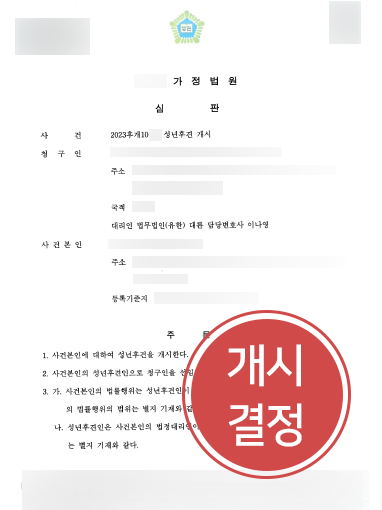
This content is based on actual case studies of Daeryun Law LLC with some adaptations, and the copyright belongs to our firm.
Unauthorized reproduction, duplication, or distribution and other copyright infringements may result in legal action under applicable laws.