
CONTENTS
- 1. The Client Who Sought Help With the State Compensation System Reimbursement Claim Lawsuit

- 2. What Is the State Compensation System?
- - Requirements for a Claim for State Compensation
- - Procedure for a Compensation Claim
- - Extinctive Prescription of the Right to Claim Compensation
- 3. Responding to the State Compensation System Reimbursement Claim Lawsuit
- - Insufficient Proof of Intent or Gross Negligence
- - The State's Reimbursement Claim Violates the Principle of Good Faith
- 4. State Compensation System Reimbursement Claim Lawsuit Outcome: Successful Dismissal

1. The Client Who Sought Help With the State Compensation System Reimbursement Claim Lawsuit
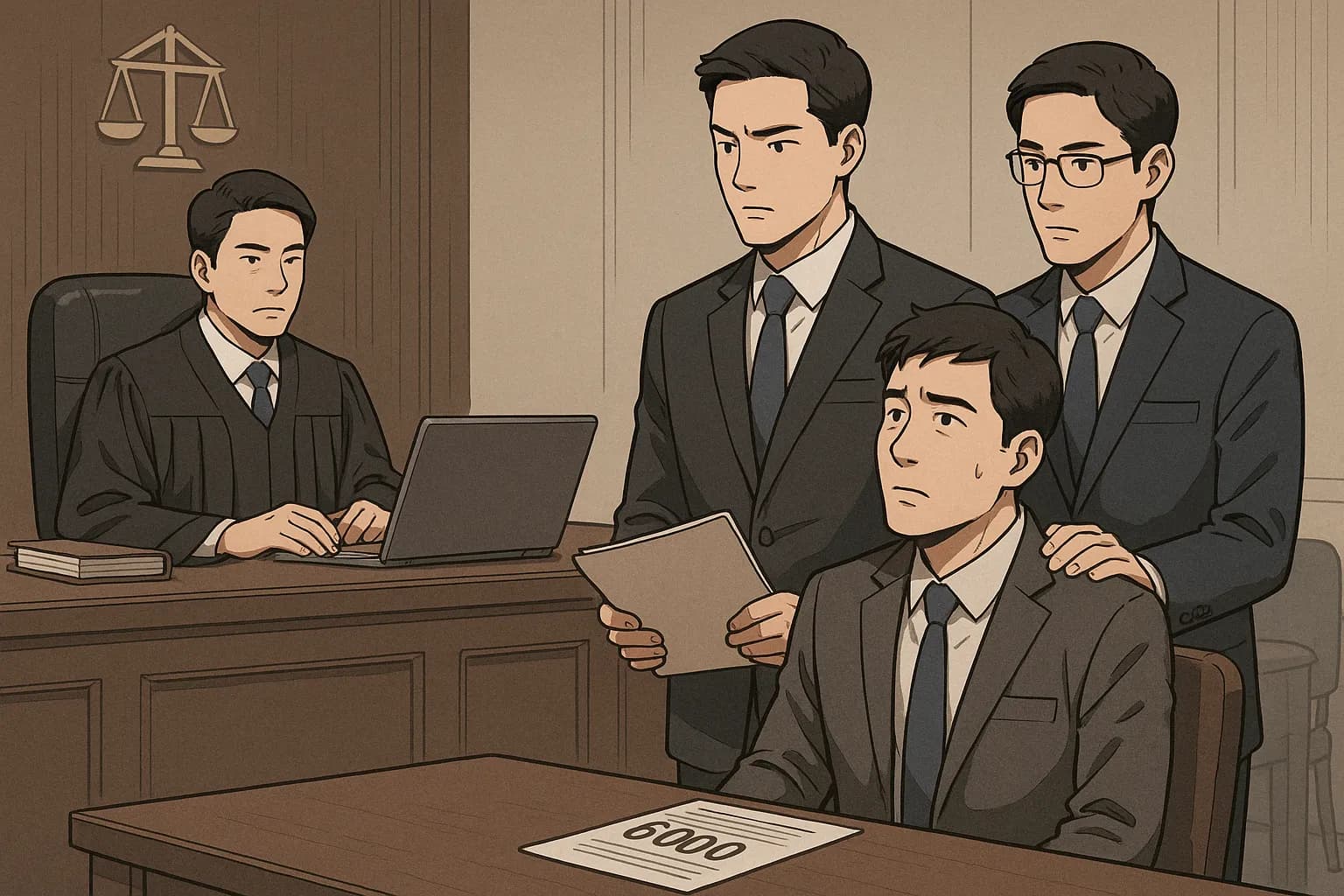
This is the story of a client who received a reimbursement claim lawsuit under the state compensation system.
This case began when the client, a public official, came to face a criminal suit on the ground that there had been an assault during an internal organizational conflict in the course of his duties.
Case overview:
The victim was assaulted by the client and several others and, as a result, made an extreme attempt and suffered serious physical harm.
In response, the victim claimed state compensation for damages against the State.
The harm was recognized, and the State paid the compensation amount.
Although the State first compensated the victim, it determined that the cause of this harm lay with the client and filed a reimbursement lawsuit.
After being held to bear part of the compensation liability in its suit with the victim and paying the damages, the State attributed the cause to the client and filed a reimbursement claim lawsuit.
The State (hereinafter the plaintiff) demanded that the client bear part of the damages, amounting to approximately 600 million won, on the basis of the following arguments.
-The fact that he received a guilty judgment in the criminal case is a circumstance indicating intent or gross negligence.
-Accordingly, he must bear a reimbursement liability for a certain proportion of the damages the State first compensated.
2. What Is the State Compensation System?
The state compensation system is a system under which, where a public official, in the course of performing their duties, causes loss to a citizen intentionally or negligently, the State or a local government, rather than the individual official, bears responsibility and compensates for the loss.
This is a mechanism to give effect to the constitutional principle of protecting fundamental rights and to accountable administration in a democratic state.
State compensation is provided for in the State Compensation Act, which guarantees that ordinary citizens, when they suffer unjust harm at the hands of public authority, may bring a claim for damages against the State or a local government.
 Requirements for a Claim for State Compensation
Let us examine the requirements for a claim for state compensation.
1. There must be an unlawful act in the course of official duties
A public official, while performing official duties, must have violated laws intentionally or negligently, and as a result harm to a citizen’s rights or legal interests must have occurred.
2. The state or a local government bears the liability for compensation
It is the state, not the individual public official, that becomes the subject of compensation.
3. Compensation is limited in special cases
For example, where a soldier or police officer suffers injury during combat or training, if compensation is received under other statutes, a separate claim for state compensation cannot be made.
Procedure for a Compensation Claim
1. Application to the Compensation Deliberation Council or filing a lawsuit directly is possible
The victim may apply to the Compensation Deliberation Council (the headquarters and district compensation deliberation councils under the Ministry of Justice), or may file a state compensation claim lawsuit directly with the civil court.
2. The litigation procedure is the same as an ordinary damages claim lawsuit
Even when the state is the defendant, there is no separate procedure, and it proceeds in the same manner as an ordinary civil lawsuit.
Extinctive Prescription of the Right to Claim Compensation
▶3 years from the date the victim became aware of the harm and the perpetrator
▶or, once 5 years have passed from the date the tort occurred, the right to claim state compensation is extinguished.


3. Responding to the State Compensation System Reimbursement Claim Lawsuit

A response was needed to a reimbursement claim lawsuit based on the state compensation system.
Specialist attorneys with experience in numerous matters relating to the state compensation system and reimbursement claim lawsuits set about devising a strategy for the client.
Insufficient Proof of Intent or Gross Negligence
The attorney in charge first emphasized that there had been no clear proof of the "intent or gross negligence" that is the requirement for reimbursement under the State Compensation Act.
① Where a public official or a private person entrusted with public duties, in the course of performing his or her duties, inflicts loss on another by violating statutes intentionally or negligently, or where there is liability for damages under the Guarantee of Automobile Accident Compensation Act, the State or a local government shall compensate for such loss in accordance with this Act.
② In the case of the main text of paragraph (1), if the public official acted with intent or gross negligence, the State or the local government may seek reimbursement (求償) from that public official.
However, the client had merely tapped the cheek with a degree of physical force that could hardly be called assault, with the intention of helping the victim adjust to work life.
In addition, there was a gap of about two weeks between the day of the cheek-tapping and the time when the victim made the extreme attempt.
On these grounds, the attorney in charge argued that the client's physical contact was not a factor influencing the victim's extreme choice, and that accordingly no intent or gross negligence could be recognized on the part of the client.
The State's Reimbursement Claim Violates the Principle of Good Faith
The attorney in charge argued that the plaintiff's reimbursement claim could not be permitted because it was contrary to the principle of good faith.
The Supreme Court has held that, even where a victim's right to claim state compensation arising from a public official's unlawful act has been extinguished by prescription, if the State has performed its compensation liability by determining that an 'assertion of the completion of prescription would constitute an abuse of rights,' then, absent special circumstances, exercising a right of reimbursement against that public official again is not permitted under the principle of good faith.
In this case, the plaintiff argued in the civil lawsuit with the victim that it bore no compensation liability on the basis of the 5-year extinctive prescription under the National Finance Act and the short extinctive prescription of 3 years under the Civil Act.
However, the court determined that this constituted an abuse of rights and did not accept it, and as a result the plaintiff came to pay the damages.
In this way, a situation in which the State performed compensation without being able to assert the completion of prescription is a matter in which the exercise of a right of reimbursement is restricted under the principle of good faith.
In particular, the client was acquitted at first instance in the criminal trial of the case in question, and in the appellate trial he was the only one among the defendants to receive a suspension of sentencing, which shows that the degree of his involvement was markedly low.
This is objective ground for finding that the defendant cannot be regarded as having actively led this case, and it also does not fall under the 'special circumstances under which the exercise of a right of reimbursement is exceptionally permitted' required by Supreme Court precedent.
The attorney in charge emphasized that, taking these circumstances together, the plaintiff's reimbursement claim against the defendant constitutes an abuse of rights contrary to the principle of good faith, and that the claim cannot be permitted.
4. State Compensation System Reimbursement Claim Lawsuit Outcome: Successful Dismissal
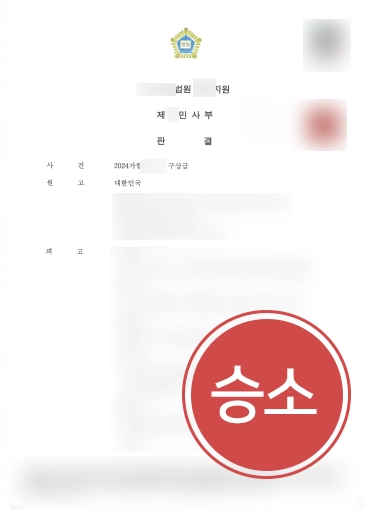
In a reimbursement claim lawsuit under the state compensation system, we obtained a judgment of complete dismissal by the court.
The court ordered, “All of the plaintiff’s claims are dismissed. The litigation costs shall be borne by the plaintiff.”
As a result, the client was able to successfully defend against the reimbursement claim lawsuit of approximately 600 million won.
This is a case that confirmed that, even within the structure of the state compensation system, where there is no proof of intent or gross negligence, it is not permissible to impose monetary liability on the public official as an individual.
The state compensation system is an important mechanism for protecting the rights of citizens, but the reimbursement claim lawsuits that arise from it have a complex legal structure, and the actual issues tend to span the civil, criminal, and administrative domains.
In particular, where a public official or an employee of a public institution has a record of criminal punishment, or where the state seeks to hold a related party liable after compensating for the loss, the following requirements must be closely analyzed in responding.
-Whether intent or gross negligence is proved
-Whether the act was performed in the course of duty
-The legal effect of the criminal judgment
-The possibility of asserting extinctive prescription and abuse of rights
Such cases are difficult to respond to simply within the framework of civil law, and various statutes and precedents, including the State Compensation Act, the Civil Act, the National Finance Act, and the interpretation of criminal judgments, must be comprehensively reviewed.
Daeryun LLC has specialized attorneys with extensive litigation experience related to the state compensation system who provide response strategies tailored to the client’s case.
Daeryun, which operates branch offices in each region nationwide and provides a 365-day, 24-hour emergency consultation system and a non-face-to-face video consultation service, welcomes your consultation inquiries at any time.
This content is based on actual case studies of Daeryun Law LLC with some adaptations, and the copyright belongs to our firm.
Unauthorized reproduction, duplication, or distribution and other copyright infringements may result in legal action under applicable laws.