
CONTENTS
- 1. The Client Implicated in Charges Including Quasi-Deposit-Taking

- - Circumstances of the Quasi-Deposit-Taking Punishment Case
- 2. What Were the Charges Against the Client in the Quasi-Deposit-Taking and Other Offenses?
- - What Is the Level of Punishment for Quasi-Deposit-Taking?
- 3. Strategy to Defend Against Punishment for Quasi-Deposit-Taking
- - Whether There Was Direct Participation in the Offense
- - The Fact of Harm Caused by Deception
- - Whether It Constitutes Quasi-Deposit-Taking
- 4. Result of Assisting the Client in the Quasi-Deposit-Taking and Other Charges: “Non-Prosecution”
- - If You Need Assistance Regarding Punishment for Quasi-Deposit-Taking?

1. The Client Implicated in Charges Including Quasi-Deposit-Taking

The client, who had faced the risk of an actual sentence for quasi-deposit-taking punishment, was able to receive a non-prosecution disposition through the systematic and swift assistance of the criminal specialist attorney.
 Circumstances of the Quasi-Deposit-Taking Punishment Case
The client was solicited to invest by a friend, A, and began investing.
Subsequently, the client’s acquaintances also came to invest in A through the client, and to simplify the transactions, investment funds were sent and received through the client’s account.
However, A, who had promised to guarantee the investment principal, did not keep the promise, and in the end the client’s acquaintances filed a criminal complaint against the client and A on suspicion of fraud.
As a result, the client was referred to the prosecutors on suspicion of fraud and quasi-deposit-taking, and requested legal assistance to defend against punishment, asserting that he was in fact merely a victim and had no involvement in the case.


2. What Were the Charges Against the Client in the Quasi-Deposit-Taking and Other Offenses?
The charges against the client, who was implicated in a case of quasi-deposit-taking, etc., were quasi-deposit-taking and the crime of fraud.
First, quasi-deposit-taking refers to the act of raising funds from an unspecified number of people by pretending to offer investment or savings to the general public, despite not being an authorized financial institution, and this is a representative type of conduct subject to punishment.
This is an illegal act carried out without authorization from the financial authorities, and it is strictly prohibited by law.
In addition, the client was also charged with the crime of fraud on suspicion of conspiring with A to deceive acquaintances by representing that ‘the principal is guaranteed’ and receiving funds from them.
The crime of fraud is a crime in which a person deceives another to receive property or obtain a pecuniary benefit. Moreover, where a third party is made to receive property or obtain a benefit in the same manner, the crime of fraud is likewise established.
What Is the Level of Punishment for Quasi-Deposit-Taking?
Act on Regulation of Conducting Fund-Raising Business Article 6
| A person who has engaged in quasi-deposit-taking | Imprisonment for not more than 5 years or a fine not exceeding 50 million won |
Criminal Act Article 347
| Fraud | Imprisonment for not more than 20 years or a fine not exceeding 50 million won |
3. Strategy to Defend Against Punishment for Quasi-Deposit-Taking

The client charged with quasi-deposit-taking and related offenses had been implicated in the criminal case somewhat unfairly.
In response, the criminal law specialist attorney established a defense strategy against the punishment for quasi-deposit-taking, emphasizing that the client did not directly lead the quasi-deposit-taking or play a central role and that the client was also a victim.
In particular, the attorney closely examined the legal issue of whether the conduct constituted quasi-deposit-taking and argued as follows, emphasizing that it did not meet the elements of the offense.
Whether There Was Direct Participation in the Offense
The complainants were claiming that the client had participated in offenses such as fraud.
Accordingly, the criminal law attorney closely collected and analyzed relevant materials, such as bank account transfer records, in order to prove that the client had not been involved in the offenses.
As a result, it was confirmed that although the client had received funds deposited by the complainants, he had remitted all of them to A as they were, at A's request.
The criminal law attorney established that the client had not obtained any monetary benefit in this process, and actively argued for a finding of no charge on the ground that the elements of involvement and acquisition of benefit required for the application of punishment for quasi-deposit-taking were difficult to recognize.
The Fact of Harm Caused by Deception
When the client first began investing, he did not suspect Mr. A and showed a cooperative attitude, such as remitting funds exactly as instructed.
However, the client too was deceived by Mr. A and suffered a large loss.
Accordingly, the criminal specialist attorney submitted the remittance records and deposit records as evidence and emphasized that the client was not a subject of quasi-deposit-taking punishment but rather a victim.
Whether It Constitutes Quasi-Deposit-Taking
The client did not engage as a business in the act of raising funds from an unspecified number of people.
The criminal law attorney argued that, because the actual complainants were all in a personal acquaintance relationship with the client, it was difficult to regard them as an unspecified number of people.
In addition, the client stated that he had merely conveyed investment-related information to acquaintances interested in investing at A’s request, and that he had no intention whatsoever to raise funds or gather investment money from an unspecified number of people.
Accordingly, the attorney emphasized that it was difficult to conclude that the client’s conduct constituted quasi-deposit-taking.
4. Result of Assisting the Client in the Quasi-Deposit-Taking and Other Charges: “Non-Prosecution”

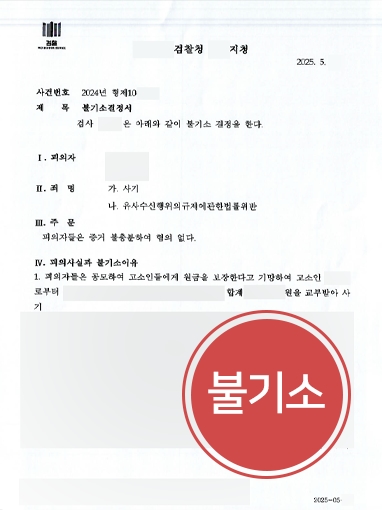
A client who had been facing difficulties on a charge of quasi-deposit-taking and related charges was able, through the assistance of a specialized criminal attorney, to obtain a non-prosecution disposition from the prosecution, as it was recognized that the application of punishment for quasi-deposit-taking was difficult.
This is a decision rendered where, as a result of the investigation, the suspect is determined to have no charge, or where, even if the charge is partly recognized, it is determined that there is no need to institute a public prosecution as a matter of law.
If You Need Assistance Regarding Punishment for Quasi-Deposit-Taking?
In a criminal case such as the above, complex facts such as the flow of funds, the method of solicitation, and the business structure are closely examined during the investigation.
In particular, because professional analysis of various legal issues, such as the existence of intent, the calculation of the scale of harm, and the scope of investors and contractual relationships, is required, an inadequate initial response may lead to legal disadvantage.
Daeryun LLC, the 9th-ranked law firm in the Republic of Korea (based on 2025 National Tax Service value-added tax filings), has many specialist attorneys with extensive experience in criminal cases and prepares prompt response measures.
In addition, it operates its own evidence investigation center to collect materials that may work in the client's favor and builds a strategy on that basis.
If you have become involved in a criminal case in a situation such as the above, please entrust your case at any time through Daeryun LLC's 🔗legal consultation reservation.


Watch related video content
for this case study.

🚨Actual client recording🚨Suspect police investigation simulation
This content is based on actual case studies of Daeryun Law LLC with some adaptations, and the copyright belongs to our firm.
Unauthorized reproduction, duplication, or distribution and other copyright infringements may result in legal action under applicable laws.