
CONTENTS
- 1. The Client Charged with a Trademark Act Violation

- 2. Requirements for a Trademark Act Violation
- - Disadvantages of Trademark Infringement
- 3. Responding to Trademark Act Violation Charges
- - Emphasizing That a Partnership Agreement Had Been Made
- - Emphasizing That the Trademark Was Not Used Unlawfully
- 4. Result of the Response to the Trademark Act Violation Charges
- - The Role of a Legal Specialist in the Case

1. The Client Charged with a Trademark Act Violation
The client, who was under suspicion of violating the Trademark Act, sought assistance from a criminal law specialist attorney at our firm.
The details of the client's case as heard by the criminal law specialist attorney were as follows.
The client operated a tableware manufacturing business. A few years ago, at the request of an acquaintance, the client manufactured and supplied tableware bearing the acquaintance's mark.
Afterward, the acquaintance owed the client payment but continued to delay making it.
As a result, the client had no choice but to stop manufacturing and supplying the tableware and demanded payment. The acquaintance then filed a criminal complaint against the client.
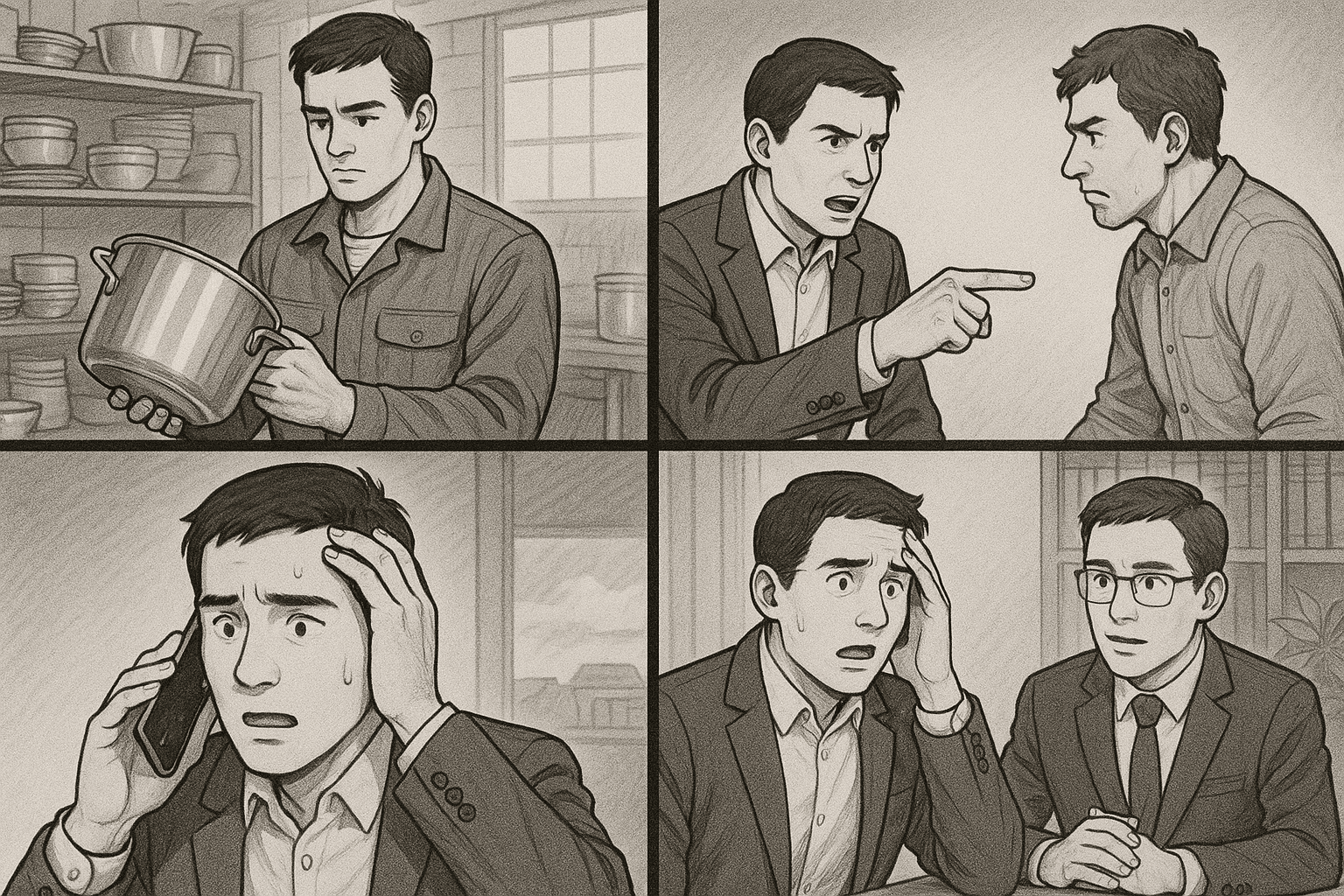
The client felt bewildered and said the client could not understand whether the client's conduct truly amounted to a violation of the Trademark Act.
The client requested assistance in concluding the case as quickly as possible.
2. Requirements for a Trademark Act Violation
The Trademark Act is a law enacted to protect rights in trademarks, and a trademark refers to any mark capable of indicating the origin of goods, such as a symbol, figure, character, sound, scent, or three-dimensional shape, used to distinguish one’s own goods from those of others.
For charges of 🔗trademark infringement such as those involving the client in this case to be established, the following requirements must be met.
1. Identity or Similarity of the Trademark : This refers to a case where, upon overall observation of the appearance, name, and concept of the trademark, it is assessed as identical or similar under generally accepted social norms, or where there is a likelihood of confusion among ordinary consumers as to the origin of the goods.
2. Identity or Similarity of the Goods : This refers to a case where the designated goods of the trademark and the goods alleged to infringe are identical or similar, such that ordinary consumers may mistake or confuse them as coming from the same business operator.
3. Use as a Trademark : This refers to a case where the mark goes beyond mere decorative expression or descriptive use and constitutes use as a trademark intended to indicate the origin of the goods and services.
Article 108 of the Trademark Act regards the following acts as acts of trademark infringement.
1. Using a trademark identical to another person’s registered trademark on goods similar to the designated goods, or using a trademark similar to another person’s registered trademark on goods identical or similar to the designated goods
2. Delivering, selling, forging, imitating, or possessing a trademark identical or similar to another person’s registered trademark for the purpose of using it, or having it used, on goods identical or similar to the designated goods
3. Forging or imitating another person’s registered trademark, or manufacturing, delivering, selling, or possessing the implements therefor for the purpose of forging or imitating it
4. Possessing, for the purpose of transfer or delivery, goods identical or similar to the designated goods bearing another person’s registered trademark or a trademark similar thereto
 Disadvantages of Trademark Infringement
If trademark infringement is established, under Article 230 of the Trademark Act it is punishable by imprisonment for not more than 7 years or a fine not exceeding 100 million won.
In addition, goods and similar items provided for the trademark infringement or produced by the infringement are confiscated.
A violation of the Trademark Act is not a crime requiring a complaint to prosecute, so punishment may be imposed even where a settlement with the victim has been reached, which requires caution.


3. Responding to Trademark Act Violation Charges
This firm’s intellectual property attorney and criminal law attorney collaborated to respond to the client’s charge of violating the Trademark Act as follows.
Emphasizing That a Partnership Agreement Had Been Made
The criminal law attorney emphasized that the client and the complainant in this case had entered into a partnership agreement.
The complainant held a trademark for tableware but lacked the funds to manufacture and distribute it, so they agreed to a partnership under which the client would invest funds and produce and sell tableware using that trademark.
The criminal law attorney argued that, although the complainant in this case claimed there was no contract, from the client's standpoint the arrangement was not much different from carrying out business as a wholesaler, and because the matter was not complex enough to warrant a written contract, no contract was prepared.
The client and the complainant had carried out the partnership in the form whereby they placed an order with the factory, and when the complainant conveyed the required quantity, the client issued a tax invoice to the complainant and sold the goods.
Emphasizing That the Trademark Was Not Used Unlawfully
The criminal law specialist attorney emphasized that the client had not unlawfully used the complainant’s trademark rights.
The complainant asserts that the client infringed the complainant’s trademark rights, but the client and the complainant agreed and ordered all the goods together, and it is rather the complainant who has not paid the client the price of the goods.
The attorney emphasized that the complainant had gradually become unreachable and, without paying the price, appeared to have filed this complaint in order to avoid the price of the goods.
The criminal law specialist attorney requested a non-referral decision for the client, on the ground that there was thus no room for the client to fall under charges of violating the Trademark Act.
4. Result of the Response to the Trademark Act Violation Charges

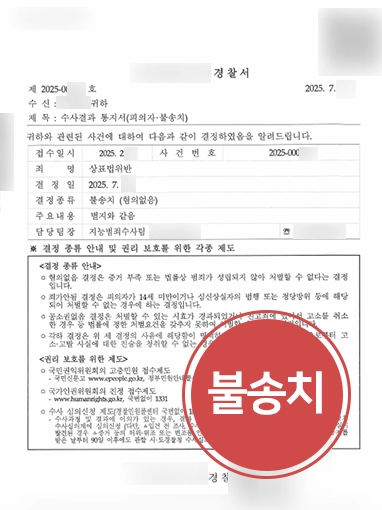
As a result of a criminal law specialist attorney and an intellectual property specialist attorney responding to the client's charge of violating the Trademark Act, the client received a decision of non-referral from the police.
The client had been unfairly accused by an acquaintance who was a business partner, but because of this firm's strategic response, the matter could be concluded at the police stage.
Because trademark infringement carries a high level of punishment, it is important to respond as soon as a charge is raised.
Because not only criminal punishment but also a civil claim for damages may follow, it is important to retain a law firm capable of a one-stop response.
At Daeryun, legal specialists including an intellectual property specialist attorney, a criminal law specialist attorney, a civil law specialist attorney, and a patent attorney provide a one-stop response service for all legal procedures arising from a charge of violating the Trademark Act.
If you need assistance, please proceed to 🔗book a legal consultation with this firm, where you can consult directly with an attorney.
The Role of a Legal Specialist in the Case
1. Trademark right attorney
Review of whether trademark infringement exists, assessment of similarity, and examination of the scope of rights
Examination of whether there are grounds for legitimate use under the Trademark Act (agreed use, non-profit purposes, and the like)
Formulation of civil litigation strategy, including claims for an injunction against infringement and claims for damages
Response to applications for a provisional injunction (suspension of sales, suspension of advertising, and the like)
2. Criminal law attorney
Assistance with the suspect's statements at the police and prosecution investigation stages
Presentation of arguments denying intent and a profit-making purpose and minimizing criminal liability
Support with settlement with the victim (negotiation of the settlement amount, drafting of the settlement agreement)
Preparation of a strategy for leniency, such as a non-prosecution disposition or a suspended sentence, depending on whether the matter involves a first-time offender or is minor
3. Civil litigation attorney
Response to the trademark holder's claim for damages
Contest over the amount of damages (reduction of the scope of actual damages, unjust enrichment, and statutory damages)
Resolution of contract disputes with business partners and issues of allocating liability related to supply
Response to civil provisional attachment and compulsory execution related to the infringement
4. Patent attorney
Technical review of the trademark registration status, scope of protection, and whether similarity exists
Representation in Intellectual Property Trial and Appeal Board proceedings, such as trademark invalidation trials and cancellation trials
Design of trademark applications, registrations, and license agreements to prevent recurrence in the future
Support with international trademark registration when entering overseas markets
This content is based on actual case studies of Daeryun Law LLC with some adaptations, and the copyright belongs to our firm.
Unauthorized reproduction, duplication, or distribution and other copyright infringements may result in legal action under applicable laws.