
CONTENTS
- 1. The Client Who Came to a Medical Accident Attorney

- - What Is a Medical Accident?
- - Medical Accidents: Precedents on the Duty of Care
- 2. Medical Accident Attorney: Assistance in Proving Harm
- - Damages Argument: Negligence Due to Delay in Diagnosis and Treatment
- - Damages Argument: Breach of the Duty to Treat
- 3. Medical Accident Attorney: Successful Proof of Harm on Appeal

1. The Client Who Came to a Medical Accident Attorney

This is the account of a client who requested help from a medical accident attorney.
After undergoing knee joint surgery, the client showed typical signs of infection, including persistent severe pain.
However, the hospital concluded that it was simply a delay in recovery and did not take active measures such as additional detailed examinations.
In the end, the client's condition worsened and they were urgently transferred to a higher-level hospital, where a deep infection was confirmed and they received long-term inpatient treatment.
In this process, additional surgery costs, treatment costs, and loss of income due to a long period off work arose.
The client, judging that serious complications had occurred after the surgery and that the hospital's appropriate treatment and explanation had been lacking, pursued a damages lawsuit.
However, at the first instance, the claim was dismissed on the ground that ‘the medical staff's negligence was not clear.’
After losing, the client reviewed the case again and decided to proceed with an appeal by seeking out a medical accident attorney with extensive experience in medical cases.
The client requested help from Daeryun LLC, where medical specialist attorneys with experience as members of the Medical Dispute Mediation and Arbitration Agency and with qualifications as pharmacists and oriental medicine doctors take the lead in handling medical-related civil, criminal, and administrative litigation.
 What Is a Medical Accident?
A medical accident refers to a case in which, in the course of a medical practitioner diagnosing, treating, operating on, or nursing a patient, physical or mental loss arises to the patient through negligence or an unforeseen circumstance.
▶Medical accidents caused by negligence
Medical negligence: a case in which loss arises to the patient because appropriate measures were not taken, judged against the medical standards of the time and the duty of care of an ordinary medical practitioner
▶Medical accidents caused by force majeure (an unforeseen outcome)
A case in which, even though the medical practitioner provided proper care, loss arises to the patient as an unavoidable outcome, such as a side effect or complication that may occur given the nature of the medical practice
For liability for damages arising from medical negligence to be recognized, the following conditions must be satisfied.
① Negligence on the part of the medical practitioner
② Illegality (infringement of a right)
③ The occurrence of loss
④ A causal relationship between the negligence and the loss
▶Laws related to medical accidents and dispute resolution procedures
-Civil litigation: a claim for damages (liability for non-performance or tort)
-Criminal litigation: occupational negligence causing injury, occupational negligence causing death, and the like
-Administrative procedures: administrative dispositions such as suspension or revocation of a license
-Korea Medical Dispute Mediation and Arbitration Agency: prompt dispute resolution through mediation and arbitration


Medical Accidents: Precedents on the Duty of Care
A case in which a patient reached a vegetative state due to the neglect of abnormal symptoms (Supreme Court 2017Da6726)
A patient who had received treatment for subarachnoid hemorrhage due to the rupture of a cerebral aneurysm was confirmed to be in a state of radiological cerebral vasospasm on CT imaging, yet the medical staff discontinued the administration of nimodipine and moved the patient from the intensive care unit to a general ward.
Thereafter, the patient exhibited abnormal symptoms such as stiffening of the limbs and falling into a coma, but did not promptly receive appropriate measures, and reached a vegetative state.
The Supreme Court determined as follows and reversed the judgment of the court below to the effect of recognizing the hospital's medical negligence.
-Failing to take necessary measures immediately when abnormal symptoms occurred is a breach of the duty of care in medical practice
-A causal relationship between the medical staff's negligence and the patient's harm is recognized
2. Medical Accident Attorney: Assistance in Proving Harm

After closely examining the first-instance record, the medical records, and the surgical progress notes, the medical accident attorney analyzed the possibility of negligence by clearly contrasting the period of suspected infection with the timing of treatment intervention.
In addition, through outside specialist consultation and an application for an appraisal of the medical records, the attorney devised a strategy to prove medically the "possibility that, had there been early diagnosis and treatment, the deterioration could have been prevented."
The direction of the medical accident attorney's legal framing
▶Liability for non-performance of obligation: neglect of the duty of post-surgical care
▶Tort liability: disregard of signs of infection and breach of the duty to explain
Damages Argument: Negligence Due to Delay in Diagnosis and Treatment
Despite the presence of clinical symptoms suggesting the possibility of infection, the hospital did not conduct an appropriate examination for early diagnosis.
The medical accident attorney argued that the medical practitioner had failed to exercise the duty of care ordinarily required at the medical standard of the time, that this constituted negligence in diagnosis, and emphasized that there was liability for damages.
Damages Argument: Breach of the Duty to Treat
Where infection is suspected after surgery, active treatment such as immediate adjustment of antibiotics, additional surgery, or transfer to a higher-level hospital is necessary.
The hospital in question, however, responded passively until the infection progressed and the tissue damage intensified, thereby lowering the client's possibility of recovery.
3. Medical Accident Attorney: Successful Proof of Harm on Appeal
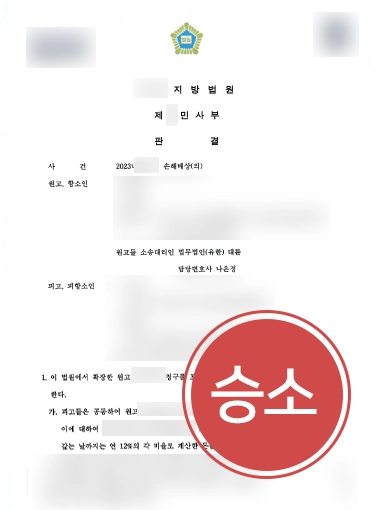
As a result of the medical accident attorney's assistance, the court recognized that the defendant medical staff had failed to take measures even though they could have sufficiently foreseen the possibility of complications and that they had not explained the risks and the necessity of treatment to the patient, and ordered the payment of approximately 100 million won in damages.
It is by no means easy for a victim of a medical accident to bring a damages suit against a hospital.
This is because, unlike an ordinary contractual dispute, a medical accident case requires proving medical facts and points of law at the same time.
Daeryun Law Firm provides the following assistance through medical attorneys who have handled numerous medical accident cases.
-Analysis of medical records: identifying the key issues of the case and the possibility of negligence
-Use of an expert network: medical advice and preparation of appraisal reports
-Construction of legal arguments: building persuasive arguments based on precedent and standard treatment guidelines
-Securing and organizing evidence: systematic documentation through digital forensics, evidence investigation, and the like
In particular, Daeryun operates an in-house evidence investigation and digital forensics center, providing one-stop responses for services such as the collection of evidence needed for a case.
This content is based on actual case studies of Daeryun Law LLC with some adaptations, and the copyright belongs to our firm.
Unauthorized reproduction, duplication, or distribution and other copyright infringements may result in legal action under applicable laws.