
CONTENTS
- 1. The Client Charged with Defamation

- - How the Case Arose
- 2. What Is Defamation?
- - Sentencing Levels
- 3. Assistance Provided to the Client Charged with Defamation
- - Whether the Crime Was Established
- - The Client's Deep Remorse
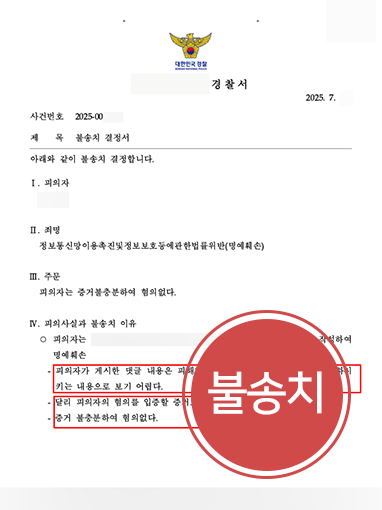
- 4. Result of Assisting the Client Charged with Defamation: ‘Non-Referral’
- - If You Are Involved in a Criminal Case?

1. The Client Charged with Defamation
The client charged with defamation had been placed at risk of a custodial sentence had matters gone wrong, but, with the assistance of a criminal attorney, a decision of non-referral was obtained and the case was concluded.
 How the Case Arose
The client was blocked on a social media account by A, a friend from another department, for no particular reason.
Later, the client happened to see one of A's videos on another social media platform and left a comment inquiring about nose surgery with genuine intent.
However, A sent messages criticizing and pressuring the client with content that differed from the facts.
Angered by this, the client left a comment containing somewhat strong language, and as a result was reported.
In order to obtain a finding of no charge, the client requested the assistance of a lawyer specializing in criminal cases who had handled many such cases.

See More


2. What Is Defamation?
Defamation refers to the act of damaging another person's reputation by disclosing specific content, whether true or false, with the purpose of disparaging that person.
In this case, the client came to be reported on suspicion of having damaged reputation in cyberspace.
For example, defamation may be established even where a post or comment written in a space that an unspecified number of people can view, such as an internet bulletin board, a café, or Twitter, damages another person's reputation.
Sentencing Levels
The penalties for defamation are as follows.
▶ Article 307 of the Criminal Act
A person who defames another by publicly alleging facts | Imprisonment with or without labor for not more than two years, or a fine not exceeding 5 million won |
A person who defames another by publicly alleging false facts | Imprisonment for not more than five years, suspension of qualifications for not more than ten years, or a fine not exceeding 10 million won |
▶ Article 70 of the Network Act
A person who defames another by publicly alleging facts through an information and communications network | Imprisonment for not more than three years, or a fine not exceeding 30 million won |
A person who defames another by publicly alleging false facts through an information and communications network | Imprisonment for not more than seven years, suspension of qualifications for not more than ten years, or a fine not exceeding 50 million won |
3. Assistance Provided to the Client Charged with Defamation

In order that the client facing the defamation allegation could receive a disposition such as non-referral, the following arguments were made.
Whether the Crime Was Established
For defamation under the Network Act to be established, there must be a statement of a specific fact capable of damaging another person's reputation.
However, the comment left by the client was merely an interrogative expression simply inquiring about information related to nose cosmetic surgery.
In other words, it was emphasized that, since the content did not assert a specific fact or disparage another person but rather sought an opinion or information in the form of a question, it did not constitute a statement of a specific fact capable of damaging reputation.
The Client's Deep Remorse
This case was not an indiscriminate crime against an unspecified large number of persons, but an impulsive incident that arose when an online dispute originating from a personal misunderstanding with A escalated emotionally.
The client recognized that their message had been expressed in an excessive manner, came to deeply realize that it had caused the other party unnecessary displeasure and misunderstanding, and is sincerely repentant and reflecting.
In addition, the client pledged not to repeat similar conduct, and emphasized that they had cooperated sincerely during the investigation and actively engaged in resolving the case.
4. Result of Assisting the Client Charged with Defamation: ‘Non-Referral’

As a result of assisting the client under defamation charges, the police rendered a “non-referral” decision regarding the client.
The client conveyed their gratitude, saying that they were able to conclude the case promptly thanks to the criminal law attorney.
If You Are Involved in a Criminal Case?
The above case is one in which a report was filed on a charge of defamation, but the client, with the assistance of a criminal-law attorney, responded actively and received a non-referral decision, bringing the matter to an amicable conclusion.
As in this case, where one becomes involved in a criminal case, it is advisable to gather evidence such as relevant messages and posts from the early stages of the case and to confirm the facts accurately.
At this firm, Daeryun Law Firm, an attorney with extensive experience in handling criminal cases consults with the client in person, grasps the overall circumstances of the case, and designs an appropriate response strategy, thereby minimizing unnecessary legal burdens.
If you are facing difficulties in a situation such as the above, please request assistance through the 🔗legal consultation reservation of Daeryun Law Firm at any time.

This content is based on actual case studies of Daeryun Law LLC with some adaptations, and the copyright belongs to our firm.
Unauthorized reproduction, duplication, or distribution and other copyright infringements may result in legal action under applicable laws.