
CONTENTS
- 1. The Client Facing the Risk of Punishment for Public Indecency

- - Public Indecency and the Offense of Excessive Exposure
- 2. Elements of Public Indecency
- - Sentencing Levels for Public Indecency
- - Key Points of the Strategy Against Punishment for Public Indecency
- 3. The Attorney Who Took On the Response to Punishment for Public Indecency
- - Denial of Public Nature and Obscenity
- - Denial of Intent
- - Denial of the Likelihood of Recidivism
- 4. Result of the Response to Punishment for Public Indecency

1. The Client Facing the Risk of Punishment for Public Indecency

This is the account of a client who sought the assistance of a sexual offense attorney at this firm, stating that they faced the risk of punishment for public indecency.
To defend against the punishment of the client, the sexual offense attorney promptly held a consultation and reviewed the details of the case.
On the day of the incident, the client was working late because additional work had arisen, and, unable to resist the drowsiness that came over them, decided to masturbate.
The client said that, at the time of the incident, only two people were working in the office, the client and the female employee who is the victim in this case, and that, because the client's seat and the female employee's seat were far apart, they had not expected that the victim would witness the act of masturbation.
The victim, however, witnessed the client's act of masturbation and filed a complaint for public indecency.
The client thus came to face the risk of punishment for public indecency and sought the assistance of a sexual offense attorney.
 Public Indecency and the Offense of Excessive Exposure
In this case, the client was charged with public indecency by the complainant and faced the risk of criminal punishment.
To a layperson, public indecency and the offense of excessive exposure may be perceived as the same crime, but they are clearly distinct criminal acts.
| Category | Public indecency | Offense of excessive exposure |
| Applicable law | Article 245 of the Criminal Act | Article 3 of the Minor Offenses Act |
| Nature of the act | An indecent act committed for the purpose of satisfying sexual desire | Mere excessive exposure of the body |
| Requirements | Causing sexual shame or disgust to the general public | Exposure to a degree that causes embarrassment or displeasure |
| Level of punishment | Imprisonment for up to one year, a fine of up to 5 million won, detention, or a minor fine | A fine of up to 100,000 won, detention, or a minor fine |
| Examples | Masturbation in a public place, exposure of the genitals, sexual acts | Walking the streets in underwear, drinking while topless, walking around the city center in a bikini |


2. Elements of Public Indecency
🔗Public indecency is punishable only when the following requirements are met.
1. Subject of the act: a person
Public indecency can be committed only by a natural person.
It may be committed by either a minor or an adult, and where it is committed by a minor, whether the provisions on juveniles below the age of criminal responsibility or the Juvenile Act apply is treated as a separate issue.
2. Object of the act: public nature
“Public” refers to a state in which an unspecified or large number of persons can perceive the act.
It is not necessary that people actually be watching, and the public nature is recognized so long as the situation is one in which anyone could see.
An act carried out secretly inside one's own home with the curtains drawn → no public nature
3. Content of the act: an indecent act
The mere fact that clothing came off or that there was some exposure is not sufficient.
The courts regard as indecent an “act that markedly stimulates the sexual shame or aversion of an ordinary person.”
Removing one's top, walking about in underwear, or being exposed because a trouser zipper came down while intoxicated → not an indecent act
4. Subjective requirement: intent
Public indecency is an intentional crime.
It is established where the actor “commits the indecent act while aware that an unspecified large number of persons can perceive it.”
Where the person had no memory due to intoxication or was exposed by mistake, there is room to deny intent.
In simple terms, public indecency is established where the actor ① commits an indecent act in a situation where an unspecified large number of persons can see, ② to a degree that arouses the sexual shame of an ordinary person, ③ with intent.
Sentencing Levels for Public Indecency
The level of punishment for the crime of public indecency is provided, under Article 245 of the Criminal Act, as imprisonment for up to 1 year, a fine of up to 5 million won, minor imprisonment, or a minor fine.
Although it is set at a lower level than other sexual offenses and may thus be regarded lightly, where imprisonment or a fine is imposed, not only a criminal record but also security dispositions such as registration of personal information may be ordered.
Where minor imprisonment (confinement in a prison or detention facility for a period of at least 1 day and less than 30 days) or a minor fine (the imposition of an amount of at least 2,000 won and less than 50,000 won) is imposed, however, one may avoid a criminal record and security dispositions.
Key Points of the Strategy Against Punishment for Public Indecency
If you face possible punishment for public indecency, the following responses may be advisable.
1. Denying intent in the conduct
For public indecency to be established, there must be an ‘intent to commit an indecent act.’
If it was a mere mistake (for example, clothing slipping while intoxicated, or a restroom mix-up), the point that there was no intent to commit an indecent act should be emphasized.
A strategy is needed to prove through CCTV, witness statements, and the circumstances at the scene that it was ‘an accident, not an intentional act.’
2. Contesting whether obscenity is recognized
The court regards conduct as public indecency only when it is ‘conduct that arouses sexual shame or disgust in an ordinary person.’
Where there was mere bodily exposure that is difficult to view as a sexual act, an argument for reduction to the offense of excessive exposure may be possible, so the obscenity itself can be contested by analyzing the surrounding circumstances, the time, the place, and the manner of the conduct at the time.
3. Reviewing the credibility of the victim's statement
Public indecency relies heavily on the victim's report and statement.
It is necessary to review who the witnesses were, whether the statements are consistent, and whether there are any exaggerated parts.
A strategy of pointing out contradictions in the victim's statement to undermine its credibility may be effective.
4. Attempting settlement and making efforts at restitution
In sexual offense cases, whether a settlement is reached with the victim has a very significant effect on sentencing.
Where a sincere apology and an appropriate settlement amount lead the victim to express a wish not to have the offender punished, the likelihood of non-prosecution or lenient treatment increases.
Even where settlement is difficult, lenient treatment may be obtained through a letter of reflection, community service, and completion of a treatment program.
5. Emphasizing efforts to prevent recidivism
In public indecency cases, the risk of recidivism is often at issue.
The offender should show a willingness to prevent recidivism through a sexual impulse control program, alcohol treatment (where the offense was committed while intoxicated), and completion of counseling.
The court is more likely to grant lenient treatment when it confirms that “the likelihood of recidivism is low.”
Where acquittal is possible, the strategy should aim at an early decision of non-referral or non-prosecution, and where conviction is likely, it should aim at the lowest possible sentence and at avoiding registration.
3. The Attorney Who Took On the Response to Punishment for Public Indecency
For the client who faced the risk of punishment for public indecency, we responded as follows.
Denial of Public Nature and Obscenity
The sexual offense specialist attorney emphasized that the client did not commit an indecent act in public.
According to Supreme Court Judgment 2000Do4372, an indecent act refers to an act that arouses and stimulates the sexual desire of an ordinary person, impairs ordinary sexual shame, and runs counter to sexual moral notions.
In addition, according to Seoul Central District Court Judgment 2019Godan7655, “in public” refers to a state in which an unspecified person or a number of persons can perceive the indecent act.
The client engaged in masturbation while working in order to ward off drowsiness, but a partition panel was installed under the desk in the client's office, so the structure was such that the client's lower body was difficult to bring into view from the victim's seat.
In addition, on the date in question, there was no possibility whatsoever that a third party would enter the office.
Accordingly, the attorney argued that the client's act of masturbation could not be regarded as the commission of an indecent act in public and therefore did not constitute public indecency.
Denial of Intent
The sexual offense attorney emphasized that the client had no intent whatsoever to commit public indecency.
The client, convinced that the victim could not see the act of masturbation, minimized the motion, and moreover had no intent to cause the victim sexual humiliation.
The client did not intentionally expose or show the genitals to the victim, but rather masturbated covertly under a desk fitted with a partition.
Accordingly, the sexual offense attorney argued that it is difficult to find that the client had an intent to make the victim perceive the act of masturbation and feel sexual humiliation, so the intent to commit public indecency cannot be recognized.
Denial of the Likelihood of Recidivism
The sexual offense attorney emphasized that there was no likelihood of the client reoffending.
The client sincerely reflected on their conduct and repeatedly expressed an apology to the victim.
The client recognized that their conduct was immoral and made efforts to prevent recurrence, such as applying for and participating in psychological counseling and a recurrence-prevention education program relating to sexual matters, and the sexual offense attorney submitted the client's counseling records on this point as evidence, emphasizing that there was no concern of the client reoffending in the future.
4. Result of the Response to Punishment for Public Indecency
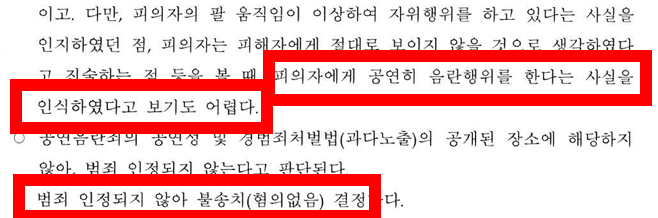
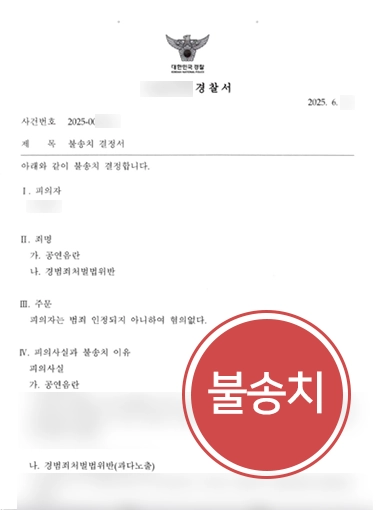
As a result of the sexual offense attorney's response to the potential punishment for public indecency on behalf of the client, the client received a decision of non-referral at the police stage.
Because the client promptly sought the assistance of a sexual offense attorney while facing potential punishment for public indecency, the case could be concluded at the police stage.
Punishment for public indecency is a clear sexual offense and can leave the lifelong label of a sex offender.
If you need assistance in a situation similar to that of the client in this case, please proceed with a 🔗criminal attorney legal consultation booking.
Daeryun, the ninth-largest law firm in Korea (based on 2025 value-added tax filings with the National Tax Service), provides legal services grounded in trust.
This content is based on actual case studies of Daeryun Law LLC with some adaptations, and the copyright belongs to our firm.
Unauthorized reproduction, duplication, or distribution and other copyright infringements may result in legal action under applicable laws.