
CONTENTS
- 1. Client Subjected to a Disposition on the Ground of a Physician's License Suspension

- - Frequently Asked Questions Regarding the Case
- 2. Daeryun's Response Strategy for Revoking the Suspension of a Physician's License
- - Argument on the Purpose of Prohibiting Unlicensed Medical Practice
- - Emphasis on the Original Meaning of a Medical Act
- 3. Suspension of a Physician's License Successfully Revoked in Litigation
- - How to Respond to the Suspension of a Physician's License

1. Client Subjected to a Disposition on the Ground of a Physician's License Suspension
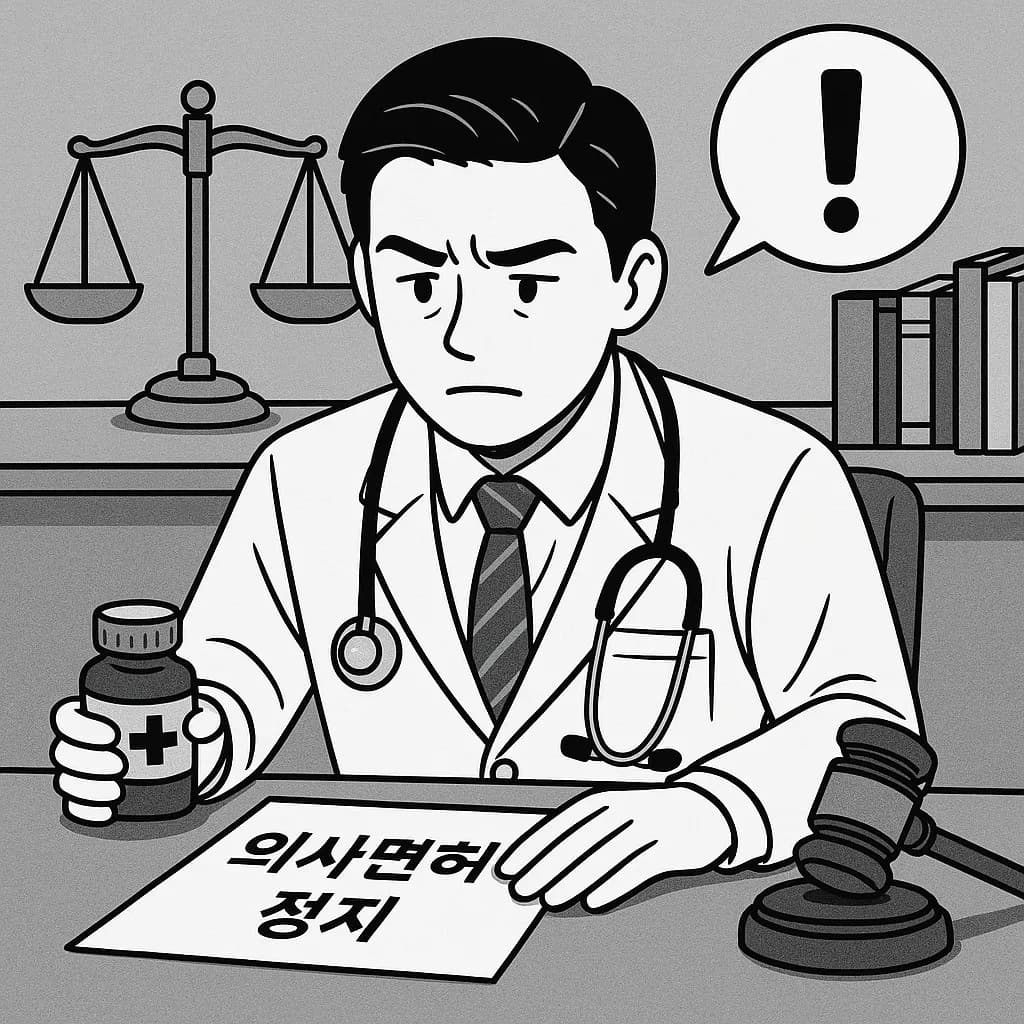
This is the case of a client who received a license suspension on the ground of a physician's license suspension.
The client, a dermatology specialist, personally purchased and took prescription drugs to address a personal health issue.
Although there was no fact of treating, prescribing for, or selling to any patient, the investigative agency issued a suspension of indictment on a charge of unlicensed medical practice, and, on that basis, the Ministry of Health and Welfare imposed a physician's license suspension.
The client appealed that this was unjust and requested Daeryun's assistance.
The Ministry of Health and Welfare determined that the client had performed a medical act outside the scope of his license.
Accordingly, viewing this as a violation of the provision under Article 27 of the Medical Service Act that a medical professional must not perform medical acts outside the licensed field, it imposed a qualification suspension.
 Frequently Asked Questions Regarding the Case
Q. What are the grounds for a physician's license suspension?
A. The grounds for a physician's license suspension under the Medical Service Act are as follows.
-Unlicensed medical practice or a medical act outside the scope of the license
-False preparation of a medical record
-Conduct damaging dignity (including crimes with a high likelihood of social condemnation, such as sexual offenses and drunk driving)
-Other violations of the Medical Service Act and related orders
The period of a physician's license suspension is up to 1 year, and it is applied on a graduated basis according to the degree of the violation.
Q. What is the difference between a physician's license qualification suspension and a license revocation?
A. These are as follows.
-Physician's license suspension : An administrative disposition under which one cannot perform medical acts for a certain period, with the license's effect restored once the period ends.
-Physician's license revocation : A disposition under which the license itself is extinguished, with reissuance restricted for a certain period.
Q. In what cases can a qualification suspension lead to a physician's license revocation?
A. According to Article 65 of the Medical Service Act, a qualification suspension may be converted into a license revocation in the following cases.
-Performing a medical act during the period of the qualification suspension
-Receiving a qualification suspension three or more times
In such cases, the license itself may be revoked rather than merely suspended, so particular caution is required.
Q. Is it possible to operate a hospital during the period of a physician's qualification suspension?
A. A qualification suspension fundamentally means that one ‘cannot perform medical acts.’
Accordingly, the subject of the suspension is the individual medical professional, not the medical institution.
For that reason, although the physician concerned cannot personally engage in treatment, operation of the hospital itself is possible if a substitute physician is employed.
Q. How should one respond when a qualification suspension is imposed?
A. When a qualification suspension is anticipated, it is important to first submit a written opinion at the prior notice or hearing stage and to sufficiently explain the facts and legal principles.
If a disposition has been imposed unjustly, you may actively contest it through an administrative appeal or administrative litigation procedure.
In particular, because qualification suspensions often follow in connection with criminal proceedings, establishing a response strategy at an early stage is above all necessary.


2. Daeryun's Response Strategy for Revoking the Suspension of a Physician's License

To revoke the suspension of the physician's license, Daeryun's medical and administrative law attorneys established that the client's conduct did not constitute unlicensed medical practice.
Argument on the Purpose of Prohibiting Unlicensed Medical Practice
The reason unlicensed medical practice is prohibited is to prevent dangers to the life and body of others and to public hygiene.
The attorney in charge argued that the client's act of taking medication for himself was unrelated to others and had no connection to public hygiene, so it could not be regarded as unlicensed medical practice.
▶ Related Precedents
In a case where a dentist personally purchased and took a hair-growth treatment, the Seoul Administrative Court held that an act directed at oneself had no direct connection to the regulatory purpose of unlicensed medical practice, and it revoked the license suspension. (Seoul Administrative Court, judgment of January 16, 2025, Case No. 2024Guhap56030)
In addition, in a case where a physician purchased a hair-loss treatment and administered it to himself, the Daegu District Court held that extending the interpretation of unlicensed medical practice to include acts directed at oneself was contrary to the principle of legality, and it rendered an acquittal. (Daegu District Court, judgment of April 14, 2023, Case No. 2023Gojeong54)
Emphasis on the Original Meaning of a Medical Act
Under the Medical Service Act, a ‘medical act’ does not mean the act of taking medication; rather, it means a series of acts by which, on the basis of specialized medical knowledge, one diagnoses another person's illness, explains the condition, and treats it through prescription, administration of medication, surgery, and the like.
The reason medical acts are legally regulated is that they have a direct effect on the life and body of others and may give rise to dangers to public hygiene.
By contrast, the client's act was merely self-administration, namely purchasing and taking medication for his own health, with no process of examination or prescription directed at any other person.
The attorney in charge emphasized that imposing the suspension of a physician's license on the basis of self-administration, which can hardly be regarded as a medical act under common social notions, was an excessive interpretation that fell outside the scope of the regulatory purpose of the Medical Service Act.
The attorney further argued that, because certain risk factors that may arise in the course of self-administration are already regulated by separate statutes such as the Pharmaceutical Affairs Act and the Narcotics Control Act, it was not reasonable to extend them further into unlicensed medical practice under the Medical Service Act.
3. Suspension of a Physician's License Successfully Revoked in Litigation
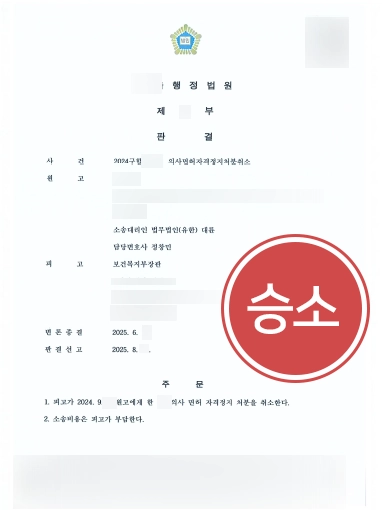
In the case concerning the suspension of a physician's license, the court found that a physician's act of purchasing and taking prescription medication for himself could not be regarded as unlicensed medical practice under the Medical Service Act.
Accepting Daeryun's arguments, the court recognized that taking medication for oneself does not pose a danger to the life or body of others or to public hygiene, and that it is an act belonging to the personal and private sphere.
Accordingly, the court found that the suspension of the physician's license imposed on the client by the Ministry of Health and Welfare was unlawful and rendered a judgment of revocation.
The significance of this case is as follows.
▶The act of self-administration has no direct connection to such dangers
▶Reaffirmation of the principle of legality, namely that provisions for criminal punishment or administrative sanctions must be strictly construed and that expansive or analogical interpretation is not permitted
How to Respond to the Suspension of a Physician's License
If you have received notice of a suspension of your physician's license, the first response you can take personally is to actively participate in the procedures for prior notice, submission of opinions, and hearing.
At this stage, it is important to clarify the facts and to submit materials so that no unfavorable misunderstanding or incorrect fact is reflected.
However, there are limits to an ordinary person's ability to respond directly to legal issues such as whether the Medical Service Act has been violated.
If the response is mishandled, there is a risk that the suspension may become final or may even lead to grounds for revocation of the physician's license.
Therefore, when a disposition is judged to be unjust, an administrative appeal or administrative litigation should be filed without delay, and in this process the assistance of medical and administrative law attorneys is needed.
At Daeryun LLC, medical law attorneys and administrative law attorneys work together to provide comprehensive services, including responding to dispositions suspending or revoking a physician's license, representation in administrative appeal and administrative litigation procedures, and Medical Service Act advisory and risk management, thereby protecting the rights and interests of clients.
This content is based on actual case studies of Daeryun Law LLC with some adaptations, and the copyright belongs to our firm.
Unauthorized reproduction, duplication, or distribution and other copyright infringements may result in legal action under applicable laws.