
CONTENTS
- 1. The Client Who Requested a Defense Against the Punishment of Elder Abuse

- - Examining the Level of Punishment for Violation of the Welfare of Senior Citizens Act and Elder Abuse
- - What Is Occupational Negligence Causing Injury?
- 2. Establishing a Response Strategy for the Defense Against the Punishment of Elder Abuse
- - Proving Completion of Safety Education and Elder Abuse Prevention Education
- - Submitting Evidence of Compliance with the Safety Management Manual
- - Emphasizing That the Accident Was Unavoidable
- 3. Result of the Defense Against the Punishment of Elder Abuse: A Successful Non-Referral Decision
- - Involved in a charge of violating the Welfare of Senior Citizens Act?

1. The Client Who Requested a Defense Against the Punishment of Elder Abuse

This is the account of a client who requested a defense against the punishment of elder abuse.
The client in this case was a care worker employed at an elderly care facility.
An elderly resident in the client's charge suddenly lost balance and fell while using the restroom, and as a result of this fall, the client came to be charged by the guardian's side with a violation of the Welfare of Senior Citizens Act (elder abuse) and occupational negligence causing injury.
At the time of the incident, the elderly person had a weakening of the musculoskeletal system due to advanced age, and the client, while assisting with the use of the restroom, was unable to prevent the sudden loss of balance.
However, the guardian filed a complaint, alleging that the care worker had neglected safety measures and, furthermore, that there had been carelessness amounting to abuse in the course of the care.
Although it was an unavoidable accident that could occur in the field of care, the client felt psychological pressure and a professional crisis simply from being involved in criminal proceedings.
In the end, the client resolved to respond with the assistance of an attorney, and requested help from Daeryun Law Firm, which has experienced numerous cases relating to the defense against the punishment of elder abuse and the crime of occupational negligence causing injury.
 Examining the Level of Punishment for Violation of the Welfare of Senior Citizens Act and Elder Abuse
A violation of the Welfare of Senior Citizens Act refers to an act that violates the prohibitions or obligations set forth in the "Welfare of Senior Citizens Act."
This Act is a law enacted to protect the rights and interests of senior citizens and to promote their welfare in an aging society, and the provisions relating to the prohibition of elder abuse in particular are at its core.
The elder abuse defined by the law is not limited to the assault or verbal abuse that one ordinarily thinks of.
-Physical abuse: assault, cruel treatment, and unnecessary physical restraint
-Emotional abuse: acts that cause mental suffering through insults, threats, neglect, verbal violence, and the like
-Sexual abuse: causing sexual shame or compelling sexual acts
-Economic abuse: unjustly acquiring the property of an elderly person or placing restrictions on its use
-Neglect: cases that harm the health and safety of an elderly person by failing to provide basic food, clothing, and shelter, medical treatment, and care services
In other words, not only active assault but also passive acts of neglecting care may be assessed as abuse.
Category | Penalty |
Using money or goods donated or paid for the benefit of an elderly person for a purpose other than that purpose | Imprisonment for not more than 3 years or a fine not exceeding 30 million won |
Inflicting an assault upon the body of an elderly person | Imprisonment for not more than 5 years or a fine not exceeding 50 million won |
Acts such as sexual assault or sexual harassment that cause an elderly person sexual shame | |
An act of neglect that abandons an elderly person under one's protection and supervision, or that neglects basic protection and treatment including food, clothing, and shelter | |
An act of emotional abuse that harms the mental health of an elderly person through verbal abuse, intimidation, threats, and the like | |
Making an elderly person beg, or begging by using an elderly person | |
An act of inflicting bodily injury upon an elderly person | Imprisonment for not more than 7 years or a fine not exceeding 70 million won |
What Is Occupational Negligence Causing Injury?
Occupational negligence causing injury is a crime that is established when, through negligence in the course of a business continuously engaged in as part of social life, one inflicts bodily injury upon another person.
Article 268 of the Criminal Act: "A person who, through occupational negligence or gross negligence, causes bodily injury to another shall be punished by imprisonment without labor for not more than 5 years or a fine not exceeding 20 million won."
Here, occupational negligence causing injury means a case in which a person performing a certain business inflicts bodily injury upon another person by failing to fulfill the duty of care required in that business.
For occupational negligence causing injury to be acknowledged, the following conditions must be satisfied.
▶That the person is engaged in a business: a person engaged in a certain business, such as a doctor, a driver, or a care worker
▶Breach of the duty of care: a case in which the person neglected the safety measures that an ordinary person engaged in the relevant business would naturally be expected to observe
▶Occurrence of injury: that another person actually suffered bodily injury as a result of that negligence
Not every accident immediately leads to occupational negligence causing injury.
If the accident was unavoidable, or occurred inevitably despite the fulfillment of the duty of care in the business, the crime is not established.
Therefore, it is very important to prove, at the early investigation stage, that the duty of care was fulfilled.
2. Establishing a Response Strategy for the Defense Against the Punishment of Elder Abuse
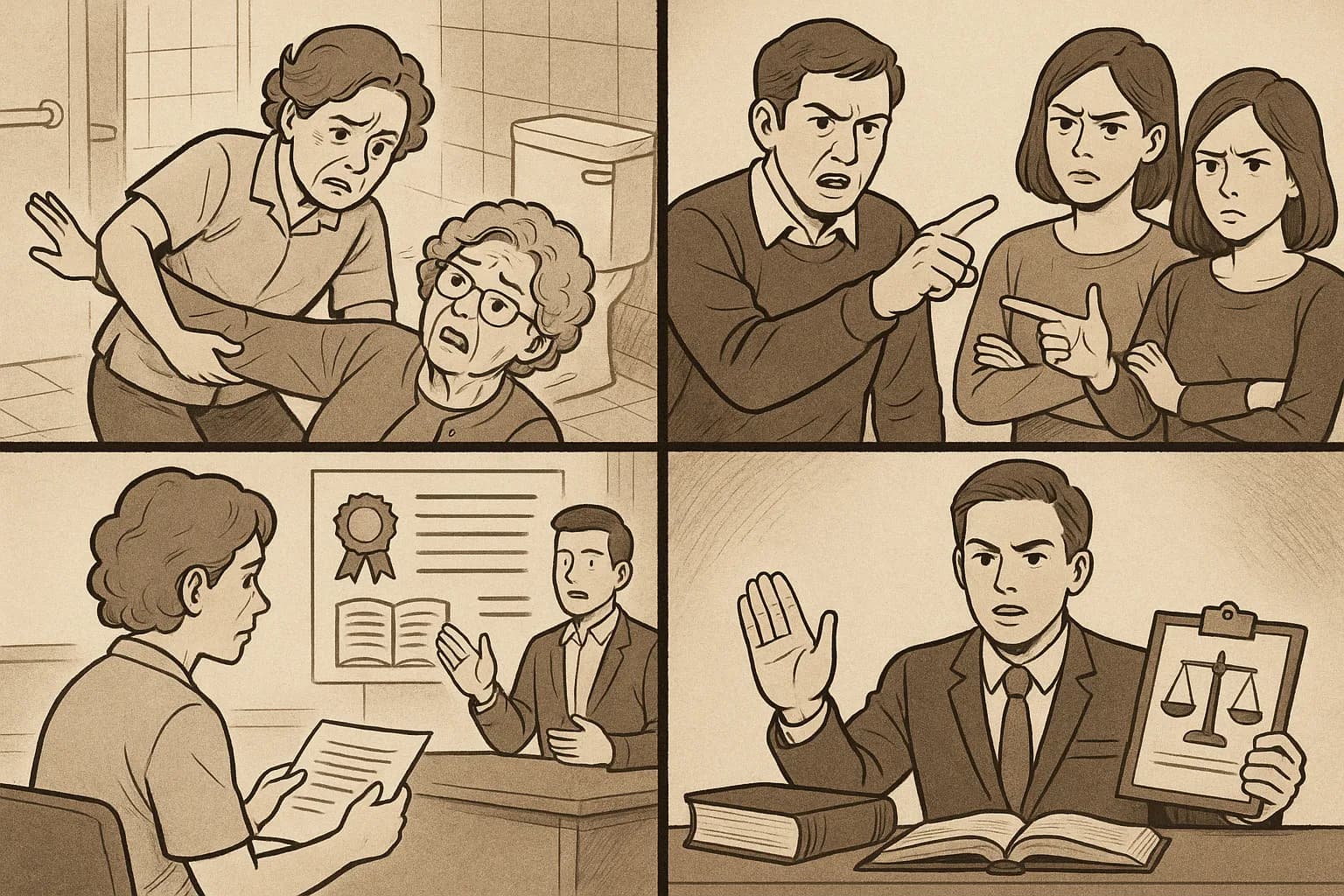
The firm set out to establish a response strategy for the defense against the punishment of elder abuse.
Proving Completion of Safety Education and Elder Abuse Prevention Education
In order to maintain the care worker qualification, the client had faithfully completed the safety education and the elder abuse prevention education conducted on a regular basis.
The attorney in charge obtained and submitted the actual certificates of completion and the records of attendance at the education.
This served as evidentiary material demonstrating that the client had ordinarily maintained an attitude of seeking to prevent abuse in care work and had fulfilled the duty of care.
Submitting Evidence of Compliance with the Safety Management Manual
The relevant care facility operated a safety management manual that it had prepared on its own.
The attorney in charge submitted statements from fellow employees and internal records in order to prove that the client had performed the work in accordance with the manual.
As a result, it was confirmed that anti-slip pads and handrails had been installed in the restroom, the place where the accident occurred.
The attorney in charge emphasized that the client had supported the elderly person in accordance with the prescribed procedures, but that the accident had occurred due to an unforeseeable, momentary deviation of force.
Emphasizing That the Accident Was Unavoidable
In the field of care, unexpected fall accidents may frequently occur owing to the physical characteristics of elderly persons.
The courts and investigative agencies judge whether there was negligence strictly, taking into account the particular nature of fall accidents.
The attorney in charge emphasized that the circumstances of the accident were unavoidable, and alleged that it did not constitute abuse or gross negligence.


3. Result of the Defense Against the Punishment of Elder Abuse: A Successful Non-Referral Decision
As a result of the defense against the punishment of elder abuse, the investigative agency rendered a non-referral decision on both the charge of violation of the Welfare of Senior Citizens Act (punishment of elder abuse) and the charge of occupational negligence causing injury against the client.
In other words, it determined that the client had not committed any intentional abuse or breach of the duty of care.
Through this decision, the client not only escaped the risk of criminal punishment but was also able to protect his professional honor as a care worker.
Involved in a charge of violating the Welfare of Senior Citizens Act?
A violation of the Welfare of Senior Citizens Act is a serious charge that can lead to criminal punishment.
In particular, the provisions on the punishment of elder abuse prohibit the physical, psychological, emotional, or economic abuse or neglect of a senior citizen, and in actual cases, not only intent but also gross negligence is frequently at issue.
(1) Organizing the facts
The time, place, and circumstances at the time of the incident should be recorded as specifically as possible.
Securing objective materials such as nearby CCTV footage, witnesses, and the facility's internal safety management manuals is important.
(2) Proving efforts to prevent abuse
One should present certificates of completion of elder abuse prevention education, records of safety training completed, and records of compliance with internal manuals.
These serve as strong defensive materials demonstrating that the person ordinarily fulfilled the duty of care.
(3) Demonstrating that the incident was an unavoidable accident
Falls or sudden illnesses are accidents that can commonly occur in the field of elderly care.
Because not every accident immediately constitutes abuse or a violation of the law, it is necessary to emphasize that the situation was unforeseeable.
(4) Amicable communication with the victim's side
The greater the conflict with the victim's family, the more unfavorably the case proceeds.
Preparing supplementary measures at the facility level, along with a sincere apology and explanation, can have a positive effect on the outcome.
(5) Initial response through retaining an attorney
The assistance of an attorney is needed from the stage of the investigative agency's inquiry.
Because each statement made before an investigator can have a significant effect on the future outcome of the case, responding to the investigation alone is risky.
At Daeryun, attorneys who have handled numerous cases involving violations of the Welfare of Senior Citizens Act and occupational negligence causing injury take the lead in providing response strategies tailored to each client's situation.
To address gaps in legal services, Daeryun operates branch offices in regions across the country and maintains a system for receiving consultations 24 hours a day, 365 days a year.
If you need prompt assistance, please visit the nearest branch office of Daeryun.
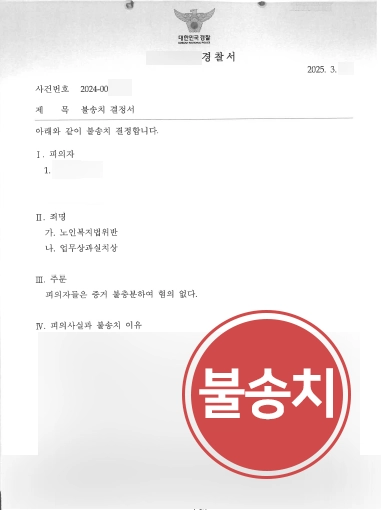
This content is based on actual case studies of Daeryun Law LLC with some adaptations, and the copyright belongs to our firm.
Unauthorized reproduction, duplication, or distribution and other copyright infringements may result in legal action under applicable laws.