
CONTENTS
- 1. The Client Charged With Illegal Filming Using a Camera

- - Background of the Case
- 2. Punishment Standards for Illegal Filming Using a Camera
- - Level of Punishment
- - Issues in the Case
- 3. Strategy for Mitigation for the Client Charged With Illegal Filming Using a Camera
- - Legal Dispute Over the Elements Constituting the Crime
- - Emphasizing Mitigating Factors Such as Recidivism-Prevention Efforts and First-Offense Status
- 4. Illegal Filming Using a Camera: Client Assistance Resulting in a ‘Fine’
- - How to Respond to a Charge of Illegal Filming Using a Camera

1. The Client Charged With Illegal Filming Using a Camera
The client charged with illegal filming using a camera faced the possibility of a custodial sentence; however, this is a case in which, with systematic assistance from the attorney, the client received a fine.
 Background of the Case
Over a period of about six months, the client used the client's own mobile phone to film parts of a woman's body.
The conduct was later detected by the police following a report, and the client was facing a police investigation.
However, because the client did not know who the victim was, the client was unable to attempt a settlement, and, concerned about a heavy sentence, the client requested an attorney's assistance to resolve the case.



2. Punishment Standards for Illegal Filming Using a Camera
Illegal filming using a camera refers to the act of using a camera or a device with a similar function to film another person's body against that person's will.
The purpose of the filming may be to satisfy sexual desire or to cause shame to the other person, and such conduct is classified as illegal filming.
Level of Punishment
The punishment standards for illegal filming using a camera are as follows.
| Article 14, Paragraph 1 of the Act on Special Cases concerning the Punishment of Sexual Crimes | Imprisonment for up to 7 years or a fine of up to 50 million won |
Issues in the Case
The principal issue in this case is whether the client's filming constitutes a crime under the law.
The key question is whether a crime is established merely because another person's body was filmed against that person's will, or whether some of the footage corresponds to a "part ordinarily exposed to view" or an "image close to the whole body," such that the establishment of a crime may be difficult.
Finally, a central consideration in the case is the extent to which it may be taken into account in sentencing that the client is a first-time offender, has faithfully completed recidivism-prevention education, and is deeply remorseful.
3. Strategy for Mitigation for the Client Charged With Illegal Filming Using a Camera

In order to help the client charged with illegal filming using a camera obtain the most lenient treatment possible, assistance was provided through the following strategy.
Legal Dispute Over the Elements Constituting the Crime
According to a precedent of the Gwangju High Court, it has been held that the mere fact that a person's body was filmed against that person's will does not, in itself, constitute a crime. (Gwangju High Court, December 7, 2017, Judgment 2017No309)
Accordingly, the attorney actively argued that, in the client's case as well, some of the photographs taken corresponded under the law to a "part ordinarily exposed to view or an image close to the whole body," and that it was therefore difficult to recognize the establishment of a crime.
Emphasizing Mitigating Factors Such as Recidivism-Prevention Efforts and First-Offense Status
The client deeply regretted the conduct and was sincerely committed to not repeating the same mistake.
To demonstrate the client's sincerity, the attorney arranged for the client to complete a recidivism-prevention education program, and the certificate of completion was submitted as evidence.
The attorney also emphasized that this was the client's first offense and actively assisted so that lenient treatment could be considered.
4. Illegal Filming Using a Camera: Client Assistance Resulting in a ‘Fine’

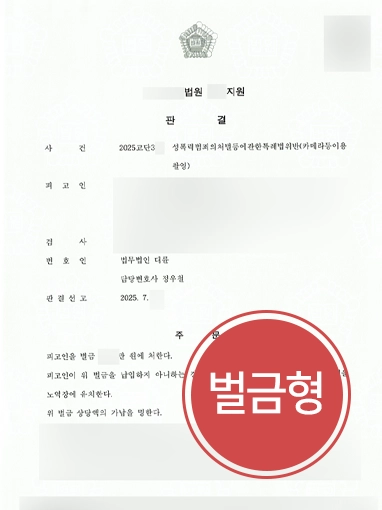
As a result of assisting the client in an illegal filming using a camera case, the court rendered an acquittal as to some of the photographs, and imposed a fine for the remaining portion.
Specifically, the attorney actively contested the portions for which the establishment of the offense was difficult as a matter of law, while also demonstrating that the client had diligently completed recidivism-prevention education and was deeply remorseful, so that these factors could be reflected in sentencing.
Through this strategic assistance, the client was able to avoid a heavier punishment such as an actual custodial sentence or a suspended sentence and to conclude the case with a fine.
How to Respond to a Charge of Illegal Filming Using a Camera
In illegal filming using a camera cases, it is important to clarify the facts and to maintain consistent statements.
In addition, factors such as recidivism-prevention efforts and whether a settlement with the victim has been reached can significantly affect the level of the disposition.
Daeryun Law Firm closely reviews the records of sexual offense cases and develops a response strategy so that the client's remorse and efforts to prevent recurrence can be sufficiently reflected.
If you have become involved in an illegal filming using a camera case in a situation such as the above, please promptly request assistance through a 🔗Legal Consultation Reservation.

This content is based on actual case studies of Daeryun Law LLC with some adaptations, and the copyright belongs to our firm.
Unauthorized reproduction, duplication, or distribution and other copyright infringements may result in legal action under applicable laws.