
CONTENTS
- 1. The Client Charged With Aiding and Abetting Fraud

- - Circumstances of the Case
- 2. A Strategy to Defend Against Punishment for Aiding and Abetting Fraud
- - Proving the Absence of Intent
- - Emphasizing the Absence of Any Prior Record of the Same Type of Offense
- - Guidance on Preparing and Submitting the Letter of Remorse
- 3. The Result of Assisting the Client Charged With Aiding and Abetting Fraud: a “Suspended Sentence”
- - FAQ Related to This Case
- 4. Elements for Establishing Aiding and Abetting Fraud
- - Level of Punishment
- - Need Help Defending Against Punishment?

1. The Client Charged With Aiding and Abetting Fraud
The client charged with aiding and abetting fraud served as a money-laundering operative and was at risk of an actual custodial sentence; however, through the attorney’s assistance, the client was able to receive a suspended sentence.
 Circumstances of the Case
After establishing a parts shop, the client attempted to promote the shop and solicit business through platforms such as Naver.
In the meantime, he received contact from a person claiming to be a team leader at Company A, who offered to help him purchase parts at low prices and sell them.
The team leader explained that, in order to leave a transaction record, money had to be withdrawn from a corporate account in the client’s name, and that a commission would be paid on the condition that the client withdraw in cash the payment remitted by the company wishing to purchase the parts and deliver it.
Accordingly, the client came to face trial on a charge of having facilitated a fraudulent scheme in the course of that process, and, judging that it would be difficult to respond on his own, requested an attorney’s help.



2. A Strategy to Defend Against Punishment for Aiding and Abetting Fraud

The main issues in this case were as follows.
· The possibility of proving the absence of intent, namely that the transaction could only have been mistaken for a legitimate business transaction
· The possibility of a suspended sentence in light of the client being a first-time offender, his social background, and a sincere attitude of remorse
In response, the attorney systematically gathered evidence capable of proving the absence of the client’s intent, submitted materials on his social background and the fact that he was a first-time offender, and established a multifaceted strategy that included guidance on preparing a sincere letter of remorse, thereby assisting the client in receiving a suspended sentence.
Proving the Absence of Intent
In order to prove that the client had not intentionally participated in the fraudulent scheme, the attorney systematically gathered the KakaoTalk messages, call records, and transaction-related supporting materials between the client and the team leader of Company A.
As a result of reviewing the gathered materials, the client was in a situation where he could only regard the transaction method explained by the team leader as a legitimate, actually existing gift-voucher transaction method, and the attorney used this as grounds to prove that the transaction could only have been mistaken for a legitimate business transaction.
Emphasizing the Absence of Any Prior Record of the Same Type of Offense
The client had no record of the same type of crime and no prior record exceeding a fine.
Accordingly, the attorney gathered and submitted to the court materials capable of proving this, such as a criminal record inquiry, a family relationship certificate, and materials on the client’s social and economic background.
In addition, the attorney prepared a written opinion that clearly explained these materials as grounds for sentencing, providing professional assistance so that the court could take them into account when considering leniency.
Guidance on Preparing and Submitting the Letter of Remorse
After receiving the indictment, the client reviewed the evidentiary records together with the attorney and examined in detail the circumstances of the case and his own conduct, and through this he came to recognize what wrong he had committed and is deeply remorseful.
In response, the attorney provided systematic assistance as follows so that the client could effectively convey his sincere remorse to the court.
- Specifically advising on the manner of expression, the structure, and the order in which to present the explanation of the case and the expression of remorse
3. The Result of Assisting the Client Charged With Aiding and Abetting Fraud: a “Suspended Sentence”

The attorney systematically carried out a multifaceted strategy, including proving the absence of the client’s intent, submitting materials on his being a first-time offender and his social background, and guiding the preparation of a sincere letter of remorse.
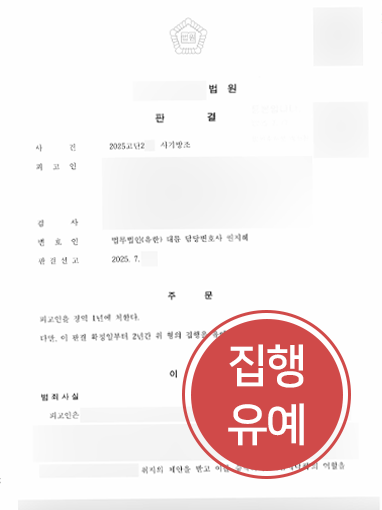
As a result, the client received a suspended sentence on the charge of aiding and abetting fraud and was able to bring the case to a close.
FAQ Related to This Case
A. Yes, the determination is based on the degree to which the principal offender’s crime was facilitated and on the person’s awareness. If the person was unaware of the crime or mistook it for a legitimate transaction, the absence of intent can be proven and the punishment may be mitigated. However, if intent or willful disregard is recognized, providing an account, delivering funds, and similar acts also become subject to punishment.Q. In an aiding-and-abetting-fraud case, can a person be punished even if he or she merely delivered money or lent an account?
A. Materials capable of proving the absence of the client’s intent, such as messages, call records, and transaction-related materials, are used as key evidence. In addition, materials showing the point at which the transaction instructions were received, the client’s responsive conduct, and the circumstances under which the transaction could only have been mistaken for a legitimate business transaction are also important.Q. When a charge of aiding and abetting fraud is applied, what evidence is important?
4. Elements for Establishing Aiding and Abetting Fraud
Aiding and abetting fraud is a crime that is established when a person, knowing that another is committing a fraudulent scheme, engages in direct or indirect conduct that facilitates its commission.
The specific elements for its establishment are as follows.
· Intent or willful disregard
· Contribution to the principal offender’s commission of the crime
· Causation
Level of Punishment
In the case of aiding and abetting fraud, Article 32 of the Criminal Act provides that the offender is to be punished as an accessory.
| Article 32 of the Criminal Act (Accessory) | (1) A person who aids the commission of another’s crime shall be punished as an accessory. |
(2) The punishment of an accessory shall be mitigated below that of the principal offender. |
An accessory means a person who aids another’s crime or who participates in its commission.
Although an accessory receives a punishment mitigated below that of the principal offender, an actual custodial sentence may still be imposed, so it is important to consult an attorney promptly and respond.
The level of punishment for the crime of fraud is as follows.
| Article 347 of the Criminal Act (Fraud) | A person who defrauds another so as to receive the delivery of property or to obtain a pecuniary advantage shall be punished by imprisonment for up to ten years or by a fine of up to 20 million won. |
Need Help Defending Against Punishment?
From the early stage of a case, Law Firm Daeryun systematically gathers mitigating factors tailored to the client’s situation and the characteristics of the case.
During the police investigation, we accompany the client and provide professional assistance to secure the consistency and accuracy of statements and to prevent unnecessary misunderstandings from arising.
In addition, throughout the entire course of the case, we actively protect the client’s rights through a multifaceted defense strategy that includes evidence analysis, the preparation of strategic written opinions, and the submission of materials favorable to sentencing.
If you are involved in an aiding-and-abetting-fraud case and are experiencing difficulty, please request assistance through a 🔗legal consultation reservation.
See More

This content is based on actual case studies of Daeryun Law LLC with some adaptations, and the copyright belongs to our firm.
Unauthorized reproduction, duplication, or distribution and other copyright infringements may result in legal action under applicable laws.