
CONTENTS
- 1. Violation of the Juvenile Protection Act | Case Details

- 2. Violation of the Juvenile Protection Act | The Concept of the Juvenile Protection Act
- - Acts Prohibited Under the Juvenile Protection Act
- - Level of Punishment for a Violation of the Juvenile Protection Act
- 3. Violation of the Juvenile Protection Act | Assistance of a Criminal Defense Attorney
- 4. Violation of the Juvenile Protection Act | Case Result

1. Violation of the Juvenile Protection Act | Case Details
This is the account of a client who sought out the firm's criminal law specialist attorney, stating that he needed assistance in responding to a case involving a suspected violation of the Juvenile Protection Act.
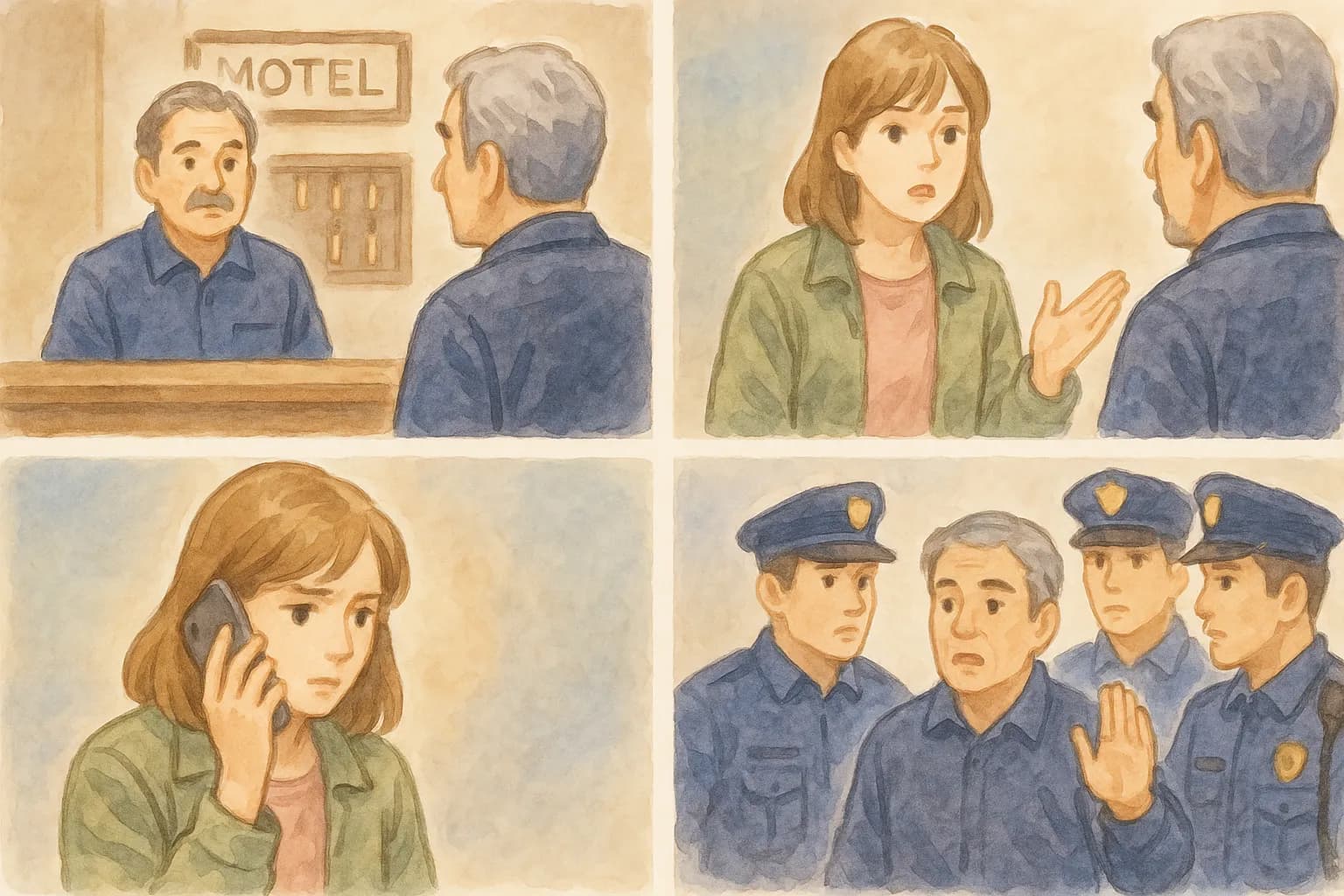
The client was operating a small motel in the area, and he had ordinarily verified the identity of guests thoroughly and strictly prohibited the entry of juveniles.
Then one day, a woman came to the front desk and demanded, “My boyfriend is staying at this motel, so tell me his room number.”
The client advised her, “I can check only if you tell me the name under which the reservation was made,” but the woman answered that she did not even know the name.
The client then firmly refused, saying, “Because I cannot verify the identity, I cannot provide the room information,” but the woman suddenly requested the room key, claiming, “Actually, I was sexually assaulted by my boyfriend.”
The client explained that, under procedure, he could not provide the room key without a police officer present, but the woman immediately reported the matter to the police, and the client was subsequently investigated on suspicion of ‘violation of the Juvenile Protection Act.’
During the investigation, the police revealed that the woman was a juvenile and raised the suspicion, “Did the client not condone the cohabitation of a juvenile and an adult male?”
The client therefore requested the assistance of a criminal law specialist attorney in order to clear himself of the wrongful suspicion.
2. Violation of the Juvenile Protection Act | The Concept of the Juvenile Protection Act
The Juvenile Protection Act is a law enacted to protect juveniles from harmful environments and to enable them to form a sound character and set of values.
This Act regulates juveniles so that they are not exposed to social and ethical risks such as sexual exploitation, entry into entertainment establishments, and exposure to obscene materials, and in particular strictly prohibits harmful conduct toward juveniles and the operation of harmful establishments.
According to Article 2 of the 「Juvenile Protection Act,」 a “juvenile” refers to a person under 19 years of age, but a person who has reached January 1 of the year in which he or she turns 19 is excluded.
 Acts Prohibited Under the Juvenile Protection Act
Article 30 of the Juvenile Protection Act prohibits the following acts.
· Having juveniles engage in serving customers through alcohol, dancing, or singing, or arranging such acts
· Coercing obscene acts by juveniles for profit or entertainment purposes
· Having juveniles' disabilities or deformities viewed for entertainment purposes
· Using or having juveniles beg
· Acts of juvenile abuse
· Having juveniles solicit customers on the street
· Business acts of having juveniles cohabit with members of the opposite sex, or the provision of a place for such cohabitation
· Having juveniles deliver beverages or condoning such acts
In particular, the business act of having juveniles cohabit is a provision frequently applied to those who operate motels, lodging establishments, pensions, and the like, and a person who aids or condones such cohabitation despite being aware that the individual is a juvenile becomes subject to criminal punishment.
Level of Punishment for a Violation of the Juvenile Protection Act
Conduct | Level of Punishment |
Arranging sexual entertainment involving a juvenile | Imprisonment for not less than 1 year and not more than 10 years |
Arranging entertainment services or obscene acts by a juvenile | Imprisonment for not more than 10 years |
Abuse or exploitation of a juvenile, among others | Imprisonment for not more than 5 years |
Permitting mixed-sex lodging or enticement of a juvenile, among others | Imprisonment for not more than 3 years or a fine of not more than 30 million won |
Accordingly, if a lodging business operator is found to have permitted or aided the mixed-sex lodging of a juvenile, the operator may be subject to imprisonment for up to 3 years.


3. Violation of the Juvenile Protection Act | Assistance of a Criminal Defense Attorney
The criminal defense attorney provided the following specific assistance in order to establish that there was no charge against the client.
① Establishing the motel's access control system
To emphasize that the client ordinarily permitted entry only after verifying the identification of every guest, the attorney submitted as evidence the notice posted at the front desk stating “No entry without identity verification” as well as the access records.
② Securing CCTV video evidence
By securing the CCTV footage from the motel entrance and the front desk, the attorney established that the time the woman in question entered the motel consisted only of the brief conversation in which she requested a room key, and that she did not actually stay there or enter a room thereafter.
③ Emphasizing fulfillment of the duty of care in business operations
The client argued that, as a lodging business operator, he had faithfully carried out the identity verification procedure required by law.
The argument that criminal liability cannot be imposed even where a juvenile makes a false statement or disguises herself as an adult reinforced the reasoning for a finding of no charge.
④ Maintaining consistency in statements regarding the circumstances of the case
The attorney logically organized the point that the client had consistently stated from the early stage of the case that he “did not provide a room key,” and that the call records and CCTV obtained by the investigative authorities supported this.
4. Violation of the Juvenile Protection Act | Case Result

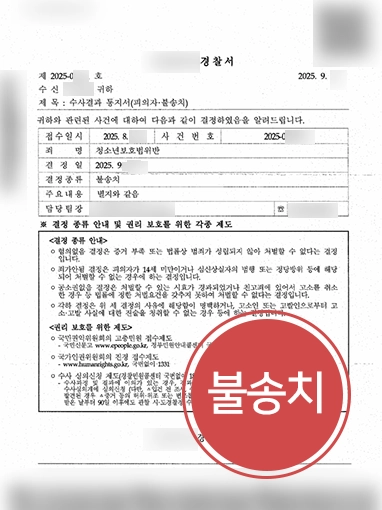
Through the criminal defense attorney's legal arguments and submission of evidence, the police determined that “there is no evidence that the client was aware of or aided the mixed-sex lodging of a juvenile,” and a non-referral decision was ultimately made.
With the assistance of the criminal defense attorney, the client was able to avoid not only criminal punishment but also administrative sanctions such as business suspension and a penalty surcharge.
If a motel operator or others, like the client in this case, are suspected of violating the Juvenile Protection Act, it is advisable to respond as follows.
Key Issue | Defense Argument | Practical Response Strategy |
Whether the juvenile's status was known | Whether identification was verified before lodging is important | Identity verification procedure and securing CCTV evidence |
Whether the lodging operator acted with intent or acquiescence | Punishment is possible only where there is objective awareness | Submission of operating guidelines and staff training materials |
Whether mixed-sex lodging actually occurred | Verification of actual lodging and access records | Submission of access, payment, and CCTV records |
Response in the early stage of the investigation | Maintaining consistency of statements | Coordinating statements with defense counsel present |
Preventive measures | Strengthening systems to prevent harmful conduct | Maintaining internal rules and training manuals |
In cases involving a violation of the Juvenile Protection Act, the outcome differs sharply depending on the facts and on whether there was awareness.
In particular, for a lodging business operator, the central issues are “whether the operator knew the person was a juvenile” and “whether there was an intent to aid.”
Where, as in the client's case, a person is investigated based solely on a juvenile's statement despite having followed the proper procedures, promptly securing objective evidence with the assistance of a criminal defense attorney and establishing that the duty of care in business operations was fulfilled becomes decisive for a finding of no charge.
Accordingly, if you are investigated on an unfounded charge of violating the Juvenile Protection Act, it is most important to develop a systematic response strategy together with an attorney from the early stage of the investigation.
If you are suspected of violating the Juvenile Protection Act, you may make a 🔗legal consultation reservation to prepare a response.
This content is based on actual case studies of Daeryun Law LLC with some adaptations, and the copyright belongs to our firm.
Unauthorized reproduction, duplication, or distribution and other copyright infringements may result in legal action under applicable laws.