
CONTENTS
- 1. The Labor Standards Act Litigation, What Were the Detailed Circumstances?

- - The Labor Standards Act Litigation, What Are the Relevant Statutes and Precedents?
- 2. The Labor Standards Act Litigation, What Was the Lower Courts' Determination?
- 3. The Labor Standards Act Litigation, What Was the Supreme Court's Determination?
- 4. The Labor Standards Act Litigation, What Was Daeryun's Strategy?

1. The Labor Standards Act Litigation, What Were the Detailed Circumstances?
This litigation relating to the Labor Standards Act was first filed back in 2020.
Before discussing the detailed circumstances of the litigation, we will first explain the persons and companies involved.
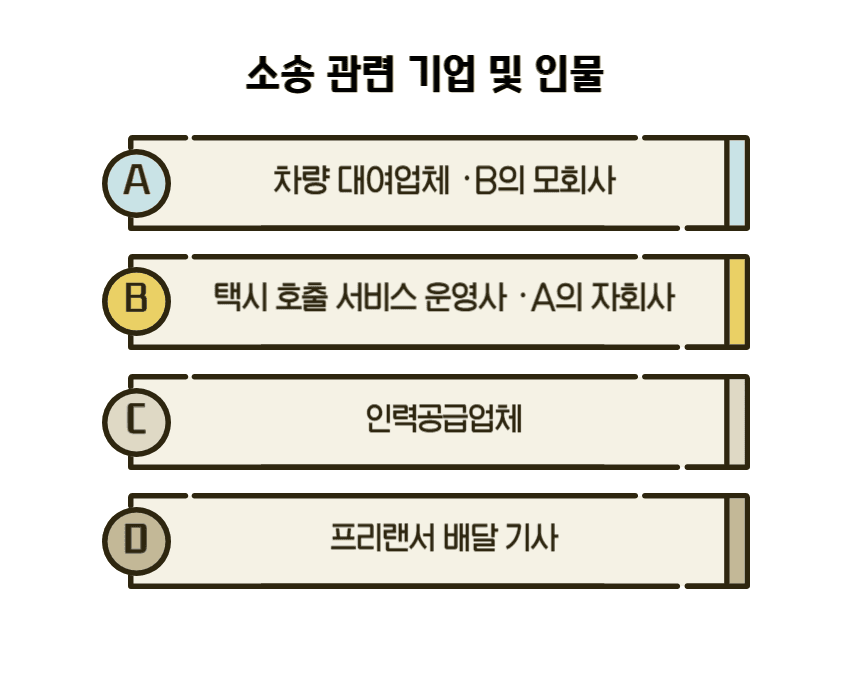
Company A is a well-known domestic vehicle rental company that, around 2018, began conceiving of ‘a new service that allows taxis to be called easily through an app.’
Having begun full-scale preparations, Company A acquired Company B, which was a software development firm, and Company B, now a subsidiary of Company A, developed the app needed for the call service.
Company B’s role was not limited to developing the app. It entered into a ‘reservation brokerage agreement’ with Company A, the terms of which included recruiting and managing customers and performing settlement-agency work for costs related to driving services.
In other words, under Company A’s direction, Company B took over the operation of the taxi call service as a whole on Company A’s behalf.
Company A also entered into a ‘driving service provision contract’ with Company C, a manpower-supply company.
Company C recruited and supplied the personnel to drive the taxis, and Company A paid the related costs.
Having entered into the contract, Company C set about recruiting drivers.
In this process, Mr. D entered into a contract with Company C as a ‘freelance driver.’
It was a system in which he drove a taxi every weekend as a freelancer and received payment in connection with that work.
The problem began one day when Company C, citing a workforce reduction, informed Mr. D that it could no longer work with him.
In response, Mr. D filed an application for remedy against unfair dismissal with the Regional Labor Relations Commission. However, the Regional Labor Relations Commission rejected the application, finding that Mr. D did not qualify as an employee as defined by the Labor Standards Act.
Mr. D contested this. He filed for reconsideration with the National Labor Relations Commission, which found that “Mr. D qualifies as an ‘employee’ under the Labor Standards Act, having provided labor in a subordinate relationship for the purpose of wages.”
It therefore stated that the notice of the workforce reduction given in this case could be regarded as a dismissal, and that because Company A violated the duty of written notice prescribed by the Labor Standards Act, this constituted an ‘unfair dismissal.’
Objecting to this outcome, Company A filed a lawsuit seeking revocation of the reconsideration decision on the remedy against unfair dismissal.
 The Labor Standards Act Litigation, What Are the Relevant Statutes and Precedents?
◈ Relevant Statutes
Labor Standards Act Article 27 (Written Notice of Reasons for Dismissal, etc.)
(1) To dismiss an employee, an employer shall notify the employee of the reasons for and the timing of the dismissal in writing.
(2) A dismissal of an employee takes effect only when it is notified in writing pursuant to paragraph (1).
◈ Relevant Precedents
“Whether a person qualifies as an employee under the Labor Standards Act must be determined not by whether the form of the contract is an employment contract, a contract for work, or a contract of mandate, but rather by whether, in substance, the labor-provision relationship is one in which the provider of labor provided labor to the employer in a subordinate relationship at a business or workplace for the purpose of wages. Whether such a subordinate relationship exists must be determined by comprehensively considering various economic and social conditions, such as: whether the employer determines the content of the work and the worker is subject to rules of employment or service (personnel) regulations, and whether the employer exercises considerable direction and supervision in the course of the performance of the work; whether the employer designates the working hours and the place of work and the worker is bound thereby; whether the labor provider can independently run a business on the provider's own account, such as by owning equipment, raw materials, or work tools, or by hiring a third party to perform the work on the provider's behalf; whether the labor provider bears the risk of generating profit or incurring loss through the provision of labor; whether the nature of the remuneration is consideration for the labor itself; whether a basic or fixed wage was set and whether income tax was withheld at source and other matters concerning remuneration; the existence and degree of the continuity of the labor-provision relationship and of exclusivity to the employer; and whether the worker is recognized as having the status of an employee under statutes concerning the social security system.” (See Supreme Court, Decision of December 7, 2006, 2004 Da 29736, etc.)
“In determining who is the employer with respect to a given worker, the actual labor relationship must serve as the standard, regardless of the form of the contract or the content of the relevant statutes, and the various factors considered in determining whether a person is an employee under the Labor Standards Act must be considered comprehensively.” (See Supreme Court, Decision of February 9, 1999, 97 Da 56235; Supreme Court, Decision of October 23, 2008, 2007 Da 7973; Supreme Court, Decision of August 18, 2023, 2019 Da 252004, etc.)
2. The Labor Standards Act Litigation, What Was the Lower Courts' Determination?
The determinations of the courts of first and second instance that heard this Labor Standards Act case diverged.
First, the court of first instance ruled in favor of Company A.
The court of first instance found that Company C, the manpower company with which Mr. D had contracted, had an independent structure and substance and recruited and trained drivers without direction or supervision from Company A.
It added that there was also no contractual obligation requiring the freelance drivers to submit to Company A’s direction and supervision.
It further noted that, although Company B appeared to manage attendance information such as the drivers’ clock-in and clock-out times and their non-acceptance of calls through the app, this was unavoidable given the nature of a platform-based service.
In the course of the litigation, Mr. D argued that, while driving, he had to follow the driving route directed by the app and was required to wait only at locations directed by the app when not carrying a passenger, and that this was equivalent to having had the specific content of his work designated by Company A.
In response, the court of first instance explained that “the determination of driving routes or waiting locations by big data and logic is something unavoidably necessary for the relevant business to be maintained on a continuous basis.”
It reasoned that Company A had merely designed the business structure to enable drivers to take part in the call-service business and to pay them appropriate consideration for performing the service, and that it was difficult to find that Company A had directed the specific content of the work.
However, the appellate court reached a different determination.
It found that Mr. D qualified as an employee under the Labor Standards Act who had provided labor in a subordinate relationship.
First, the appellate court found that the freelance drivers had no aspect of their work that they could determine on their own.
The basis for this was that there were mandatory service scripts that had to be provided at each stage after a customer boarded, and that the drivers could not solicit any passenger other than the relevant service’s customer during the operating time.
In addition, the court explained that Company B distributed various training materials, basic work manuals, and work rules to Company C and other partner companies, and that these directly and specifically set out what the drivers had to do or must not do.
The court also noted that, when customers raised complaints about some of the drivers, a Company B employee even visited the garage in person and conducted various training sessions.
On the basis of these circumstances, the appellate court found that Mr. D appeared to have been subject to specific direction and supervision.
It then explained that Company C, the manpower-supply company, had mainly recruited and supplied the personnel needed for the service business operated by Company A and received and passed on the remuneration for that personnel, and did not appear to have conducted independent labor management.
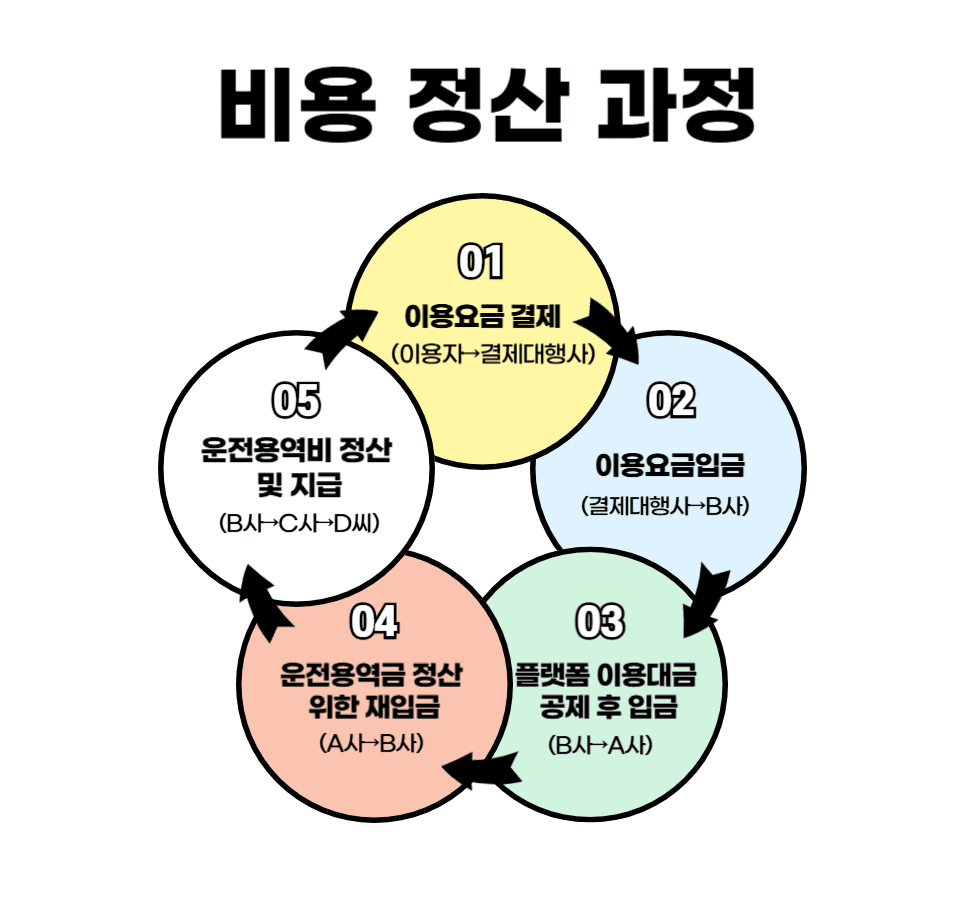
For these reasons, the court emphasized that the entity that actually operated the taxi call service was Company A, and that Company B had merely been entrusted with and performed part of the work for the service business on behalf of Company A, so Company B could not be regarded as the actual employer.
Against this reversed determination, Company A indicated its intention to file a final appeal, and the matter was passed to the Supreme Court.
3. The Labor Standards Act Litigation, What Was the Supreme Court's Determination?
The Supreme Court, which subsequently heard this Labor Standards Act case, rendered the same judgment as the court of second instance.
It regarded Mr. D, who had been a freelance driver, as an ‘employee.’
The Supreme Court pointed out that “although Company A entered into a ‘reservation brokerage agreement’ with Company B and had it perform the service operation work, the wages and the content of the work of the freelance drivers were all determined by Company A, and all of the remaining revenue from the service fees, after deducting certain commissions and the driving service payments, went to Company A.”
Of course, given the nature of freelance work, the drivers did have the option not to apply for a dispatch on days they did not want and to apply for a dispatch on days they did want; however, because a driver could perform driving work only once Company B, which operated the app, accepted the dispatch application and assigned a vehicle, it is reasonable to find that the working hours and the place of work for performing the driving work were determined by Company A, the court stated.
The court also added that Company B operated a driver-level system under which it paid special commissions on a differentiated basis according to level, and that because the evaluation items included the number of trips and distance, as well as the number of dispatch non-acceptances and cancellations, it was difficult to find that the drivers could freely choose whether to accept calls, whether to rest, or when to end their work.
It then explained that the appellate court had not erred in its determination as to employee status under the Labor Standards Act, the establishment of an implied direct employment relationship, and the like, and that Company A’s final appeal was dismissed.
4. The Labor Standards Act Litigation, What Was Daeryun's Strategy?
In connection with this Labor Standards Act litigation, we have analyzed a Supreme Court judgment holding that a freelance driver, too, may be regarded as an employee as defined by the current law if the driver receives considerable direction and supervision from the employer.
As platforms based on digital data and algorithms continue to emerge, the number of workers who work on the basis of such platforms is also increasing.
With the Supreme Court issuing a judgment recognizing the employee status of platform workers, platform operators have been left in considerable confusion.
This judgment is expected to have a significant effect on related rulings concerning other freelance workers that are currently pending before the lower courts.
Daeryun Law Firm LLP operates a 🔗 ‘Corporate Legal Group’, staffed with attorneys experienced in related matters, and a 🔗‘Labor and Industrial Accident Group,’ respectively.
If you are a business owner employing platform workers, or a freelancer who provides labor on the basis of a platform and have inquiries regarding the Labor Standards Act, you are welcome to reach out to Daeryun Law Firm LLP at any time.