Page title background (PC version)Page title background (mobile version)

Press Coverage

Numerous media outlets recognize the expertise of Daeryun Law LLC.
Explore interviews, legal commentary, and columns by Daeryun lawyers.

lowrider
2025-08-05
법무법인 대륜, ㈜엘마인즈와 MOU···AI로 중대재해 막는다
Daeryun Law Firm, MOU with L Mines Co., Ltd. Prevents major disasters through AI
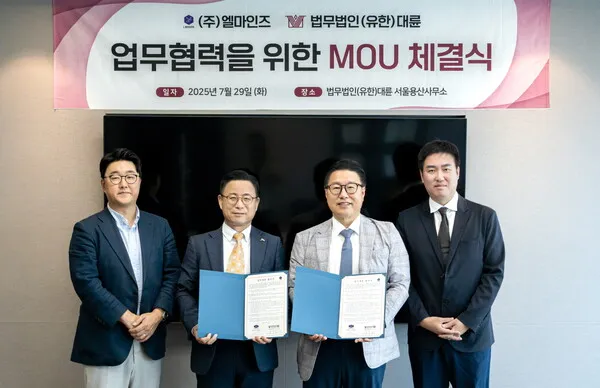
Daeryun Law Firm announced on the 5th that it has signed a business agreement with ‘LMinds Co., Ltd.’, an AI-based voice recognition technology solution company, and will join forces to respond to legal risks and strengthen technology commercialization advice. The agreement ceremony, which was held at Daeryun Law Firm’s Seoul Yongsan branch office on the 29th of last month, was held at Daeryun Law Firm’s Yongsan branch office in Seoul. Key figures including CEO, Attorney Jeong Il-woo, L Mines CEO Yang Kwon-seok, and Director Park Gyeong-min attended. L Mines is an AI technology-based voice recognition business solution company that succeeded in developing Korea's first voice recognition-specific SoC. ‘Catch 24’, a scream recognition on-device AI solution, is used in various places such as public restrooms, walking trails, and industrial sites, and is being adopted by various companies such as Hyosung to prevent serious disasters. Based on such technological capabilities, LMinds was selected as a smart safety equipment product by the Ministry of Employment and Labor, and also received the ‘2025 Jang Young-sil Award’. Recently, it is drawing a blueprint for targeting the global market, such as signing an export contract worth $1 million with Japan's Resta Holdings. Through this agreement, Daeryun Law Firm provides △ customized advice such as preliminary diagnosis of legal risks and information protection, △ legal review and contract support such as technology commercialization and licensing, △ joint research on algorithm ethics and platform legal response, △ legal support in the process of supplying AI solutions to public institutions, We plan to cooperate in △ promoting various joint seminars, workshops, and campaigns for the industry, and △ establishing a mutual cooperation system for global advancement. “L Mines is creating a safer society with highly reliable technology and product development, and is focusing on responsible use of data and ethical AI implementation,” he said. “Through the agreement with Daeryun, we will accelerate our leap forward as a global company and create a trusted technology ecosystem.” Kim Kook-il, CEO of Daeryun Management, said, “As various legal problems are arising through AI technology, responding to and strengthening compliance has become more important than anything else.” He added, “By adding Daeryun’s legal safety net to LMinnes’ innovative technology, we will do our best to build a responsible business environment where both technology and people can feel safe.” Lawleader Reporter Son Dong-wook twson@lawleader.co.kr Daeryun Law Firm, MOU with L Mines Co., Ltd. Prevents major disasters with AI (Go here)
Sports Seoul
2025-08-05
부당한 지시 따라 해고된 직원…法 “부당 해고 인정”
An employee who was fired following unfair instructions... Law “Recognition of unfair dismissal”
Allegations of violation of duties and active participation in management breach of trust... “I only followed instructions” - the judge said, “I cannot be seen as actively involved in breach of duty… the dismissal is an excessive disciplinary action.” An employee who was fired for causing damage to the company by following unfair instructions from management was ruled unfair dismissal by the court. On the 10th of last month, the 14th Division of the Seoul Administrative Court ruled in favor of the plaintiff in a lawsuit filed by a man in his 50s, A, in his 50s, against transportation company B to cancel the unfair dismissal sanctions judgment. I received notice of dismissal from Company B for violating my duties and engaging in breach of trust. At the time, the executives pursued a contract to lend funds to affiliates, but Mr. A caused losses to the company by obeying their unfair instructions without securing appropriate collateral. Mr. A claimed unfair dismissal and applied for relief from the Local Labor Relations Commission, but it was rejected. He also requested a retrial from the National Labor Relations Commission, but it was dismissed again on the grounds that ‘grounds for disciplinary action exist and the amount of punishment is appropriate.’ Accordingly, Mr. A filed an administrative lawsuit to cancel the retrial decision. During the trial, Mr. A argued that the company's disciplinary action was excessive. He said that he was notified of the decisions made by the former management and the board of directors and only followed instructions, but was not aware of the specific circumstances, so it was difficult to determine that it was a breach of trust. The court ruled in Mr. A's favor. First, the court explained, “It is difficult to justify that the plaintiff, who is in charge of the business, followed the management’s decision without sufficiently reviewing or raising questions about the risks of lending, bond security, and collection plans,” and added, “The retrial ruling that he violated his professional duty not to respond to unfair instructions is reasonable.” However, the court said, “The management points out that the plaintiff participated in the breach of trust by former executives as a reason for disciplinary action, but it is difficult to say that the plaintiff devised or directly proposed an illegal means.” He added, “Dismissal is an overly excessive disciplinary action, as it is reasonable to say that it is recognized only to the extent of violation of job duties, excluding active participation in breach of trust.” Attorney Ki-eun Lee of Daeryun Law Firm, which represented Mr. A, said, “According to social norms, a dismissal is justified only when the employee is responsible to the extent that the employment relationship cannot continue, and this is judged by comprehensively considering the motive and circumstances of the misconduct, the status of the worker, etc.,” adding, “At the time, Mr. A was directly involved in management’s decision-making.” “I was not involved, and the difficulty of handling work contrary to orders due to my position was accepted, so it was recognized as excessive disciplinary action,” he explained. Reporter Kim Jong-cheol (jckim99@sportsseoul.com)[View full article] An employee who was fired following unfair instructions... Law “Recognition of unfair dismissal” (link)
international newspaper
2025-08-04
6000만 원 대출 숨기고 카페 넘긴 사장…檢 “양수인 피해 없다”
The owner who hid a 60 million won loan and took over the cafe...Prosecutors “There is no damage to the transferee”
A man in his 30s who was sent on charges of failing to disclose the existence of an existing loan during the transfer process of a cafe was cleared of charges. On the 7th of last month, the Busan District Prosecutors' Office decided not to indict Mr. A, who was accused of fraud. Mr. A was accused of intentionally hiding a business loan worth 60 million won received in the name of the cafe when transferring the cafe to the complainant, B, in October 2022. Mr. B acquired the cafe by transferring Mr. A's business registration number as is in order to inherit the existing reviews of the delivery app. Afterwards, while looking for a new loan, Mr. B was told that a loan had already been made using Mr. A's business number, so additional loans were not possible. Accordingly, Mr. B asked Mr. A to repay the existing loan in full, but when this was not accepted, he filed a complaint. Mr. A denied the fraud charges. Although he received a loan, he claimed that it was not for the purpose of passing it on to Mr. B. Mr. A explained, “The loan in question was made before taking over from Mr. B for purposes such as interior decoration of the cafe and operating funds,” and “At the time of signing the contract, we also revealed that it would be difficult to make additional loans in the name of the business.” The prosecution found that Mr. A was not guilty. The prosecution explained, “Considering that the complainant had run the cafe for about two years after signing the contract and looked for a loan, it cannot be concluded that whether or not the loan was a key aspect of the transaction at the time of the transfer contract. Since the suspect also repaid all of the loan, it is difficult to say that he intentionally deceived the complainant.” Attorney Kwon Ji-hye of Daeryun Law Firm, who represented Mr. A, said, “For a fraud to be established, there must be a direct causal relationship between the act of deception and the resulting property damage.” “It must be proven,” he said. “Because the loan in question was Mr. A’s personal debt, there was no obligation to notify, but Mr. A clearly demonstrated that he notified Mr. B of this and that no actual property damage occurred.” Digital Content Team[View full article] The owner who hid a 60 million won loan and took over the cafe...Prosecutors “No damage to the transferee” (Shortcut)
KBC Gwangju Broadcasting
2025-08-04
4억 원대 세금계산서 허위 발급 혐의 스타트업 대표 '무혐의'...왜?
Startup CEO acquitted of charges of issuing false tax invoices worth 400 million won... Why?
The CEO of a startup who was investigated by the prosecution on charges of issuing false tax invoices worth 400 million won was acquitted. On the 8th of last month, the Daejeon District Prosecutors' Office decided not to indict Mr. A, in his 40s, who is suspected of violating the Punishment Act on Tax Defenders. Mr. A is suspected of having received false tax invoices stating that he had received materials and services from two companies, including a manufacturer, from October to December 2023. Mr. A is accused of receiving these false tax invoices. The total value of the tax invoices issued by the company amounted to 450 million won. According to Article 10 of the Tax Offenders Punishment Act, if a false tax invoice is issued without a physical transaction, one may be imprisoned for up to one year or fined up to twice the tax amount calculated by applying the value-added tax rate to the supply price. In the investigation by the investigative agency, Mr. A said, "When receiving materials from the manufacturer, only ownership is transferred and the actual He denied the charge, saying, "The goods were placed in the company's warehouse, leading to a misunderstanding that a false tax invoice was issued." He then explained, "The reason a cash transaction did not take place during the payment process was because the transaction was carried out in a way to write off the debt the company had previously borne." The prosecution decided not to indict Mr. A due to insufficient evidence, believing that the statements of the companies were consistent with Mr. A's statements and that there was a related contract, so there was no charge. The prosecution said, "Mr. A was transferred from the companies. He stated the reason for the disposition, saying, "There is no basis to conclude that a tax invoice was received without receiving goods or services." Mr. A's legal representative, attorney Jeong In-ho of Daeryun Law Firm, said, "After signing a contract with the manufacturer, Mr. A received the materials through revision of possession (transfer of ownership, maintenance of possession) rather than actual delivery." He explained, "In the case of other companies, Mr. A was unable to afford to pay the transaction price at the time, so he wrote an IOU and received the goods. However, this was also a matter of mutual agreement, and partial repayment was made." He added, "Because this case cannot be seen as creating a false tax invoice without a physical transaction, a non-prosecution should be imposed on Mr. A." Go Woori (wego@ikbc.co.kr)[View full article] Startup CEO 'not guilty' on charges of issuing false tax invoices worth 400 million won... Why? (Shortcut)
Gangwon Ilbo
2025-08-03
[월요칼럼]자녀의 생존권과 직결된 양육비
[Monday Column] Child support directly related to a child’s right to survive
An acquaintance of mine with whom I had not been in contact for some time recently called. An acquaintance said that he got divorced by agreement last year due to his spouse's cheating, and that after the divorce by agreement, he sent child support for his minor daughter for 3 to 4 months, but has not been paying child support for several months. Surprisingly, cases of non-payment of child support, which the author is currently in charge of, have also occurred to acquaintances close to the author. According to the 'Single-Parent Family Survey' conducted by the Ministry of Gender Equality and Family last year, 7 out of 10 (71.3%) reported never receiving child support from the non-custodial parent. Parents who raise their children alone after divorce have the burden of raising their children as well as their own lives, and the biggest problem is by far the financial problem. As the head of a single-parent family, you inevitably need money to raise a child, and any parent who has raised a child will know how frustrating and frustrating it would be if the ex-spouse avoided contact or unilaterally stopped paying child support. Ms. A, a working mother raising two children alone while divorcing by agreement due to her spouse's cheating, promised to pay child support of 700,000 won per child per month when divorcing by agreement with her ex-spouse, but her ex-husband did not pay child support every month, even when he did. A small amount of about 200,000 won was paid. In this situation, Ms. A can forcibly execute the ex-husband's property without a separate civil suit by using the child support burden record prepared and delivered in the divorce procedure by agreement as the right of execution. If the ex-husband does not comply, the family court may issue a direct payment order or performance order in accordance with Articles 63-2 and 64 of the Family Litigation Act. Violation of compliance orders may result in imprisonment and a fine of up to 10 million won. Imprisonment is a sanction that allows detention in a detention center for up to 30 days if the court's decision is not complied with. In addition, pursuant to Articles 21-3 to 21-5 of the Act on Securing and Supporting Compliance with Child Support, a driver's license suspension and ban on leaving the country can be requested for defaulters, and indirect sanctions such as disclosure of names are also possible. However, although the performance order and detention order are very powerful means of securing compliance, the other party may request that the child support defaulter be banned from leaving the country. If the delivery of legal documents is interrupted, it is very likely that the trial itself will be delayed as it is difficult for the hearing to be held, and execution is also not easy if you change your residence even after the citation has been cited. For this reason, the issue of child support is likely to become a long-term battle that will not end for several years, and those who claim payment are often emotionally exhausted before receiving the actual child support, so it is necessary to prepare sanctions that ensure speed and effectiveness. Due to this problem, the 'Act on Securing and Supporting Compliance with Child Support' was revised in 2021 to provide for defaulters who intentionally fail to pay child support, but who do not fulfill their child support obligations for less than one year despite receiving a detention order. The basis has been established for criminal punishment of imprisonment or a fine of up to 10 million won. From July 1, 2025, child support will be paid by the state first to children from single-parent families with a median income of 150% or less, and will be collected from non-custodians who are debtors of child support in accordance with the example of compulsory national tax collection. It is said that about 500 applications were received on the first day of implementation when the advance payment system was implemented. When going through a child support lawsuit, you realize that what the custodial parent ultimately wants is not an execution right such as a judgment or imprisonment or punishment of the other party, but the immediate deposit of the money needed to raise the child. In today's era of high prices, child support is not only a matter of children's well-being, but also a matter directly related to their survival, and is also the responsibility of parents who are bound to their children. Recently, while raising three children, including myself, I feel a lot of gratitude towards my mother, who was unable to buy even the right things for herself. Children will also one day come to know such parental love.[View full article] [Monday Column] Child support directly related to a child’s right to survive (link)
2 places including Laurider
2025-07-31
학폭 지도 중 아동학대 고소 당한 교사···검찰 ‘무혐의’ 처분
Teacher accused of child abuse while teaching school violence... Prosecutors acquit him of charges
When an incident occurred in the process of filling out a fact-confirmation report for a school violence incident, a report was filed for emotional abuse... Prosecutors applied for violating the Child Welfare Act, saying, "As a teacher, it is inevitable to accurately understand the facts of school violence." There was a case in which a teacher who was sent to the prosecution on charges of swearing and other abuse while teaching a student who committed school violence was acquitted. On the 7th, the Cheongju District Prosecutors' Office reported A, a teacher in his 40s who was sent on charges of violating the Child Welfare Act (child abuse). A non-indictment decision was made. While investigating a school violence case last January, Mr. A was accused of damaging the child's mental health by swearing at a student suspected of school violence, such as "Hey, you bastard." The parents of the perpetrator filed a criminal complaint against Mr. A, claiming there was a problem with his teaching method. It is known that the student stated that he felt anxious due to Mr. A's words and actions at the time. Mr. A refuted this claim by saying that it was only discipline and not abuse. Mr. A claimed, “There may have been somewhat strong guidance in the process of writing the fact confirmation regarding the serious issue of school violence, but there was absolutely no conduct that could be considered abuse.” The prosecutors who investigated this case decided not to indict. This is because it is judged that Mr. A, as a teacher, has a duty to confirm the facts of school abuse. The prosecution said, “Mr. A was in a situation where he had to determine the exact facts, and there was a need to conduct this process in a somewhat serious atmosphere.” He said, “Considering that there was no assault or threat during the proceeding, Mr. A is not suspected of child abuse.” Attorney Lee Eun-seong of Daeryun Law Firm, who represented suspect A in this case, said, “Mr. “Because I was the head of the grade department, when school violence occurred, I had the obligation to fairly investigate the facts of harm and damage to students and report the results to my superiors,” he explained. “In fact, in accordance with the Act on Prevention and Countermeasures against School Violence, when we are aware of a case of school violence, we have a dedicated organization or an affiliated teacher confirm the facts of harm and damage without delay.” Attorney Eun-seong Lee said, “Mr. A complies with the requirements within the scope permitted by education laws and school regulations.” “The procedures were followed,” he said, adding, “This can be seen as an educational necessity and an act to maintain order in the school.” Law Leader Reporter Son Dong-wook twson@lawleader.co.kr Law Leader - Teacher accused of child abuse while teaching school violence... Prosecutors ‘not guilty’ (link) Korea Law Daily - Teacher accused of child abuse by saying “Hey, you bastard” while teaching school violence... Prosecutors decide not to indict (Shortcut)
KBC Gwangju Broadcasting
2025-07-31
'현실경계' 지적재조사 2심서 뒤집혀…"다툼 있는 경우로 봐야"
'Reality boundary' cadastral reinvestigation overturned in second trial... “It should be viewed as a case of dispute.”
Two pieces of land between a stone wall... 1st trial: "We did not request to move the fence...there is no dispute regarding the boundary" 2nd trial: "If there is a conflict of opinion even after the cadastral reinvestigation, it should be considered a case of dispute." The court ruled that if there was a conflict of opinion about the boundary even after the cadastral reinvestigation notification, it is a case of dispute. According to the legal community on the 31st, the 1st administrative division of the Gwangju High Court filed a lawsuit filed by a woman in her 70s, A, on the 26th of last month, against the Jeollanam-do Administrative Tribunal for cancellation of the administrative judgment decision. The appeals court canceled the first trial judgment and ruled in favor of the plaintiff. Mr. A is the owner of land in a village located in Goheung-gun, Jeollanam-do. There is a stone wall between the adjacent land of Mr. B. Mr. A has been managing and occupying the land on a daily basis, including installing a TV receiver in the space beyond the stone wall, because according to the cadastral map, this space was Mr. A's land. However, in 2021, Goheung-gun sent Mr. A a cadastral confirmation notice. The conflict began when the county sent a report to Mr. A. The county notified Mr. A of its plan to adjust the boundary using the stone wall as the actual boundary according to the results of the cadastral resurvey survey. In this case, the space beyond the stone wall that Mr. A had used for a long time will be owned by Mr. B. Accordingly, Mr. A submitted a written opinion to the county requesting that the boundary between the two lands be maintained as existing. The county boundary determination committee accepted Mr. A's opinion, but Mr. B objected and filed an objection. The committee dismissed the decision. However, Mr. B filed an administrative appeal again, and the Jeollanam-do Administrative Appeals Commission subsequently canceled the county's decision to dismiss. Mr. A filed an administrative lawsuit based on Article 14, Paragraph 1 of the Cadastral Resurvey Act. The relevant provision stipulates that 'if there is no dispute over the land boundary, the boundary shall be determined based on the actual boundary of occupation, and if there is a dispute, the boundary shall be determined based on the survey record at the time of registration.' Mr. A has been involved since before the cadastral resurvey survey. Since he was actually using the space, he claimed that it was a case of 'a dispute' between the two landowners. The first trial court dismissed Mr. A's claim. The court said, "The plaintiff did not request Mr. B to move the fence outside the boundary or file a lawsuit related to this until before the cadastral resurvey project, and only submitted a written opinion after completing the survey," and ruled, "Therefore, it is difficult to say that there was a dispute regarding the boundary." Dissatisfied, Mr. A appealed, and the second trial. The court ruled in Mr. A's favor. The appellate court explained, "Before the cadastral resurvey, there was no room for a dispute to arise as Mr. B did not use the space in question, but after the boundary adjustment notification, the plaintiff submitted a written opinion. Even after the cadastral resurvey, if there was a conflict of opinion about the boundary, this should be considered a 'case of dispute.'" Attorney Ko Young-kyung of Daeryun Law Firm, representing Mr. A, said, "The land owners did not give each other explicit or implicit consent to use the land." He said, "If the land was used accordingly, even if there was no long-term dispute, it cannot be concluded that there is no dispute over the ground boundary unless there are special circumstances such as agreement or relinquishment of ownership." He explained, "We were able to overturn the result in the appellate trial by emphasizing that Mr. A did not give up ownership of the land, citing the fact that he occupied and managed facilities beyond the fence regardless of the structure." Shin Min-ji (sourminjee@ikbc.co.kr)[View full article] 'Reality boundary' cadastral reinvestigation overturned in second trial... “It should be viewed as a case of dispute” (Shortcut)
4 places including international newspapers
2025-07-29
“수천 명에게 폰지사기” UK플랫폼 상대 집단소송 추진
“Ponzi scheme targeting thousands of people” Class action lawsuit filed against UK platform
Daeryun Law Firm, which increased the damage through a multi-level Ponzi scheme to recruit investors using the referral system, and formed a related task force, identified the amount of damage and filed a lawsuit. While the CEO of Uplus KMA (hereinafter referred to as UK Platform), which was engaged in an asset management service business, is under arrest and investigation on fraud-related charges, Daeryun Law Firm announced on the 29th that it will gather victims and file a class action lawsuit. Daeryun estimates that there are more than thousands of UK Platform members across the country. UK Platform, headquartered in Changwon-si, Gyeongnam, has been recruiting members by saying it provides an all-in-one service that takes care of health, leisure, and retirement at once. In addition, it is known that more investors were gathered by utilizing a referral system where existing members receive rewards when they attract new members. The company operated by giving members points that could be used on the platform when they provided investment funds. Specifically, members were encouraged to receive a variety of services by guaranteeing a 5-10% return on investment per month and paying points worth four times the amount invested. Members were expected to use these points to receive services such as receiving treatment at affiliated hospitals or taking cruises through travel companies. In particular, the CEO of the UK platform introduced himself as a doctor and received a large amount of investment from members, but was arrested last month on charges of violating medical law and fraud. Accordingly, the original promise was not properly carried out, and damage continued to occur, such as the payment of profits or the use of services were stopped. Because of this, members demanded a return of their investment, but Daeryun explained that the company was even massaging secondary damage by encouraging members to reinvest their points into coins. As damage continued to occur, Daeryun Law Firm formed the UK Platform Fraud Victims Criminal Complaint Task Force (TF). Daeryun plans to form a team of lawyers with extensive experience in Ponzi fraud cases and take formal procedures, including filing a fraud complaint against the UK platform representative. In addition, it plans to identify the specific amount of damage, organize damage cases by type, and file a complaint. We also plan to focus on requests for investigation of suspected accomplices. In addition, it was decided to proceed with civil actions such as claims for damages and provisional seizure if necessary. Daeryun Law Firm's CEO Kim Gook-il said, "Recently, so-called Ponzi schemes that prevent investors from returning their money have been rampant. Now, they have taken on a multi-level format and the scale of damage is becoming enormous." “I will help you do that,” he said. Digital Content Team[View full article] Kookje News - “Ponzi scheme targeting thousands of people” Class action lawsuit pursued against UK platform (Go here) Sejeong Ilbo - Daeryun, recruiting victims for class action suit against UK platform for ‘Ponzi scheme worth hundreds of billions of won’ (Go here) Tax and Finance News - ‘Ponzi scam worth hundreds of billions of won’ UK platform… Daeryun, recruiting victims for class action lawsuit (link) Segye Ilbo - Daeryun Law Firm Recruiting Victims for Class Action Against UK Platform for “Ponzi Scheme Worth Hundreds of Billions of Won” (Click here)
Money Today
2025-07-29
상법 개정, 지배구조 재편 현실화…기업 대응책은?
Revision of commercial law, realization of governance restructuring... What is the company's response?
As the Commercial Act Amendment Bill, one of the key legislative tasks of the Lee Jae-myung administration, passes the National Assembly, major changes are expected in corporate activities. This revision was promoted with the purpose of strengthening the rights of minority shareholders and increasing transparency in corporate governance. Although the business community sympathizes with the purpose of this amendment, they are expressing concerns about the side effects it may have. This is because it includes some toxic provisions that have a significant impact on corporate governance. So what provisions are the business community concerned about? Looking at the main contents, there are ① introduction of directors' duty of loyalty to shareholders, ② introduction of independent director system, ③ expansion of application of the combined 3% rule when electing and dismissing audit committee members, and ④ introduction of electronic general shareholders' meeting system. First, Article 382-3 of the current Commercial Act stipulates directors' duty of loyalty to the company, but no duty of loyalty to shareholders has been established. Accordingly, it was stipulated that directors should perform their duties for the benefit of not only the company but also the shareholders. For this reason, if the board of directors' decisions infringe on the interests of minority shareholders, they can now be held legally responsible. In the end, it is pointed out that this could lead to a decline in management activities as the possibility of shareholders increasing their lawsuits, such as seeking compensation for damages or accusing directors of breach of trust, is increasing. The introduction of the independent director system is also a big concern for companies. This system includes changing the name of outside directors to independent directors and increasing the mandatory appointment ratio (from more than 1/4 to more than 1/3). This is a system originally used in the United States, and its purpose is to separate ownership and management and prevent arbitrary decision-making. The purpose is to increase fairness and transparency in management, but there is also the problem of excessively restricting autonomous management rights. The following is a revision to the election and dismissal of audit committee members. The amendment strengthened the regulations related to the appointment of audit committee members for listed companies with total assets of 2 trillion won or more. Accordingly, the so-called 'combined 3% rule', which limits the combined voting rights of the largest shareholder and related parties to 3% when appointing audit committee members of a listed company, will be expanded to apply to all audit committee members. The purpose is to increase the independence of the audit committee by expanding the regulations that previously applied only to inside directors to include outside directors. However, since most companies organize their audit committees with outside directors, such revisions are bound to be a burden. In particular, as minority shareholders, institutional investors, etc. can exercise substantial influence in the audit committee selection process, related disputes are likely to increase. Some argue that the management rights of major shareholders are the right to form the board of directors, and this is being infringed upon. The last thing to consider is the introduction of electronic general shareholders' meetings. Previously, shareholders exercised their voting rights by physically attending the general meeting of shareholders, but with this revision, participation in resolutions through electronic methods became possible from a remote location. As time and space constraints disappear, minority shareholders can conveniently participate in general shareholders' meetings and participate in management. However, from the company's perspective, many trials and errors are expected for complete introduction as there are still legal responsibilities such as security issues and the cost burden associated with establishing an electronic voting system. In summary, companies are concerned that management uncertainty will increase due to the unprecedented situation of a board of directors led by external forces rather than the existing major shareholder-centered board. Even from a professional standpoint, realistically, it seems close to impossible to combine the interests of all the various shareholders. What should we do to minimize damage to companies during this crisis? First, it is necessary to establish a response plan tailored to each company's situation. This is because the strategy is bound to change depending on whether it is listed or not, shareholder equity ratio, board structure, etc. Once you have established an initial direction, you must begin practical preparations to support it. Specifically, it is necessary to document and manage the actual roles and responsibilities of the board of directors. In addition, it is recommended that risks be minimized by closely examining the confrontational structure before submitting the future audit committee appointment proposal. In addition, preemptive preparations such as ensuring the stability and security of the electronic shareholders' meeting system and maintaining the manual will be necessary. Through this, we believe that we can ultimately improve management transparency and improve corporate governance to increase corporate value. Small Business Team[View full article] Revision of commercial law, realization of governance restructuring... What is the company's response? (Shortcut)
blotter
2025-07-29
[상법개정안 여파] M&A 활성화 기대되지만…적대적 투자 우려도
[Aftermath of the Commercial Act Amendment] M&A is expected to revitalize, but… Hostile investment concerns
We examine the impact of the Commercial Act amendments on corporate management. The revised Commercial Act, aimed at improving corporate governance centered on major shareholders and strengthening shareholder rights, is predicting changes in the mergers and acquisitions (M&A) market. In the long term, increased trust and revitalization of the M&A market are expected, but there are also concerns that hostile M&A attempts may increase. The legal community advises that a careful transaction structure must be designed while at the same time securing M&A legitimacy and procedural transparency. According to the legal community on the 28th, the revised Commercial Act promulgated this month includes the expansion of directors' loyalty obligations to shareholders, the conversion of outside directors to independent directors, and the '3% rule' that limits the voting rights of major shareholders when appointing audit committee members. The key is to check the dominance of major shareholders and protect the interests and rights of all shareholders. This sends a positive message, including revitalizing the M&A market. Attorney Shin Jong-soo of Daeryun Law Firm said, "Clarifying directors' loyalty obligations to shareholders and strengthening the independent director system can lead to improvements in corporate governance, so there are aspects that can contribute to increasing the trust of overseas investors and revitalizing the M&A market." Attorney Lee Young-ju of One Law Firm predicted, "I think this will have the effect of strengthening minority shareholder rights in the M&A market, leading to more active transactions and an increase in various types of participants." Some say that among exit (investment recovery) methods, the preference for initial public offering (IPO) will decrease and the M&A method of acquiring 100% of stocks will be preferred. Seunggyu Byun, a lawyer at Seum Law Firm, explained, "Exiting through an IPO has the advantage of allowing the founder to maintain management rights, but since the stocks are distributed to multiple shareholders, there is a possibility that they may file a lawsuit for violation of the fiduciary duty of directors, including the founder." He continued, “Unlike an IPO, M&A-type exits do not disperse stocks or distribute them on a large scale, so they can maintain a closed shareholder structure and the risk of being sued by shareholders is relatively small,” and added, “Even among companies that are already listed, the number of cases of voluntarily delisting due to difficulties in shareholder management is expected to increase more than before.” Careful transaction design and transaction fairness need to be reviewed. There were also many voices concerned about being exposed to hostile M&A attempts due to the impact of the revised Commercial Act. Attorney Shin said, "External investors may point out management problems of the controlling shareholder and attempt to propose a hostile M&A and appoint an audit committee member, claiming that it is beneficial to all shareholders. In this case, the directors must be in the position of so-called auctioneers by fairly reviewing the interests of all shareholders, not the existing management and controlling shareholders, so the likelihood of hostile M&A attempts and success is likely to increase." Kim Ji-ho, an attorney at Lin Law Firm (Limited), pointed out, "As directors' responsibilities will increase in the short term and the unclear interpretation of their duty of loyalty will continue for some time, there are concerns that companies may hesitate or reduce the size of M&A." He added, "There is also a possibility that the M&A process will become cloudy, with the acquired company requesting more favorable transaction terms or delaying negotiations on the grounds of possible violation of directors' duties." As changes in the M&A market under the Revised Commercial Act become inevitable, the transaction structure is There are also voices calling for more careful design. Lim Dong-han, an attorney at Dongin Law Firm, said, "In particular, the risk of directors' violation of their fiduciary duties must be carefully considered when designing a transaction structure that may conflict with the interests of controlling shareholders and general shareholders. This can increase the complexity of the transaction structure in major M&A transactions such as mergers, listings of subsidiaries, and physical spin-offs." In addition, some point out that it is important to review to ensure that there are no problems with procedural transparency and transaction fairness. This means that they must keep in mind the possibility that shareholder lawsuits or criminal lawsuits related to management's breach of trust may be filed during the transaction process. Attorney Yoo Seok-hyun of the law firm Mission said, "The interests of all shareholders were considered during the M&A process, but the management judgment criteria for whether the will of some shareholders were ultimately violated are still unclear. Accordingly, companies should prepare more objective data and fair procedures than before to prepare for the intervention of minority shareholders and secure the legitimacy and transparency of M&A to increase corporate value and reliability. “We need to take this as an opportunity,” he advised. Reporter Park Seon-woo (closely@bloter.net)[View full article] [Aftermath of the Commercial Act Amendment] M&A is expected to revitalize, but… Hostile investment concerns (link)
Have more questions?
Quick Menu

KakaoTalk