Page title background (PC version)Page title background (mobile version)

Press Coverage

Numerous media outlets recognize the expertise of Daeryun Law LLC.
Explore interviews, legal commentary, and columns by Daeryun lawyers.

Sports Seoul
2025-06-25
교원 민감정보 누설한 교사…“과실 있다면 손해배상 해야”
Teacher who leaked sensitive information... “If there is negligence, damages must be compensated”
Meeting minutes containing sensitive information are registered in the system without setting ‘employee viewing restrictions’… After being left alone for 2 years, the second trial court said, "I was found not guilty because there was no intent... There was negligence in not setting a viewing limit." A teacher who was indicted and acquitted on charges of leaking a colleague's sensitive personal information lost a lawsuit for related damages. The court ruled that even if criminal punishment was avoided because intentionality was not acknowledged, damages should be compensated to the injured party if there was negligence in the leak. On the 29th of last month, the 1st Civil Division of the Busan District Court overturned the original trial ruling and ruled in favor of the plaintiff in the appeal for damages filed by A, a teacher in his 50s, against a school corporation and teacher B. In 2019, Mr. A had a meeting with the school for the purpose of protecting school rights. The minutes of the meeting were completed based on the interview at the time, and the minutes contained sensitive personal information about Mr. A. The problem began when Mr. B, who was the head teacher at the time, uploaded the minutes to the Education Administration Information System (NEIS) without setting a ‘restriction on employee viewing’. This is because other faculty members can now freely view the meeting minutes containing Mr. A’s personal information. It was found that this state of full disclosure had been maintained for two years. Accordingly, Mr. A filed a claim for mental damages against Mr. B and the school corporation on the grounds that his sensitive information was leaked to a third party. On the other hand, Mr. B countered that he was not aware of the viewing restriction function and had no intention of spreading Mr. A's information. He also emphasized that the information was already known to other faculty members and that the meeting minutes were not leaked because NEIS was discontinued in December 2019. The first trial court ruled in Mr. B's favor. The court said, “Mr. B recorded the meeting minutes in accordance with the regulations and registered them in the system, but it appears that he was unaware of the viewing restriction function and registered them with the default setting of ‘do not set’,” and added, “Considering that Mr. B was indicted on charges of violating the Personal Information Protection Act and was found not guilty, it is difficult to acknowledge the illegality.” However, the judgment of the second trial court was different. The appellate court overturned the original trial ruling, saying, “Mr. B knew that the meeting minutes were a matter that should be kept private, so he should have checked the ‘employee viewing restrictions’ section and set it so that employees could not view them.” The defendant’s acquittal was not recognized as intentional, so he was not subject to criminal punishment, and his negligence in not setting employee viewing restrictions was recognized, so he is responsible for compensating the plaintiff for damages.” Daeryun Jeong Woo-young, a law firm representing Mr. A, said The lawyer explained, “Under the Personal Information Protection Act, ‘leakage’ refers to any act of revealing personal information to an unknown person, and if there is negligence for damages, liability cannot be avoided.” He added, “We were able to overturn the lower court ruling by emphasizing that not all teachers were aware of Mr. A’s sensitive information and that Mr. B’s actions amounted to a violation of the duty of care at work.” Reporter Kim Jong-cheol (jckim99@sportsseoul.com)[View full article] Teacher who leaked sensitive information... “If there is negligence, damages must be compensated” (Shortcut)
Segye Ilbo
2025-06-24
강남 개포 래미안 불륜 사건’…전문가 “문제되는 사안” 우려
‘Gangnam Gaepo Raemian affair incident’… Experts worry about “problematic issue”
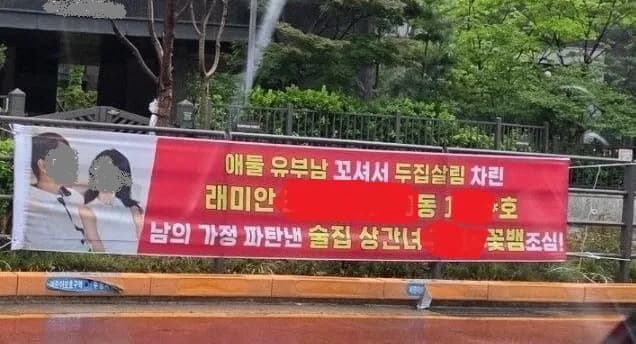
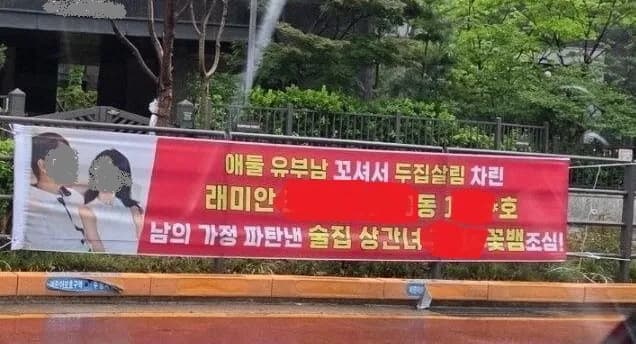
A similar banner was hung in Yeoksam-dong, in front of the Raemian apartment complex in Gaepo-dong, Gangnam-gu, which is considered one of Seoul's representative wealthy villages. A banner accusing a spouse of having an affair was hung in front of the apartment complex. An expert who saw this expressed concern about defamation to Segye Ilbo on the 24th. According to various media outlets on this day, banners accusing adultery were reportedly hung in Gaepo-dong and Yeoksam-dong in Gangnam-gu, Seoul. The banner reads, ‘No. ○○○, ○○○-dong, who has two children and seduces a married man to run two houses. It reads, ‘Kim ○○, the adulteress at a bar who ruined someone’s family, be careful of the flower snake!’ Next, as if taking into account the possibility of being sued for defamation, certain dong/housing numbers and the endings of names are marked with a star (*) in the content. Also, a banner hung in front of a building in Yeoksam-dong reads, ‘A married man with two children acts as a bachelor, lives with an adulterous woman for three years, and is shameless and shameless with no remorse.’ Likewise, the name and workplace of the man on the Yeoksam-dong banner were mosaicized. In particular, the two banners even contain affectionate photos of a man and woman believed to be having an affair. The unidentified person holding the banner covered their eyes, but bystanders appear to be able to recognize the person involved. These banners were hung at the entrance to the apartment complex and in the lane where many vehicles pass by, causing controversy as not only nearby residents but also a citizen who saw the banner posted a photo on the Internet. Regarding this banner, lawyer Kim Dong-jin of Daeryun Law Firm expressed concern to Segye Ilbo on this day, saying, “It is a requirement for establishing defamation under Article 307 (1) of the Criminal Act, and specificity is an issue.” He said, “In the case of specificity, it is recognized as a direct statement, but if the general public can know who the person is talking about through indirect information, the requirement for specificity is satisfied.” He also said, “It is somewhat difficult to predict the establishment of guilt or innocence based on the content of the banner in question.” He continued, “The banner avoids specificity by refraining from mentioning the real name and listing the last digit of the residence number in question as *. Therefore, if the other party can be sufficiently identified with the number of apartments in question and the additional information revealed in addition to the given information, this constitutes specificity in defamation.” At the same time, he advised, “In the case of defamation when the facts are stated, punishment can be avoided if it is for the public interest according to the reasons for illegality under Article 310 of the Criminal Act.” “However, in this case, it is difficult to say that it was for the public interest, so Article 310 of the Criminal Act does not seem to apply.” Reporter Lee Dong-jun (blondie@segye.com)[View full article] ‘Gangnam Gaepo Raemian affair incident’… Expert concerns about “problematic issue” (link)
Gyeonggi Ilbo
2025-06-24
남편이 횡령한 7억, 생활비로 사용한 아내 불기소…"공동정범 아냐"
Wife not prosecuted for embezzling 700 million won from husband and using it for living expenses... “I’m not a co-principal.”
The prosecution said, "The fact that the embezzled money was remitted alone does not prove prior knowledge." A, a woman in her 30s who was sent to the prosecution on charges of using company money stolen by her husband for living expenses, was cleared of charges. On the 20th of last month, the Incheon District Prosecutors' Office decided not to indict Ms. A, who was sent to the prosecution on charges of embezzlement under the Aggravated Punishment for Specific Economic Crimes Act. Ms. A was accused of conspiring with her husband, Mr. B, to embezzle 700 million won in company funds over a period of 3 years and 6 months starting in April 2021. This case began when the company, which discovered Mr. B's embezzlement, filed a complaint against Mr. A. Mr. B registered his wife, Ms. A, as an employee of the company and had her receive a remittance of 130 million won as salary. Afterwards, Mr. B, who had been embezzling company money for over three years, could not handle it and committed suicide, and the embezzlement was revealed by the company while reviewing the accounting data. During the prosecution investigation, Mr. A completely denied the charges of embezzlement. Although she acknowledged that she had received part of the embezzlement, she claimed that she had no knowledge that her husband had embezzled company funds. In addition, Ms. A said, "My husband was entirely in charge of financial management, including salaries, and the amount remitted was not large, averaging about 3 million won per time," and explained, "All the money I received was used for living expenses." The prosecution reasoned that it was difficult to prove that Ms. A was aware of the embezzlement in advance based on the fact that she received money remittances every month. The charges were dismissed. Kim Dong-jin, a lawyer at Daeryun Law Firm who represented Mr. A, said, "In order to establish a common crime, the 'subjective requirement' of committing a crime together and the 'objective requirement' corresponding to the fact that it was committed must be met. Although it is true that a certain amount of money was transferred to Mr. A's account, Mr. A convincingly demonstrated that he had no knowledge of the source or purpose of the funds and was not involved in the process of using the money at all." Reporter Jeong Ye-eun (ye9@kyeonggi.com)[View full article] Wife not prosecuted for embezzling 700 million won from husband and using it for living expenses... “I’m not a co-principal” (Shortcut)
Money Today
2025-06-24
온라인 게임 내 금전거래 위험성과 대응방법
Risks of financial transactions in online games and countermeasures
As the popularity of online games increases, the number of items and money transactions used within the game naturally increases. However, most game companies restrict cash transactions of game items, money, and accounts between users according to their terms and conditions. If caught, you may be subject to sanctions such as permanent account suspension. The reason game companies prevent the cashing of in-game assets is to avoid encouraging ‘speculative behavior.’ In particular, according to the Game Industry Act, game-related business operators must not allow or encourage gambling using games. This is because exchanging game money for cash induces excessive gambling and undermines a healthy gaming culture. As such, monetary transactions within online games are fraught with risk. Although transactions between individuals may not be illegal in themselves, they are likely to be subject to sanctions because they violate the game company's terms and conditions. In particular, caution is required as you may be punished for fraud if you make a profit through deception during the transaction process. In this regard, I will look at a case I was in charge of. The client, the suspect, was a user who enjoyed playing online RPG games and often sold game money to other users for cash. One day, the suspect made a deal with someone he met through an anonymous chat room. The other party transferred approximately 20 million won in cash to the suspect and received game money. However, the other party's game account was permanently suspended due to the game terms and conditions, which state that illegal acquisition of game money can result in sanctions such as account blocking. According to this policy, the other side, which had about 100 million won in game money and items tied up in the game, ended up making absurd demands on the suspect. He insisted on compensation in cash for 100 million won, the amount of game money tied up in his account. When the suspect refused to comply with the ridiculous demand, the other party eventually sued the suspect for fraud. To resolve the case, the first thing I did was check the game terms and conditions. According to the terms and conditions, the game company owns the cyber assets traded between the complainant and the suspect, so it was difficult to say that there was an objective transfer of value based on social norms. In addition, the complainant also knew that the use of game money could be suspended during cash transactions, so it could not be said that the suspect deceived the complainant. Thanks to the explanation of these legal aspects to the police, this case was successfully dismissed. Incidents related to virtual spaces such as games are constantly increasing. You may encounter unexpected disputes during the transaction process, but it may also happen that you do not receive legal protection. Therefore, users considering financial transactions within online games should be aware of the risks and make decisions based on sufficient information, and if they are already involved in a dispute, it is recommended that they seek out an expert who has handled many related cases. Small and Medium Business Team[View full article] Risks of financial transactions in online games and countermeasures (link)
Seoul Newspaper
2025-06-24
술자리 합석 후 “나 미성년잔데”…강제추행 혐의 40대 ‘무죄’
After drinking together, “I’m a minor”… Man in his 40s found not guilty on charges of sexual assault
A man in his 40s who was sent to trial on charges of forcible harassment after drinking with a woman without knowing she was a minor was found not guilty. This is because the court judged that the crime could not be proven due to inconsistencies in the woman's statement. According to the legal community on the 24th, the Busan District Court recently declared A, in her 40s, not guilty, who was recently sent to trial on charges of forcible harassment. In April of last year, Mr. A was summarily indicted on charges of touching the shoulders and thighs of Ms. B, a teenager she met while drinking with an acquaintance, and was ordered to be summarily fined, but he objected and requested a formal trial. During the trial, Mr. A denied the charges, saying, “I never once revealed that Ms. B was a minor.” The court ruled that Mr. B’s statement was not credible and declared him not guilty. This is because key statements, such as where the person was seated and how he or she got to know Mr. A, were different between the investigative agency and the court, and the statements were inconsistent, with content that was not said by the investigative agency being newly mentioned in the court. The court also ruled that it was difficult to say that there was proof of a crime because the people who were present at the drinking party each gave different statements about whether or not A had physical contact with B. Jang Ho-cheol, an attorney at the Daeryun Law Firm who represented Mr. A, said, “In a sex crime case, the judge must leave a reasonable doubt beyond a reasonable doubt. “If we are not sure that the indictment is true, we must judge it in the defendant’s interest,” he said. “Mr. B kept changing his statement and even asked for settlement money with his acquaintances. By explaining these strange circumstances, we were able to get a not guilty verdict.” Busan reporter Jeong Cheol-wook[View full article] After drinking together, “I’m a minor”… A person in his 40s was found not guilty on charges of forced harassment (link)
international newspaper
2025-06-23
‘고수익 코인 투자 미끼’ 사기 혐의로 송치된 50대…검찰 “불기소”
A person in his 50s was sent on charges of ‘high-profit coin investment bait’ fraud… Prosecution: “Not indictment”
Plaintiff: “Investment after receiving a promise to guarantee the principal”: “In addition to receiving the profits for a considerable period of time… the plaintiffs are acquaintances, not an unspecified number of people” A man in his 50s who was accused of stealing 100 million won by recruiting coin investors using high profits as bait was cleared by the prosecution. The Tongyeong branch of the Changwon District Prosecutors' Office on the 26th of last month decided not to indict Mr. A, in his 50s, who was transferred on charges of violating the law on the regulation of fraud and similar receiving activities Mr. A was accused of opening an anonymous chat room with an acquaintance last year and then inviting Mr. B and others to invest in stocks, promising to guarantee principal and generate high profits. The investment they received was confirmed to be over 100 million won. The victims filed a criminal complaint, claiming that only a portion of the profits were paid at the beginning of the investment, and that they did not receive the principal or the profits back thereafter. He also emphasized that Mr. A and others committed the crime by using the so-called ‘turnaround’ method of using their investment funds as profits from other investors. However, Mr. A denied the charges. He said that he only lent the account based on the words of an acquaintance, and like other victims, he had not heard anything about specific investment details or profit structure. The prosecution ruled that there were no charges. The prosecution explained the reason for non-indictment by saying, “Coins are products with very high price fluctuations, and considerable discretion is granted to the operator when purchasing or selling an item, unless specifically specified,” and “It is difficult to admit fraud charges considering various circumstances, such as the fact that the complainants also appear to have had no knowledge of specific investment items, the fact that Mr. A immediately transferred most of the money received from them to an acquaintance, and the fact that the complainants received the profits for a considerable period of time.” Mr. A's legal representative Attorney Lee Il-kwon of Daeryun Law Firm said, "In this case, Mr. A can also be seen as a victim. He believed in the words of a close acquaintance and provided investment funds, and he simply complied with all of the acquaintance's demands in the hope of receiving the proceeds." He added, "For a quasi-receipt act to be established, there must be an act of raising funds in the name of investments, etc. from an unspecified number of people, and the accusers were acquaintances such as seniors and juniors at school. They were also not invited to the chat room. “It was a structure that was inaccessible to humans,” he said. “Also, when considering repetition, continuity, and business nature, there was no evidence to comprehensively admit illegal activities, such as business registration, advertising, or investment briefings to raise funds, so the case was acquitted.” Digital Content Team[View full article] A person in his 50s was sent on charges of ‘high-profit coin investment bait’ fraud… Prosecution: “Not indicted” (Shortcut)
KBC Gwangju Broadcasting
2025-06-23
"상장 시 3배, 원금 보장"..코인 투자 권유 50대 여성 불기소
“Three times the principal amount guaranteed upon listing”... Woman in her 50s not prosecuted for recommending coin investment
The head of a multi-level sales organization, who was sent on charges of receiving investment money by recommending coin investment through an internet shopping mall, was cleared of charges. According to the legal community on the 23rd, the Jeonju District Prosecutors' Office decided not to indict A, a woman in her 50s, on charges of violating the Act on Regulation of Quasi-Receipt Activities on the 12th of last month. Person A ran a multi-level sales organization in March 2021 and received tens of millions in coin investment from victim B. In the process, Ms. A received 36 million won by promising to return the entire investment upon request when Ms. B complained about the burden of her financial situation. However, Ms. B expressed her intention to withdraw due to her husband's opposition, and when the return of the promised investment continued to be delayed, she sued them. Ms. A denied the charge, saying that the promise she made with Ms. B was not a guarantee of the investment but a guide to refunding the product. The shopping mall in question provides coins as free gifts when purchasing products. It was a payment system, but he claimed that he never recommended direct investment in coins. He said that he was also a victim who lost about 300 million won, and that he had never operated by promising principal guarantee to an unspecified number of people. The prosecution ruled that Mr. A was not guilty. In order to establish a quasi-receipt act, a 'business' agreement to guarantee the principal amount must be made to an unspecified number of people, and the 'return' mentioned by Mr. A is when the investment is withdrawn within a month to a specific person who complains of difficult circumstances. I thought the intention was to return the principal. Attorney Gwang-Woo Lee of Daeryun Law Firm, who represented Mr. A, explained, "For a crime of quasi-receipt to be committed, the key is to conduct business with an unspecified number of people," adding, "We argued that this case was only a personal promise taking into account the special circumstances of one complainant and cannot be considered a business activity as defined by the law, and this led to a non-indictment." Jeong Eui-jin (jej88@ikbc.co.kr)[View full article] “Three times the principal amount guaranteed upon listing”...Woman in her 50s who recommended coin investment not prosecuted (link)
Pharmacy Newspaper
2025-06-22
[기고] 리베이트 관련 규제 변천사 및 최신 규제 동향
[Contribution] History of rebate-related regulatory changes and latest regulatory trends
Daeryun Lee Il-hyeong, lawyer, "After the introduction of the CSO reporting system, interest in pharmaceutical companies has increased" "Establishing a sound business method - upgrading the compliance system...an essential task for sustainable development" 1. Introduction Rebates are a long-standing issue in the pharmaceutical industry, but the industry's attention is being focused again due to the government's strengthened regulations, including the recent introduction of the CSO reporting system. In this contribution, we systematically examine the historical evolution of rebate-related regulations and analyze the latest regulatory trends and future prospects. 2. Concept and characteristics of rebates A pharmaceutical rebate refers to a payment in cash or in kind by a pharmaceutical company or wholesaler to medical personnel, medical institution founders, or pharmacy operators to promote drug sales. The main forms include ▲supporting expenses for hospitals and clinics to attend overseas training and seminars ▲free supply of medicines to open hospitals and clinics ▲provision of in-kind items such as office equipment. The characteristic that distinguishes rebates in the pharmaceutical field from other industries is the strength of their regulation. Rebates are common not only in the pharmaceutical industry but also in other industries, and are subject to a certain level of regulation under the Fair Trade Act. However, due to its special nature in the pharmaceutical field, a multi-layered and strengthened regulatory system is applied, including the Fair Trade Act, Pharmaceutical Affairs Act, Medical Services Act, and drug price-related laws. 3. History of regulatory evolution: Step-by-step flow of strengthening Looking at the history of rebate-related regulations, we can see a clear trend in which the type and intensity of regulations have been continuously strengthened along with the growth of the pharmaceutical market. ▶ Stage 1: Early regulations centered on the Fair Trade Act (until the early 2000s) In the early days, regulations were mainly implemented by applying the Fair Trade Act to prohibit acts of enticing competitors' customers to do business with them by providing unfair or excessive profits in light of normal practices. ▶ Step 2: Introduction of the rebate-drug price reduction linkage system (2009) From August 1, 2009, the Ministry of Health and Welfare will implement the 'rebate-drug price reduction linkage system' as a means to eliminate the bubble in drug prices caused by rebates and eradicate rebates. However, this system was widely criticized as being unreasonable in administration, and, crucially, as cases of courts canceling dispositions continued to emerge, the system experienced ups and downs in the form of changes along the way. Nevertheless, similar systems continue to be implemented to this day. ▶ Step 3: Introduction of the rebate dual punishment system (2010) As rebates were not eradicated, the government introduced the ‘rebate dual punishment system’ in May 2010. The dual punishment system for rebates refers to ‘a system that punishes both those who provide and those who receive illegal rebates in the trade of drugs and medical devices’ (refer to the Ministry of Health and Welfare’s pharmaceutical policy website). The legislative history of the introduction of the dual punishment system is as follows. • July 1992: Prohibition of ‘providing prizes related to pharmaceutical transactions’ • December 2008: Prohibition of illegal rebates in the pharmaceutical sector • May 2010: Introduction of a dual punishment system that punishes kickback recipients ▶ Stage 4: Strengthening of administrative disposition standards (2011-2013) ∙ June 2011: Ministry of Health and Welfare Ordinance No. 62 In the revised 「Medical Related Administrative Disposition Rules」, standards for sanctions are established based on the results of criminal dispositions (refer to Seoul Administrative Court's 2017 Guhap 3526 ruling on December 14, 2017) ∙ April 2013: Additional strengthening of standards for administrative dispositions (suspension of qualifications and work suspension) (refer to the Ministry of Health and Welfare Pharmaceutical Policy website) ▶ Step 5: Implementation of the CSO reporting system (2023) On April 18, 2023, Article 47 of the Pharmaceutical Affairs Act was further revised, and the CSO reporting system, which includes provisions such as 'prohibiting entrustment of pharmaceutical sales promotion work to persons other than pharmaceutical sales promotion operators,' came into full effect. 4. Latest regulatory trends: Joint crackdowns become routine. What is noteworthy in the latest regulatory trends is that government management is becoming more tight. Currently, kickback investigations are not simply conducted by investigative agencies such as the police or prosecutors, but have the following characteristics. ▲Joint investigation: Generalization of joint investigation between related agencies such as prosecutors, police, Health Insurance Review & Assessment Service (HIRA), National Health Insurance Corporation, Ministry of Health and Welfare, etc. ▲Multi-faceted detection: Expanding the method of capturing rebate circumstances during the tax investigation process and handing over the case to related agencies ▲All-round surveillance: Establishment of a system for detecting rebates through various channels such as insider tip-offs 5. Future outlook and conclusion If we summarize the history of regulatory changes above, The government's consistent position regarding rebates focuses on 'strengthening regulations', and it seems very unlikely that this trend will be reversed in the future. Therefore, although it may be a bit cliché, pharmaceutical companies are likely to face greater difficulties if they do not fundamentally improve their constitution beyond simply responding one-time whenever an issue arises. Establishment of a sound business method that does not rely on rebates and advancement of the compliance system are emerging as essential tasks for the sustainable development of the pharmaceutical industry. Next, we plan to cover it in more depth, including a summary of punishment cases.[View full article] [Contribution] History of rebate-related regulatory changes and latest regulatory trends (link)
Korean economy
2025-06-22
가맹점 접고 바로 옆에 새 매장?…'경업금지조항' 따져 봤나요 [대륜의 Biz law forum]
A franchise store closes and a new store opens next door? Have you considered the ‘non-competition clause’? [Daeryun’s Biz law forum]
Based on precedents of controversy over clause validity after contract termination 3There is a need to reach a balanced agreement from the beginning when all requirements are met. This is a scene we often see in franchise contract disputes.. This is a case where, after the contract is terminated, the franchise operator simply changes the sign at the existing business location and resumes business in a similar business or opens an independent store in a nearby area.. At this time, the franchise headquarters "Violated the non-competition clause in the contract."He said he is taking legal action., Affiliate store operators "The contract is over, what's the problem?"They fight back. At the center of the conflict 'Non-competition clause'This is in place. Is this clause valid even after the contract ends?? By what standard does the court judge?? Non-competition clause, Is the contract valid even after termination? Act on Fairness of Franchise Business Transactions(below 'Franchise Business Act') 6article 10Ho prohibits franchise operators from engaging in the same business as the franchisor during the period of the franchise contract.. This is to protect the operating profits of the franchise headquarters and maintain order in the franchise business.. There is similar content in the standard restaurant franchise agreement established by the Fair Trade Commission.. This is a clause that states that during the contract period, the franchisee cannot engage in the same business directly or through a third party without permission from the franchisor..The problem is after the contract ends.. Provisions prohibiting competition for a certain period of time even after the contract is terminated or terminated are constitutionally guaranteed. 'freedom of career choice'may directly collide with. Accordingly, the court applies fairly strict standards to the validity of the non-compete clause after termination of the contract.. Among the lower courts "Even if the franchise operator sets a non-competition period in accordance with the agreement with the franchisor, the type of franchise business, The role and proportion of franchise headquarters in the business operation process, After termination of the contract, the validity of the agreement must be determined based on whether there are interests of the franchise that are valuable enough to be protected by a non-competition agreement, taking into account all circumstances, such as the risk of trade secrets being leaked by the franchise operator or the possibility of misappropriation of the existing commercial area.. In addition, the person claiming it has the burden of proving all the circumstances that can recognize the validity of the above non-competition agreement."There is a ruling that said(2021year 7month 7Busan District Court 2020Gahap46673 judgment). The court's general position is that in order for a ban on competition to be recognized as valid, the following three conditions must be met:.first, There must be a legitimate interest for the franchisor to protect.. If the headquarters simply provided the right to use a trademark or general operating guidelines, such information is in the public domain and cannot be considered a level of benefit that justifies a ban on competition.. On the other hand, differentiated recipes, Independent marketing strategy, If educational materials that are trade secrets are passed on, the value of protection is recognized.. In this regard, Daegu District Court(2022me329254, 2023year 5month 10sentencing)The industry in which franchise operators are subject to a non-competition obligation is sweet and sour pork., Jjajangmyeon, In Saan, a widely known food sales business such as Jjambbong, restaurant business using such menus cannot be seen as being based on the franchisor's original ideas or know-how., It has been determined that the information provided by the franchisor to the franchisee according to the franchise agreement is not known to competitors and therefore cannot be considered a trade secret worthy of legal protection..second, The period, region, and scope of industry subject to competition ban must be reasonable.. generally 1period of less than a year, Existing store radius 1~3㎞ area within, Restrictions within the same industry are customarily permitted.. Beyond this, nationwide, 3more than a year, If it is set to encompass a wide range of industries, the court is likely to deny its effectiveness.. Suwon District Court(2023Gahap18730, 2024year 12month 18sentencing)After the franchise agreement ends 1Concerning the contract clause prohibiting management, investment or advice in the same industry in the name of oneself or a family member in any region of the country for one year. "The terms and conditions are unfair and invalid because they broadly restrict franchisees’ freedom of occupation."I decided.third, Whether compensation was provided to the franchise operator is also an important factor.. If a certain amount of compensation is paid in exchange for restricting business for a certain period after the termination of the franchise agreement, or if a structure is in place to compensate for the franchisee's losses, the legitimacy of the prohibition of competition is further strengthened.. Non-competition clauses must be carefully reviewed before concluding a contract. In light of these standards, franchise operators need to closely review the non-competition clause in the contract before concluding a contract.. In particular, if post-termination restrictions are included, you should check in advance whether it will conflict with the business model or industry you envision in the future.. simply "It’s irrelevant because the contract is over."It is dangerous to make a judgment like this., This may lead to civil liability such as penalties or compensation for damages..It is also undesirable for franchisors to establish unreasonably broad and long-term bans on competition.. Excessive restrictions may not only be legally invalid, but may also have a negative impact on brand image.. Damaging the trust relationship with franchise operators, There is a high risk of causing unnecessary disputes.. The non-competition clause depends on the characteristics and level of know-how of the relevant franchise business., It must be set within a reasonable range by comprehensively considering the franchise business type, etc.. The non-compete clause is an important element that constitutes the essence of a franchise business.. If a franchise operator accumulates various know-how while doing business based on the systematic support and brand value of the headquarters, and uses this as is to start a similar business after the contract ends, it will be a huge loss to the headquarters.. This goes beyond simple freedom of business and acts as a serious problem that can undermine the order of the entire franchise contract..At the same time, this does not justify unconditional bans and broad restrictions.. The effect of the non-competition clause is 'rationality'class 'righteousness'It operates on two axes:, The judgment always depends on the facts of each individual case.. The important thing is that both parties are fully aware of their respective rights and obligations at the time of entering into a contract and then agree to fair and balanced terms.. Furthermore, it is also necessary to receive assistance from a legal expert as a preventive measure before a dispute occurs..Considering that franchise business is structured based on long-term trust and cooperation, non-competition clauses should be understood not as simple restrictions but as a device for the sustainability of partnerships and a fair competitive order.. We hope that both franchisors and franchise operators will create a more transparent and sound franchise business culture based on this awareness.. [View full article] A franchise store closes and a new store opens next door? Have you considered the ‘non-competition clause’? [Daeryun’s Biz law forum] (Shortcut)
KBC Gwangju Broadcasting
2025-06-20
지인에 판 건물이 전세사기?..전 건물주 40대 불기소
Was the building sold to an acquaintance a lease scam? Former building owner in his 40s not indicted
A man in his 40s, who was accused of conspiring with an acquaintance to commit a rental fraud against tenants, was not indicted. According to the legal community on the 20th, the Seoul Central District Prosecutors' Office announced that it had decided not to indict Mr. A, a man in his 40s who was sent on fraud charges on the 22nd of last month. Mr. A, who had purchased and operated a building since 2016, sold it to Mr. B, an acquaintance, in 2023. At that time, Mr. A to Mr. B. A condition was put forward to take over the debt for the return of 2.1 billion won in jeonse deposit, and Mr. B also accepted this, and the transaction was concluded. However, 7 months after purchasing the building, Mr. B applied for personal rehabilitation, and the investigation began when he was unable to pay the jeonse deposit to the tenants. The tenants made Mr. A sign a contract by reducing the senior deposit at the time of the jeonse rent contract and swindled the deposit, turning the building into a 'can jeonse'. He claimed that he sold it to Mr. B at a low price. Although it is true that a mistake was made in the process of notifying the senior deposit, Mr. A denied the charge, saying that the brokerage real estate agent was also negligent in not clarifying the relevant amount and that there was no intent to defraud him. Regarding the charge of jeonse fraud, he said, "Mr. B personally showed me his salary statement at the time and the bank loan was obtained normally, so I could not doubt his financial ability," and claimed, "If Mr. B's financial condition had not been good, he would not have sold the building." The prosecution accused Mr. A of “There was negligence in reducing the senior deposit, but considering that Mr. A had sufficient cash assets to prepare for the return of the deposit and had a high level of income when he owned the property, it is difficult to conclude that it was intentional defrauding.” Attorney Park Seong-yoon of Daeryun Law Firm, who represented Mr. A, said, “In a general lease relationship, it cannot be said that there is an obligation to notify the existence of a senior lien right,” and “In this case, Mr. B has a property other than Mr. A’s building. He explained, "We achieved revival by purchasing additional buildings for a long time, and Mr. A actively explained to the tenants that there was no intention to deceive them at the time of signing the contract, which led to a good result." Jeong Eui-jin (jej88@ikbc.co.kr)[View full article] Is the building sold to an acquaintance a lease scam?..Former building owner in his 40s not indicted (link)
Have more questions?
Quick Menu

KakaoTalk