Page title background (PC version)Page title background (mobile version)

Press Coverage

Numerous media outlets recognize the expertise of Daeryun Law LLC.
Explore interviews, legal commentary, and columns by Daeryun lawyers.

international newspaper
2025-06-16
명의 도용당해 실행된 대출, 상환 독촉에…法 “본인확인의무 지켰어야”
A loan taken out with stolen identity and a demand for repayment... Law: “Identity verification obligation should have been observed”
The court ruled that if a loan was made under a stolen name, the financial company that did not properly verify identity was responsible. On the 15th of last month, the Western Branch of the Busan District Court ruled that the plaintiff lost in a lawsuit filed by a credit card company against Mr. A, a man in his 60s, on the 15th of last month on the 15th of last month. He collapsed while working and was taken to the hospital, but did not fully regain consciousness and was diagnosed with severe disability. Afterwards, the children began managing Mr. A's cell phone for industrial accident insurance processing, but a problem arose when one of the children received an unauthorized loan of about 35 million won in Mr. A's name. The child issued a card and received a loan in Mr. A's name, and when this fact was discovered, he wrote an IOU to repay the loan to Mr. A and his wife. However, the card company gave Mr. A a loan. A reminder was sent to repay the loan. Even if the child's identity was stolen, the loan amount was transferred to an account in Mr. A's name after an identity verification process through a mobile phone, so Mr. A should be regarded as a loan contract pursuant to Article 7, Paragraph 2, Item 2 of the Framework Act on Electronic Transactions. Accordingly, Mr. A's side emphasized that Mr. A had been unable to communicate long before the loan contract was executed, and that the deposited loan money was also immediately transferred to the child's account. The court ruled in Mr. A's favor. The court said, “A contract is established by the agreement of the parties, but considering the defendant’s state of consciousness at the time of the loan, it is recognized that the defendant’s identity was stolen, so the contract was not established.” “Even if Mr. A and his wife allowed their children to use mobile phones, it cannot be seen that they agreed to proceed with the identity verification process or even accepted the results arising from it.” It continued, “Authentication through mobile phones is not a complete means of ensuring reliability and stability,” and “The plaintiff properly fulfilled its obligation to verify identity.” He added, “It is reasonable to say that it was not implemented.” Attorney Son Yun-jeong of Daeryun Law Firm, who represented Mr. A, explained, “If a financial institution shifts responsibility for a financial accident to the customer just because it has gone through a formal non-face-to-face real name verification, it could lead to an unfair result of reducing the duty of care regarding identity verification for non-face-to-face transactions.” Digital Content Team[View full article] A loan taken out with stolen identity and a demand for repayment... Law: “Identity verification obligation should have been observed” (Shortcut)
2 places including Laurider
2025-06-16
[기고] 기업 면죄부가 된 국가 인증, ‘진짜 책임’을 위한 법이 필요하다
[Contribution] National certification has become a corporate impunity; a law is needed for ‘real responsibility’
Following SK Telecom, suspicions of personal information leakage were also raised at YES24. YES24 stated that “there was no personal information leakage” immediately after becoming aware of the ransomware attack on the 9th, but the seriousness of the matter was revealed when the Personal Information Protection Committee detected abnormal member information inquiry circumstances and began an investigation. This incident is not limited to a simple hacking incident. Repeated personal information leaks raise fundamental questions about the actual responsibility of major domestic companies for personal information protection and whether the institutional response system is functioning properly. In particular, both SK Telecom and YES24 had received government-run ISMS (Information Security Management System) or ISMS-P (Integrated Certification for Personal Information Protection) certification. ISMS-P is a system that examines and certifies that a company has certain managerial and technical protection measures in place. However, this system does not evaluate whether a hacking incident occurred or whether the company fulfilled its actual responsibilities after the incident. The damage relief system and practical measures to prevent recurrence are unrelated to the validity of certification. As a result, as long as the requirements are met, the certification is maintained. The problem is that this certification is easily abused by the company's logic of immunity after the accident, saying, “We were operating a system that was certified by the government.” Certification for prevention and strengthening responsibility is actually used as a tool for ‘fulfilling formal responsibility’ when an accident occurs. The certification system is functioning differently from its original intent. If we are relying on a system that neither prevents accidents nor strengthens responsibility, citizens will inevitably end up thinking, “National certification does not protect me.” The system exists, but its effectiveness is weak, and the problem is even more serious in that it is a structure that allows companies to avoid responsibility even after an accident occurs. Overseas are different. A U.S. federal court ordered Israel's NSO Group to pay approximately $167 million in punitive damages in a case involving unauthorized infringement of WhatsApp users' devices. US telecommunications company T-Mobile also paid a multi-million dollar class action settlement after a large-scale personal information leak. The law and system are structured to actually hold companies accountable. On the other hand, Korea is still limited to mild punishment. This is because administrative fines, corrective orders, and formal supervision are all that are involved. In civil lawsuits, the burden of proof is excessively placed on the victim, and the level of compensation is far from reality. A more serious problem is that some media outlets and large law firms are spreading the logic that "claiming compensation for personal information leaks is of no use," creating an atmosphere that causes citizens to give up exercising their rights. In order to crack this structure, Daeryun Law Firm is pursuing class action lawsuits against large corporations for personal information leaks. This decision is by no means a favorable choice if viewed solely from the profit logic of the legal market. However, since its establishment, Daeryun has placed the reason for the existence of legal services not on ‘profit’ but on ‘practical realization of citizens’ rights.’ This class action lawsuit is also an extension of that. Daeryun dispersed the legal market centered on the metropolitan area to a regional basis and established a nationwide branch office so that all citizens can receive high-quality legal services. We partnered with large law firms in the U.S. and Japan to incorporate advanced legal systems in Korea, and introduced a customer service system (AS system) that allows for customer satisfaction surveys, replacement of lawyers, and even refunds. This SK Telecom class action lawsuit is also an exercise to prove that such a structural experiment is feasible in reality. There is no reason why the personal information of Korean citizens should be less important than that of American or European citizens. What is needed now is the introduction of a punitive damages system, strengthening the effectiveness of the class action system, and establishing a legal foundation that can lead to actual corporate responsibility. The court must also present clear standards and a strong message so that companies accept personal information protection as the ‘essence of management’ rather than an ‘optional’. This lawsuit is not just a case asking for the legal responsibility of one company. This should be the starting point for laws and systems to officially declare that personal information is a fundamental right under the Constitution, not subject to technical management. Personal information is a valuable asset. The rights of the people should never be given away at a cheap price.[View full article] Law Leader - [Contribution] National certification has become a corporate impunity, a law is needed for ‘real responsibility’ (link) Korea Law Daily - [Contribution] National certification has become a corporate impunity, a law is needed for ‘true responsibility’ (link)
Seoul Economic Daily
2025-06-15
10곳 중 1곳 중도 사퇴…상법 개정 추진에 커지는 ‘사외이사 기근’ 우려[안현덕의 LawStory]
1 out of 10 companies resign midway... Concerns over ‘famine of outside directors’ growing amid push for commercial law revision [Ahn Hyeon-deok’s LawStory]
This year, 119 companies left their positions mid-term. With more than a year left in office, the risk of lawsuits has risen due to the revision of the Commercial Act. Small and medium-sized companies may face an environment where reappointment is difficult as compensation is not high. It was found that an outside director resigned mid-term at one of the 10 KOSDAQ listed companies this year. Most of them resigned from their positions as outside directors with more than one year remaining in their term due to personal reasons. As discussions on amending the Commercial Act to expand the scope of director loyalty obligations from companies to shareholders are in full swing, there are concerns both inside and outside the legal community that a “starvation” of outside directors may occur in the future. If the revision of the Commercial Act becomes a reality, outside directors may avoid taking on the role of outside directors as the burden of judicial risk increases. According to electronic disclosure on the 15th, there are 119 KOSDAQ-listed companies where outside directors resigned this year with one year remaining in their term of office. Considering that there are a total of 1,791 KOSDAQ listed companies, in one out of 10 companies, an outside director resigned from his position without completing his term. In particular, many of them resigned from their positions as outside directors within a month or two of being appointed. According to Article 382 of the Commercial Act, an outside director is a director who is not engaged in the management of the company (a director who handles and executes daily business at a company, etc.). △The largest shareholder, his or her spouse, lineal ascendants, and descendants △Directors, auditors, and executive officers who have been engaged in the company's management within the past two years △Directors, auditors, and executive officers of the company's parent company or subsidiary, etc. cannot be appointed. The purpose is to prevent the arbitrary management and tyranny of the major shareholder in advance by allowing external personnel unrelated to the largest shareholder to participate in the board of directors. Depending on the size of the company's assets, etc., it must be more than one-fourth (three or more) of the total number of directors, but it must be a majority of the total number of directors. If this is violated, a fine of up to 50 million won will be imposed. The problem is that, with the number of outside directors retiring during their term, especially at KOSDAQ listed companies, discussions are underway to amend the Commercial Act to expand the scope of directors' loyalty obligations from the company to shareholders. Experts believe that if the commercial law amendment passes the National Assembly, the judicial risk of outside directors may increase. This is because shareholders can file civil and criminal lawsuits against outside directors regarding matters resolved by the board of directors, including mergers, personal and material divisions, and new stock listings. Choi Seok-gyu, an attorney at Dongin Law Firm, analyzed, "If the commercial law amendment is passed through the plenary session of the National Assembly, sound companies will not face a significant burden, but companies with weak financial structures may face the risk of increased lawsuits." He added, “The amendment to the Commercial Act is a structure that allows (shareholders) to file lawsuits directly against internal and external directors,” and added, “As there is no need to increase risk (on one’s own) in a situation where the remuneration is not high, it is unlikely to be easy to find outside directors in the future.” Under commercial law, even if an outside director causes a loss to the company, the liability is reduced by 3 times (6 times for inside directors) the amount of remuneration for the most recent year. However, because the compensation itself is not high, candidates for outside directors may choose not to take on the judicial risk arising from the revision of the Commercial Act rather than bear it. Bang In-tae, an attorney at Daeryun Law Firm, also pointed out, "After the revision of the Commercial Act, even if an (outside) director's work performance does not cause damage to the company, some shareholders may interpret the decline in the stock price itself as a violation of the duty of loyalty." He also pointed out, "The principle of management judgment that reduces directors' liability in determining directors' liability for damages or breach of trust may no longer be possible." He added, "As legal risks increase, directors' decision-making and other work performance may have greater incentives to be conservative and safety-oriented. Not only will it be difficult to find outside directors, but their compensation may also rise further." Legal reporter Hyeondeok Ahn (always@sedaily.com), Reporter Jonghyun Lim (s4our@sedaily.com)[View full article] 1 out of 10 companies resign midway... Concerns over ‘famine of outside directors’ growing amid push for commercial law revision [Ahn Hyeon-deok’s LawStory] (link)
Gangwon Ilbo
2025-06-15
[월요칼럼]이혼과 졸혼, 당신의 선택은?
[Monday Column] Divorce and divorce, what is your choice?
While handling various divorce cases, I have some particularly memorable clients. These are people who are over 60 years old and come to see me saying, “I can no longer live with my spouse.” The reasons for deciding to divorce only after the children have all grown up are varied, such as the spouse's continuous cheating, domestic violence and verbal abuse, extreme pressure to save money, and the breakdown of the marriage due to conflict between the mother and father. However, in most cases, they have endured for a long time to protect their families. Recently, not only celebrities and famous people, but also ordinary couples often choose to divorce after reaching their twilight years to live their own lives by separating from their spouses. 'Graduation marriage' is a legal term. It is not a concept, but maintaining a legal marriage relationship under mutual agreement between the couple, and living each other's lives without interfering with each other's lives, literally 'graduating from married life'. Divorce is presented as an alternative to divorce, which inevitably involves a process of battle and defense, but an accurate understanding of this is necessary because it does not usually require division of property or claims for alimony like divorce, which is a legal procedure. Even if a spouse has been a housewife all her life and has only done housework, if she proceeds with a twilight divorce, both spouses can cooperate to achieve divorce. The right to claim property division for joint property is recognized, and an average of 50% of the property can be divided depending on the degree of contribution to property formation. In particular, if the other party has the right to receive a pension, according to Article 45 of the Civil Service Pension Act and Article 64 of the National Pension Act, if a person who has been married for more than 5 years divorces, he or she can claim an amount divided equally between the pension amount corresponding to the marriage period. This can be decided differently during the divorce process through negotiation and trial, so in old age when income decreases after divorce. It can serve as a living aid. In principle, the subject of property division corresponds to property formed through joint efforts during the marriage period. However, even in the case of unique property inherited by a spouse, if he or she contributed to the maintenance or increase of the property, it is advantageous to divide the property according to the degree of contribution. The right to claim alimony is the right to claim compensation for mental suffering suffered by one spouse due to the illegal acts of the other spouse responsible for the breakdown of the marriage. In Article 840 of the Civil Code, the spouse's misconduct, It stipulates six types of judicial grounds for divorce, including malicious abandonment and other serious reasons that make it difficult to continue the marriage, and alimony can be claimed in a divorce lawsuit or mediation by alleging the tort of the at-fault spouse. However, in the case of a graduate marriage, unlike the property division or claim for alimony upon divorce, since the couple maintains a legal marriage relationship, if the couple has agreed on the division of property at the time of the divorce, this is merely an agreement between the parties as a property contract during the marriage. Therefore, if details are not specified, written in ambiguous language, or not notarized, it can become the spark of another dispute in the future. If you live separately during the period of graduation and eventually get divorced, the period of marriage itself may not be recognized as the actual period of marriage. Conversely, the spouse who took advantage of the fact that the legal marriage was maintained may claim alimony by claiming that the other party violated the duty of chastity, and may be placed at a disadvantage in future divorce lawsuits. In addition, since you may become a defendant in an adultery lawsuit after dating someone who graduated from marriage, you should first think carefully about the disputes that result from graduating from marriage. Although the couple can no longer live together due to an insurmountable conflict, there may be various reasons that third parties are not aware of that prevent them from legally getting divorced. However, careful attention is needed to ensure that graduation is a happy marriage and that it does not become a means for one spouse with an economic advantage to escape.[View full article] [Monday Column] Divorce and divorce, what is your choice? (Shortcut)
15 places including Maeil Business Newspaper
2025-06-13
[단독]‘예약 10분 지나면 환불 불가’ 야놀자 규정 제동…법원 “전액 환불하라”
[Exclusive] Yanolja suspends its policy of ‘no refunds after 10 minutes of reservation’… Court: “Give a full refund”
After requesting cancellation 2 hours after booking a hotel accommodation product, Yanolja was informed that ‘no refund will be given after 10 minutes’. Both sides rejected the decision to recommend a settlement and ‘refund half of the accommodation fee’, leading to a formal trial. First trial “Unfair terms and conditions unfavorable to the customer are invalid.” The court ruled that the terms and conditions of the accommodation reservation platform, which stipulated that refunds are not possible if cancellation is not made within 10 minutes after completing the reservation, were unfair and invalid. The court ruled that even if an accommodation reservation platform is simply a mail-order intermediary, legal liability can be recognized if it unfairly sets refund regulations that are unfavorable to consumers. According to the legal community on the 13th, Chief Judge Ha Hyun-guk of the Seoul Central District Court Civil Division 1002 ruled in favor of the plaintiff on the 11th in a lawsuit filed by consumer A against the accommodation reservation platform ‘Yanolja’. The court sentenced the defendants, including Yanolja, to refund the entire lodging fee to Mr. A. Mr. A made a reservation for a hotel accommodation worth about 660,000 won through the Yanolja app in 2023 and requested cancellation of the reservation about 2 hours later. However, Yanolja rejected this based on refund regulations. The refund policy includes the following: ‘Cancellation of a reservation is only possible within 10 minutes, and if it exceeds 10 minutes, a cancellation fee equivalent to 100% of the reservation fee will be incurred.’ The hotel that sold accommodation products through the Yanolja app also did not accept Mr. A’s request for a refund. The hotel argued that since the reservation was made through a lodging platform rather than the hotel's official website, it was not the party that directly entered into the reservation contract, so it had no right to cancel and no responsibility for a refund. Accordingly, Mr. A filed a lawsuit in this case. During the trial, Mr. A argued that Yanolja's regulations regarding refund penalties were invalid as they violated the Electronic Commerce Act and the Terms and Conditions Act. Article 17 of the Electronic Commerce Act stipulates that ‘Consumers who purchase goods, etc. from a mail order seller may withdraw their subscription within 7 days from the date of receiving a written letter regarding the contents of the contract.’ In addition, Article 6 of the Terms and Conditions Act stipulates that ‘any provision that is unfavorable to the customer is presumed to have lost fairness and is invalidated.’ However, Yanolja countered that ‘since it is only a mail-order intermediary, not a mail-order seller, it cannot be considered subject to the law, so it is not responsible for a refund.’ The first trial court accepted Mr. A’s argument and ruled in favor of the plaintiff. Chief Judge Ha said, “It is reasonable to say that ‘Nol Universe,’ which merged with Yanolja, is a mail order seller or a mail order intermediary,” and added, “The refund policy in this case is invalid as it is unfair terms and conditions that are unfairly disadvantageous to customers.” Regarding the hotel, he said, “The hotel claims that it is not the person who made the reservation for Mr. A and that it is not the person who received the payment from Mr. A. However, according to the evidence, the hotel receives a certain percentage of the payment from Nol Universe every month. He added, “The facts are acknowledged,” adding, “He falls under the category of ‘a person who has received payment from a consumer’ as defined in Article 18, Paragraph 2 of the Electronic Commerce Act.” Previously, in November of last year, the court made a decision to recommend reconciliation, saying, ‘The defendants should join together and pay half of the lodging fee to Mr. A.’ However, both sides rejected this, leading to a formal trial. Daeryun Law Firm, which represented Mr. A, said, “We would like to thank the court for ruling that Yanolja’s cancellation fee agreement was unfair,” and added, “We expect that this ruling will serve as an opportunity to put a brake on some unfair refund regulations such as online lodging platforms.” Reporter Park Min-ki (mkp@mk.co.kr)[View full article] Maeil Business News - [Exclusive] Yanolja’s policy of ‘no refunds after 10 minutes of reservation’ is broken… Court: “Refund the full amount” (Shortcut) Korea Economic Daily TV - Yanolja struck down by the court... Accommodation cannot be canceled 10 minutes after reservation. “It’s unfair.” (Shortcut) Edaily - Yanolja "No cancellation after 10 minutes"... Law “Applicable to unfair terms and conditions” (link) Segye Ilbo - Yanolja, which introduced unfavorable terms and conditions for customers, saying, “cancellation is not possible after 10 minutes,” was eventually withdrawn (link) Hankyoreh - Yanolja loses case after refusing to refund 650,000 won in hotel fees 10 minutes after reservation (Click here) Legal Times - [Civil Affairs] ‘No refunds after 10 minutes of reservation’ Yanolja terms and conditions invalid (link) Daily An - Yanolja refuses refund 10 minutes after reservation... “Losing” (Shortcut) Digital Today - Court, Yanolja unfair ruling that refunds are not possible after 10 minutes... Noluniverse "Immediate appeal" (Shortcut) News Tomato - Yanolja announces appeal against loss in lodging refund lawsuit (Go here) Money Today - “It’s been 10 minutes since you made your reservation? No refund”… Yanolja's terms and conditions are declared invalid by the court (Shortcut) Jemin Ilbo - Yanolja, ruling that no refund within 10 minutes rule is unfair (link) Hankook Ilbo - Court "No refunds allowed 10 minutes after the reservation for 'Yanolja' is completed is invalid" (Shortcut) Roisch - Court “Accommodation cannot be canceled 10 minutes after reservation… Unfair terms and conditions unfavorable to customers” (link) TV Chosun - Court "No refunds after 10 minutes of reservation for 'Yanolja' is invalid" (Shortcut) Daily Pop - [News Zoom-in] Legal battle over 'Yanolja' refund terms and conditions 'unfair' ruling... Brokerage platform vs lodging company, who decides on 'refund'? (Shortcut)
9 places including financial news
2025-06-13
대륜, ‘SKT 해킹’ 공동소송 2차 접수…“손해배상 인정 가능성 충분”
Daeryun files second joint lawsuit over ‘SKT hacking’… “There is sufficient possibility of compensation for damages”
In the second round, 331 civil cases and 43 criminal cases were added... A total of 637 people participated in the first and second civil and criminal investigations. SKT's negligence was objectively revealed... Daeryun law firm is taking full-fledged legal action by filing a second criminal complaint and complaint on behalf of the victims and filing a civil suit on behalf of the victims in relation to the SK Telecom (SKT) SIM information hacking incident. Daeryun Law Firm is representing 43 victims secured through the second internal recruitment on the 5th of this month following the 1st of last month, and Yoo Young-sang representing 43 victims. A criminal complaint was filed against SK Telecom's CEO and those responsible for security at Namdaemun Police Station in Seoul. The contents are the same as the first, including charges of breach of trust and obstruction of business, and the key point is that the company neglected its information protection obligations as a telecommunications company. Then, on the 12th, Daeryun filed a second civil damages claim with the Seoul Central District Court on behalf of 331 victims. As a result, a total of 581 people, including those who participated in the first civil lawsuit filed on the 27th of last month, have participated in the process of seeking civil and criminal liability through Daeryun. The civil lawsuit claim amount is 1 million won per person. Amid continued criticism that SK Telecom's poor security management, such as non-encryption of SIM card information, non-preservation of server logs, and lack of security investment, contributed to the accident, attention is focused on the level of disciplinary action ahead of the announcement of the final investigation results of the SK Telecom public-private joint investigation team into the infringement accident. As a result of the investigation team's additional investigation, it was confirmed that over 290,000 pieces of sensitive information, including unique device identification numbers (IMEI), were stored on the hacked server, and the situation is rapidly spreading. Daeryun is taking legal action by establishing a system led by the 'Special Enforcement Headquarters (Special Department)', which is composed of attorney Cho Young-gon, a former chief of the Seoul Central District Prosecutors' Office, and attorney Yeo Sang-won, a former Supreme Court trial researcher. Attorney Yeo explained, “There were a huge number of victims, and in the process of dealing with the damage, we plan to actively assert the direct and additional damage caused by SK Telecom’s efforts to conceal the hacking, as well as the victims’ anxiety about their information being exposed.” Attorney Yeo also refuted some of the skeptical views surrounding this lawsuit. It is not right to unconditionally deny the possibility of winning the case simply because there is no precedent for punitive damages being recognized in relation to personal information infringement incidents. Attorney Yeo said, “This is an unusual case in which SK Telecom’s serious negligence was objectively revealed,” and “If the results of the investigation by the public-private joint investigation team, which will be announced later, are used as proof, liability for damages may be acknowledged.” Attorney Young-gon Cho said, “Sensitive information stored on a hacked server can be seen as the basis for mass hacking.” He added, “IMEI, ICCID, etc., which appear to have been leaked in this incident, can lead to financial fraud, identity theft, and invasion of privacy.” “The leak itself not only poses a serious risk, but also causes psychological damage to individuals,” he said. He added, “The Constitution and the Personal Information Protection Act make it clear that the responsibility for preventing the possibility of damage lies with the business operator. The reasons why victims have been disadvantaged in class action lawsuits are the asymmetry of technical information, the passivity of the judiciary, and the structure of burden of proof. As Daeryun recognizes this case as a public interest lawsuit to protect the rights and interests of the entire public, it holds companies accountable and victims are entitled to rights. “We will respond thoroughly to help you recover,” he added. Meanwhile, Daeryun plans to continue recruiting victims and begin filing additional complaints sequentially. In addition, we plan to carry out follow-up procedures, including securing evidence of SK Telecom's intentional or gross negligence, following the investigation team's final announcement. Reporter Park Jae-gwan (paksunbi@fnnews.com)[View full article] Financial News - Daeryun files second joint lawsuit over ‘SKT hacking’… “There is sufficient possibility of compensation for damages” (Shortcut) Roishu - Daeryun files second joint lawsuit over ‘SKT hacking’… “There is sufficient possibility of compensation for damages” (Shortcut) Newsis - 331 SKT users additionally participate in lawsuit against 'USIM hacking'... Increased to 580 people (Shortcut) Asia Economy - Daeryun "SKT hacking damages of 1 million won each... A total of 580 people applied" (link) Korea Economic Daily - Daeryun files second joint lawsuit over ‘SKT hacking’… “There is sufficient possibility of compensation for damages” (Shortcut) Tax and Finance News - Daeryun ‘SKT hacking’ joint lawsuit 3rd round of recruitment accepted... 637 people participated until the 2nd round (link) Wide Economy - 331 SKT users additionally participate in 'USIM hacking' lawsuit... Increased to 580 people (Shortcut) Point Daily - SK Telecom's 'Son Complaint' Participation Doubles in Boreumsae (Shortcut) The Fact - 580 victims of 'SKT hacking' sued for damages worth 1 million won per person (link)
Gyeonggi Ilbo
2025-06-13
하청업주에 사망 노동자 합의금 변제 요구한 업체…법원 "기각"
A company demanded payment from a subcontractor for settlement money for a deceased worker... Court "dismissed"
The court said, "Plaintiffs who subcontracted must also bear joint tort liability." A facility management company requested that a subcontractor repay the settlement money paid to the surviving family of a deceased worker, but the court dismissed the request. On the 14th of last month, the Suwon District Court ruled that the plaintiff lost in the contract money lawsuit filed by facility management company A against Mr. B, the owner of the subcontractor. The case dates back to 2023. The deceased worker, Mr. C, was a worker who had been hired by Mr. B after subcontracting the cleaning service from Company A. He collapsed and died while cleaning the subway after its operation ended on June 28, 2023. At that time, Company A paid about 100 million won in funeral expenses and condolences to the bereaved family, and later filed a contract lawsuit against Mr. B. This is because Mr. C paid the settlement amount on behalf of Mr. B at the request of Mr. B even though he was not a member of Company A, but Mr. B is not keeping his promise to repay. In relation to this, Mr. B refuted that Mr. C and himself were only workers of Company A, and that the accident occurred while performing work instructed by Company A. Regarding the settlement, he also claimed that he had never consulted with Company A, such as promising to repay. The court said, "If you look at the agreement signed with the surviving family, the plaintiff is listed as a party, and the defendant appears to have been unaware of the main content of the agreement." It ruled, "It is difficult to say that an agreement regarding repayment of the settlement was made between the plaintiff and the defendant." It also said, "Because the plaintiff subcontracted the service work to the defendant, the possibility that the plaintiff also bears joint tort liability cannot be ruled out. “There is none,” he explained. Article 760, Paragraph 1 of the Civil Code stipulates that ‘when two persons cause damage to another person through a joint illegal act, they are jointly and severally liable to compensate for the damage.’ Company A's failure to submit documents and other evidence to prove that Mr. B had promised to repay was also used as the basis for the judgment of the plaintiff's defeat. In relation to this, lawyer Jang Eun-min of Daeryun Law Firm, who represented Mr. B, said, "If the plaintiff claims that the defendant promised to pay part of another person's debt, the burden of proof for this also lies with the plaintiff." He added, "Company A did not submit any evidence that it was entrusted with the agreement from Mr. B, and the fact that Mr. B's name is not even in the agreement. “I was able to get a favorable ruling by emphasizing it,” he said. Reporter Jeong Ye-eun (ye9@kyeonggi.com)[View full article] A company demanded payment from a subcontractor for settlement money for a deceased worker... Court "Dismissed" (Shortcut)
3 locations including KBC Gwangju Broadcasting
2025-06-12
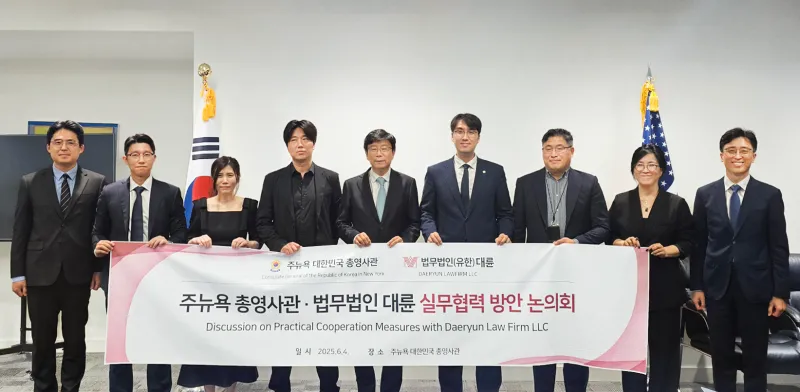
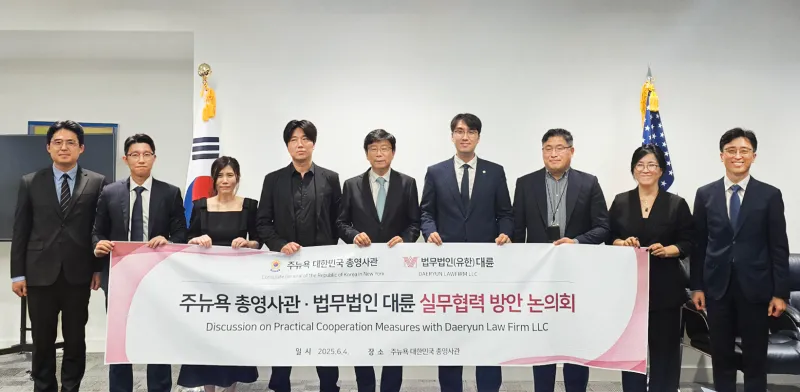
대륜-뉴욕 총영사관, 재외국민 법률지원·한미 법률교류 논의
Daeryun-New York Consulate General discusses legal support for overseas nationals and Korea-U.S. legal exchanges
Daeryun Law Firm announced on the 12th that it held a working-level meeting with the Consulate General of the Republic of Korea in New York (Consul General Kim Ui-hwan) to protect overseas nationals and strengthen legal cooperation between Korea and the United States. At the meeting held at the Consulate General of the Republic of Korea in New York on the 4th, diplomatic working-level staff, including Chairman Daeryun Shim Jae-guk, representative attorney Dong-il Park, and Consul General Kim Ui-hwan of the consulate, attended. This meeting was held to promote the Korean community in the United States and advance into the Korean community. It was prepared as part of discussions to respond to the diverse and complex legal demands of companies and to design a cooperation model between diplomatic missions and private law firms in advance. On this day, the two sides exchanged in-depth opinions to establish a practical cooperation structure in various fields, including △ establishing an emergency legal support and information linkage system for Korean nationals living abroad △ measures to share information on living laws related to residence, immigration, labor, and family △ operating public interest legal education programs for international students and overseas Koreans. Eui-hwan Kim The Consul General said, “We welcome the advancement of leading domestic law firms like Daeryun into the local market,” and “We hope that they will successfully settle on the global stage.” Chairman Shim Jae-guk of Daeryun emphasized, “We seek to promote national interests and substantially contribute to the people through the expansion of domestic law firms into the global market.” Representative attorney Dong-il Park said, “This discussion is the first step in organically connecting Daeryun’s global strategy with local public diplomacy,” and added, “The public performance of global legal services.” “It will be an opportunity to increase effectiveness,” he said. Starting with this meeting, Daeryun plans to further solidify the system based on practical cooperation with public institutions and promote various plans to lead to joint programs such as specific business agreements in the future. Meanwhile, Daeryun, as one of the top 10 law firms in Korea, provides comprehensive legal services encompassing all fields, including criminal, corporate law, and strategic litigation, and is pursuing a full-fledged global expansion strategy to New York and Washington. Digital News Team (jebo@ikbc.co.kr)[View full article] KBC Gwangju Broadcasting - Daeryun-New York Consulate General, legal support for overseas nationals and discussion on Korea-U.S. legal exchange (link) Segye Ilbo - Daeryun Law Firm holds a meeting to strengthen legal cooperation with the Consulate General in New York (Go here) Tax and Finance Newspaper - Daeryun and the Consulate General in New York discuss legal support for overseas Koreans and legal exchange between Korea and the United States (link)
international newspaper
2025-06-12
[기고] 북극항로의 시대, 부산은 다시 해양수도로 일어서야 한다
[Contribution] In the era of the Northern Sea Route, Busan must rise again as a maritime capital.
Climate change caused by global warming is shaking the landscape of shipping logistics around the world. As Arctic melting accelerates, the Northern Sea Route is no longer a future possibility, but is emerging as an imminent reality. The Northern Sea Route, which can significantly shorten the sailing distance and time compared to the existing Suez Canal route, is attracting attention as a key axis in the reorganization of the global supply chain. Currently, most of Korea's import and export volume uses the route to the Suez Canal via the East and South China Seas. However, this route overlaps with disputed waters where military and diplomatic tensions are high, such as the Taiwan Strait and the Senkaku Islands. In fact, in recent years, conflicts between China and neighboring countries have become a serious threat to the stability of maritime logistics. In this uncertain international situation, the Northern Sea Route is emerging as a new axis of the national shipping strategy beyond a simple alternative route. Changes in the international shipping order herald a significant turning point for Busan. If the full-scale operation of the Northern Sea Route becomes a reality, Busan, which is geographically located at the gateway connecting the Northern Sea Route and Northeast Asia, can reestablish its status as a transshipment base and strategic maritime city. However, the reality of Busan has reached a point where it is mentioned as being on the verge of extinction due to problems such as population decline, weakening industrial competitiveness, and concentration in the metropolitan area. The current state of a city that was once attracting attention as a maritime hub in Northeast Asia is a sad state. What Busan needs now is not piecemeal administrative reorganization or expansion of physical infrastructure. It is time to fundamentally reorganize the ‘maritime city software,’ including smart port technology, digital shipping systems, and legal and institutional infrastructure that can handle global disputes, while maximizing the use of existing ports and logistics infrastructure. In this regard, President Lee Jae-myung publicly announced his intention to establish a maritime court in Busan during his presidential campaign. This is noteworthy in that it goes beyond a simple commitment to balanced regional development and builds a strategic judicial infrastructure to respond to global shipping competition. In fact, the world's leading shipping cities, such as Singapore, London, Rotterdam, and Shanghai, without exception, operate specialized maritime judicial functions or independent maritime courts. The institutional foundation goes beyond just a framework for resolving disputes and operates as a core infrastructure that supports transactions and trust in the overall maritime economy, including ship finance, marine insurance, and international contracts. While leading Daeryun Law Firm's overseas expansion, the author personally visited major maritime cities such as Singapore, London, and Dubai, and experienced how closely the maritime courts work with the local economic ecosystem. In particular, despite being an Islamic country, Dubai has created a legal environment in which global companies can transact with confidence by applying British common law within the Dubai International Financial Center (DIFC). Such a bold decision to adapt the legal system to the outside to enhance the city's competitiveness has significant implications for us as well. The maritime court to be established in Busan should also not be limited to a simple physical installation. In order to secure its status as a global maritime city, international If necessary, it should be developed into an international maritime court system that faithfully reflects the standards and procedures used in maritime transactions. A separate area can be designated to operate a dispute resolution system based on British common law, and furthermore, a plan to develop the court into a court capable of performing the functions of the International Court of Justice in maritime affairs can be considered. Busan is now standing at the doorstep of a historic opportunity called the Northern Sea Route, but it is not a simple matter of establishing a new court, but establishing a new center of Korea's maritime strategy. The sea is still Busan's future, and Busan can be the most important starting point on the road for Korea to become a maritime power again.[View full article] [Contribution] In the era of the Northern Sea Route, Busan must rise again as a maritime capital (Shortcut)
blotter
2025-06-11
[그림자 내부거래]③ 자본시장 위협에 법조계 "규제 필요" [넘버스]
[Shadow Internal Transactions] ③ Legal profession needs regulation due to threats to capital market [Numbers]
While there have been cases in the United States where the act of profiting by investing in another company's stocks based on the company's internal information was judged to be insider trading and fined, there are voices calling for related regulatory measures in our law as well. Under the current law, insider trading is limited to cases of trading the company's own stocks. Accordingly, if a case like the US case occurs in Korea, there will be limits to sanctions and it may have a negative impact on the fairness and reliability of the capital market. The legal community points out that legislative supplementation is needed to expand the scope of insider trading. Betting on a rise in competitors' stock prices... U.S. court imposes three times fine for unjust enrichment What sparked the discussion surrounding the scope of insider trading was the so-called 'shadow insider trading' case that occurred in the United States. Shadow insider trading refers to the act of making profits by purchasing stocks of other companies based on the company's undisclosed internal information. Previously, in 2016, Matthew Panuwert, an executive at the biopharmaceutical company Medivation, heard internal information that large pharmaceutical company Pfizer was pursuing the acquisition of Medivation, and purchased options to bet on the rise in the stock price of competitors whose movements were linked to the company's stock price. The Securities and Exchange Commission (SEC) determined that Panuwat's actions constituted insider trading. Last September, the court accepted the SEC's argument and imposed a fine equivalent to three times the amount of unjust enrichment on Panuwat. However, as Hoban Group recently purchased a stake in LS, interest in shadow insider trading has increased in Korea as well. Hoban purchased shares while the subsidiaries of both companies were engaged in a lawsuit. The stock of the other party in the lawsuit was purchased. In addition, when the stock price jumped due to a partial ruling in favor of an LS subsidiary, which would ultimately be good news for Hoban, suspicions were raised that the stock was traded using internal information. “Explicit legal regulations are needed... uncertainty must be resolved” The legal community agreed that although it is difficult to view the Hoban case as shadow insider trading, laws to regulate such cases are needed to ensure a fair trading order. Attorney Kwon Mun-gyu of the law firm Space and Gil said, “Shadow insider trading is unfair trading in a state of unequal information,” and added, “Because criminal punishment is difficult under the current Capital Market Act and the provisions on the basis for other regulations are somewhat insufficient, legislative efforts to resolve this seem necessary.” Ahn Hee-cheol, the representative attorney at DL Law Firm, also said, "Shadow insider trading is a new form of unfair trading that can avoid existing insider trading regulations." He added, "We need to expand the regulatory scope of insider trading and explicitly stipulate it in the Capital Markets Act to resolve legal uncertainty." Weight was also placed on the possibility of related discussions taking place. Seungmin Lee, a lawyer at Seum Law Firm, said, "Korea's capital market law has been greatly influenced by the U.S. securities law, so if precedents such as the Panuwert case that punish shadow insider trading are established in the U.S., related discussions will inevitably continue in Korea." Cho Young-gon, a lawyer at Daeryun Law Firm, said, "Considering the recent attitudes of financial authorities and prosecutors and the direction of system improvement, there is room to discuss the creation of new punishment provisions or revision of legal provisions with the need for punishment in mind. In this process, it is necessary to analyze the impact of undisclosed information on the stock price of the industry as a whole and suspected cases of use of inside information that affect the industry as a whole." However, the key during the discussion process is to clarify the standards for shadow insider trading. Attorney Lee said, "The U.S. case was a case where insider trading was expanded to include trading the stocks of another company that is economically related (sharing market connection) using undisclosed information of one company. Since the term 'economically connected' is quite vague and can be interpreted broadly, if it is not defined accurately, there is a risk that trading in the stocks of competitors or affiliates will be unfairly restricted." Reporter Park Seon-woo (closely@bloter.net)[View full article] [Shadow Internal Transactions] ③ Legal profession calls for regulation due to threats to the capital market [Numbers] (Shortcut)
Have more questions?
Quick Menu

KakaoTalk