Page title background (PC version)Page title background (mobile version)

Press Coverage

Numerous media outlets recognize the expertise of Daeryun Law LLC.
Explore interviews, legal commentary, and columns by Daeryun lawyers.

3 places including Jose Ilbo
2024-10-28
법무법인 대륜, 교보스틸과 법률자문 MOU 체결
Daeryun Law Firm signs legal advisory MOU with Kyobo Steel
Daeryun Law Firm, which plans to cooperate in various fields including sharing ESG management strategies, announced on the 28th that it signed an MOU for legal advice with Kyobo Steel on the 24th. The business agreement ceremony held in the conference room of Daeryun headquarters was attended by officials including Daeryun CEO Kim Kuk-il, Lee Gyeong-min, Won-il Won, Park Jeong-gyu, lawyer Kim Hyeong-jin, Kyobo Steel CEO Kim Mi-seong, and auditor Kim Bong-ho. Kyobo Steel Co., Ltd. was established in 2013. It is an established steel manufacturing company. Currently, it is operating a structural pipe with an annual capacity of 14,000 tons and a 60,000 tons slitting process line at the Gwangyang National Industrial Complex in Jeollanam-do, and plans to expand the plant in the second half of this year. Daeryun is a large law firm with 240 lawyers as of October 2024 and is expanding its scope by strengthening its corporate legal group. Through this agreement, the two organizations will △ conduct legal reviews related to the steel business. We plan to cooperate with each other in △sharing ESG management strategies △advising on various contracts △promoting education and seminars for exchange. Kyobo Steel CEO Kim Mi-seong said, "The steel industry is facing a period of upheaval in line with the ESG management trend. Other steel companies are also joining in to achieve carbon neutrality." He added, "A variety of legal issues are arising related to ESG management, and we want to respond more systematically with the help of experts. There are many people in the corporate legal field. “I thought that Daeryun, which we are investing in, is the best law firm to form a partnership with,” he said. “We hope to have many exchanges for mutual development in the future. Requests for legal advice related to eco-friendly business have recently increased, so we will provide optimal advice to Kyobo Steel, which is planning to expand its plant,” he said. “In addition to lawyers in the corporate legal group, we will hire accountants and tax accountants. “Expert personnel, including labor attorneys, will utilize all resources to help both companies develop,” he said. [View full article] Jose Ilbo - Daeryun Law Firm, signs MOU for legal advice with Kyobo Steel (Shortcut) Aju Economy - [Law Firm Lounge] Daeryun, signs MOU for legal advice with Kyobo Steel (Shortcut) Steel & Metal Newspaper - Kyobo Steel, signs MOU for legal advice with Daeryun Law Firm (Shortcut)
daily
2024-10-28
법무법인 대륜, 킹스꼬마김밥과 MOU 체결
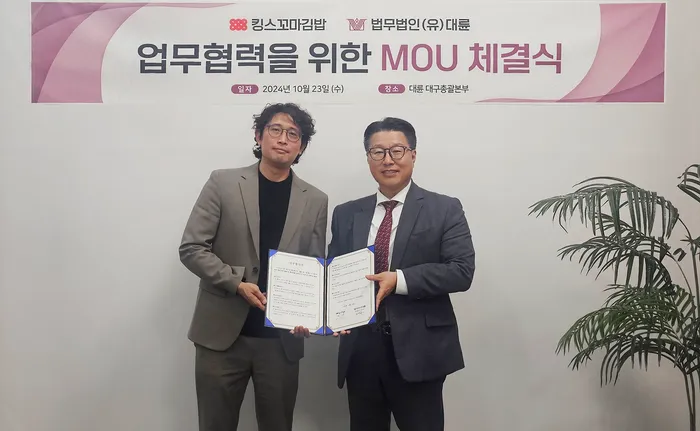
Daeryun Law Firm signs MOU with King's Little Kimbab
Legal assistance such as fair trade… Minimizing legal risks based on abundant experience Daeryun Law Firm "We will provide legal services tailored to the rapidly changing industrial environment" Daeryun Law Firm (Limited) announced on the 28th that it signed an MOU with 'King's Little Kimbab', a kimbap specialty franchise. At the signing ceremony held at the Daegu headquarters office of Daeryun on the 23rd, CEO Kook-il Kim of Daeryun and CEO Eun-deok Lee of King's Little Kimbab attended. King's Little Kimbab was established in 2019. This brand specializes in little kimbap and currently has 65 stores nationwide. It grew rapidly by adopting a differentiated strategy from existing kimbap franchise brands, and won first place in the franchise (snack food) category at the 'Korea Customer Satisfaction Index No. 1' awards ceremony hosted by the Korea Premium Brand Promotion Agency in 2021. Through this MOU, Daeryun will ▲ review the drafting of contracts related to supply, distribution, and sales ▲ manage intellectual property rights, including trademark registration ▲ resolve legal disputes such as violation of contracts. The policy is to assist. In particular, as the franchise headquarters may be subject to an investigation by the Fair Trade Commission depending on the situation, we plan to minimize risks by reviewing related legal issues in advance. King's Little Kimbab CEO Lee Eun-deok said, "The restaurant industry has grown to this point through repeated growth despite difficult circumstances," and added, "We will secure legal stability through Daeryun's professional advice and further develop in the future." “Based on Daeryun’s know-how, we will cooperate with King’s Little Kimbab to provide a strong support,” he said. “We will help provide effective legal services in line with the rapidly changing restaurant industry environment.” Meanwhile, Daeryun is operating a fair trade group comprised of experts such as accountants, tax accountants, and lawyers as well as specialized lawyers in each industry. We provide comprehensive solutions, including legal advice and business problem reviews, to corporate officials across the country. [View full article] - Daeryun Law Firm signs MOU with Kings Little Kimbab (Click here)
Sports Seoul
2024-10-27
숙박 플랫폼 ‘취소 수수료’ 논란 여전…법적 공방으로 번져
Controversy over accommodation platform ‘cancellation fee’ continues… It spread into a legal battle
Among applications for damage relief related to the use of accommodations, 75.8% are ‘penalties’ Complaint Law Firm Daeryun “Platform tyranny, consumer protection is needed” Recently, the number of cases of travelers being denied refunds while booking and canceling accommodations through online accommodation platforms has been increasing. However, it is pointed out that the damage to consumers is increasing as the lodging establishment passes responsibility to the platform, and the platform only sticks to the unilateral ‘no refund’ policy. According to data released by the Korea Consumer Agency, there were a total of 4,118 applications for consumer damage relief related to the use of lodging facilities received over the three years from 2021. Looking at the detailed reasons for application, complaints about the penalty arising from contract cancellation were the highest at 78.5% (3,234 cases). There were also not many cases of agreement to recover damages such as refund, compensation, or contract cancellation. The average agreement rate of the seven major lodging platforms was 64.8%, but Booking.com had the lowest at 39.6%. Yanolja and Timon also recorded low agreement rates of 58% and 43.8%, respectively. Half of the consumers who used the platform did not receive proper damage relief. In fact, many dissatisfied posts regarding cancellation fees are appearing in online communities. Mr. A, who said he had lost hundreds of thousands of won in lodging expenses, said in a post, “My travel itinerary changed, so I re-entered the platform a few hours after payment, but the cancellation column was blocked.” He added, “Even when I contacted the customer service center, the only response was that they could not help, and I was embarrassed to find out about the cancellation policy within 10 minutes later.” The legal battle over cancellation fees also began in earnest. On the 2nd, the Seoul Central District Court held the first hearing of a lawsuit filed by consumers against the lodging platform Yanolja for the return of unfair profits. Previously, Yanolja became a problem because it did not refund lodging fees due to internal regulations even though consumers who reserved special price products requested cancellation within 10 minutes. Accordingly, consumers filed a class action lawsuit against Yanolja. On this day, the two sides had sharply conflicting opinions regarding the violation of the Electronic Commerce Act and the Terms and Conditions Act. According to Article 17 of the Electronic Commerce Act, the regulations related to withdrawal of subscription, consumers who purchased goods from a mail order seller can withdraw their subscription within a certain period of time. In addition, in accordance with Article 6 of the Terms and Conditions Act, provisions that are unfairly disadvantageous to customers are presumed to have lost fairness and are invalidated. The plaintiff, the consumer, argued that “Yanolja is a mail-order intermediary, which is a mail-order seller,” and that “Article 17 of the Electronic Commerce Act applies.” However, Yanolja countered, saying, “It cannot be subject to the law because it is only an intermediary, not a mail-order seller.” Since it is not subject to the regulation law, there is no responsibility for refunds. Both sides also confronted each other regarding the ‘refund policy within 10 minutes’. Yanolja emphasized, “This is a part that was notified to the consumer in advance and agreed to,” and “In principle, waiving the cancellation fee for non-refundable products only if canceled within 10 minutes is a provision that considers the convenience of the consumer.” The consumer side said, “It is difficult to see it as a benefit because it is nothing more than misleading consumers and selling products that were not reserved until one day before the accommodation date, so it is difficult to see it as a benefit.” He emphasized, “It does not fall under the exception rule that restricts consumers’ exercise of their right to withdraw their contract.” It was confirmed that the court proposed an agreement at the date of the meeting and proposed a refund of more than half of the accommodation fee to Yanolja. However, both sides did not accept this, so the trial was moved to the next date. Attorney Kim Jin-woo of Daeryun Law Firm (Limited), the consumer's legal representative, said, “There are frequent situations where consumers do not receive a refund of accommodation fees ranging from 100,000 won to 1 million won due to a momentary wrong decision.” He added, “As the purpose of the Electronic Commerce Act is to protect consumers, the court must make a wise decision to prevent further unfair consumers.” “Please,” he said. [Read full article] - Controversy over lodging platform ‘cancellation fee’ continues… It spreads into a legal battle (link)
Newsis
2024-10-25
'기적의 치료기'에 다리 마비…노인 상대 불법 기기 체험방 '기승'
‘Miracle cure’ paralyzes legs… ‘Giseung’, an illegal device experience room for the elderly
Equipment used by unqualified people, not professionals Need to be careful about exaggerated advertisements in free trial rooms Last August, Soon-rye Kim (78, pseudonym) visited a trial room in Jungnang-gu, Seoul after hearing from a medical device company that “painful legs can be cured with electrical treatment.” Mr. Kim, who had a chronic illness, used a personal combination stimulator that was said to relieve muscle pain, but soon developed paralysis in his right leg and was taken to the hospital. Mr. Kim explained the situation at the time, saying, “The employee who was helping me use the device raised the temperature too high.” Initially, Company A advertised that using this personal combination stimulator could treat painful parts all over the body. They even attracted customers by advertising that attaching the device to the face would smooth out wrinkles. However, the personal combination stimulator is a medical device that applies electric current to the human body through electrodes, and was initially approved for the purpose of relieving muscle pain. According to Newsis coverage on the 24th, while the 'silver healthcare' market continues to grow ahead of the entry into a super-aging society, illegal medical device and equipment experience rooms that sell products through false and exaggerated promotions to the elderly are still active. Over the past three years (2021 to March 2024) A total of 1,188 applications for damage relief related to medical devices were filed with the Korea Consumer Agency, with more than 350 cases occurring every year. As of March of this year, a total of 98 cases were filed, showing a 7.7% increase compared to the same period last year. Looking at age groups, damage to elderly consumers in their 60s or older was the largest at 28.4% (333 cases). As the age group increased, the proportion of online sales decreased, but for those in their 60s or older, the proportion of general sales and door-to-door sales was higher than that of other age groups. Mr. Kim, who was hospitalized after being found that 58% of his nerves were damaged, demanded compensation from Company A for the damage. However, the only reply that came back was, "There is no problem with the medical device in question and it is Mr. Kim's fault that he was injured." Company A gave out daily necessities such as soap and toothpaste for free to elderly people when they visited the free trial room. After winning their favor in this way, they carried out promotional activities to encourage people to purchase their medical devices. However, if false or exaggerated advertisements are made to medical personnel, medical institution founders, or the general public other than medical institution workers in the experience room, or if labeling and description requirements are violated, it can be a legal problem. Lee Seo-hyung, a lawyer at Daeryun Medical Litigation Group, said, "False or exaggerated advertisements about the performance, efficacy, or effects of a medical device, such as claiming that it is effective in treating obesity and lumbar disc problems in addition to relieving muscle pain, which is permitted, He pointed out, "Even though it is an industrial product, advertising that claims to be a medical device, such as improving cervical disc problems, causing the product to be misunderstood as a medical device, or labeling or listing information that is false or likely to be misunderstood, may constitute a violation of the Medical Device Act." In fact, Company A was caught by the Ministry of Food and Drug Safety's so-called 'floating cafe' surveillance network in January 2017 for false and exaggerated advertising. At the time, the Ministry of Food and Drug Safety detected 52 medical device experience rooms, including Company A, and filed criminal charges. In particular, in such illegal experience rooms, unqualified people, not professionals, usually lead the use of the device, and even in the event of damage, related compensation or relief measures are not in place, so consumers must be especially careful. Lee Seo-hyung, a lawyer at Daeryun Medical Litigation Group, said, "If an unqualified person goes beyond simply helping to use a medical device and performs medical activities such as relieving muscle pain using a medical device, it is a violation of the Medical Services Act. “It may be an unlicensed medical practice prohibited by Article 27,” he pointed out. Meanwhile, Company A told Newsis, “There is no problem with the device in question,” and “I don’t know what the experience room has to do with the medical law.” [View full article] - ‘Miracle cure’ paralyzes legs… ‘Giseung’, an illegal device experience room for the elderly (link)
lowrider
2024-10-24
퇴직금 지급안해 고발·송치된 사업주···‘불기소·항고기각’이유는?
Employer accused and transferred for failing to pay severance pay... What is the reason for ‘non-indictment and dismissal of appeal’?
Following the decision of non-indictment, the Seoul High Prosecutors' Office dismissed the appeal of an employer who was sent by the Employment and Labor Office on charges of failing to pay severance pay to an employee who had worked for 10 years. The Seoul High Prosecutors' Office on the 12th of last month accepted an appeal from 'Retired Employee A' in response to an appeal case in which the Central Region Employment and Labor Office sent the employer, Mr. B, to the prosecution on charges of violating the Employee Retirement Benefits Security Act in September of last year. It was dismissed. Mr. A was hired by Mr. B's company in May 2012, but suffered an injury in July of that year, two months after joining the company, and entered industrial accident care. Afterwards, he did not work for over 10 years. However, Mr. A's four major insurance policies were lost only in February 2023, 10 years later. However, only then did Mr. A demand severance pay of about 21 million won from Mr. B. This was an amount calculated based on the working period from May 2012, when Mr. A started working, to the date when the four major insurance policies expired. However, Mr. B refused to pay severance pay to Mr. A. Then, Mr. A submitted a petition to the competent Employment and Labor Office, and after completing the related investigation, the Employment and Labor Office sent Mr. B to the Uijeongbu District Prosecutors' Office on charges of non-payment of severance pay. Mr. B said, “Mr. A's actual working period was 2 months. “In addition, we reported the four major insurance policies late so that the injured person A could maintain his health insurance and receive treatment,” he said, adding, “We thought there would be no obligation to pay severance pay.” The Uijeongbu District Prosecutors’ Office, which investigated this case, determined that Mr. B’s failure to pay severance pay was not intentional. The main reason was that Mr. A had never worked since the injury, and the actual working period was less than a year. In the decision not to indict, the prosecution said, “It would have been difficult for the employer to think that severance pay should be paid because more than 10 years have passed since the end date of employment. The delayed loss of the four major insurance policies is only an administrative process and cannot be considered the actual end date of the working period,” adding, “It is possible that Mr. B recognized that he had no obligation to pay severance pay to Mr. A. Mr. A stated the reason for non-indictment, saying, “It is enough.” Mr. A objected and submitted a notice of appeal. However, as a result of the Seoul High Prosecutors’ Office’s investigation into Mr. B’s charges, the appeal was dismissed due to insufficient evidence and the non-indictment against Mr. B was maintained. Attorney Heo Seong-guk of Daeryun Law Firm (Limited), who represented the business owner Mr. B in this case, said, “If there was a mistake or unavoidable circumstances in not paying wages or severance pay, it cannot be considered intentional.” “From the business owner’s perspective, it was difficult to think that Mr. A would have incurred severance pay because his actual working period was short. In addition, it appears that it has been acknowledged that there were difficulties in making actual payments due to the deterioration of the company’s management,” he said. [View full article] - Employer accused and transferred for failing to pay severance pay... What is the reason for ‘non-indictment and dismissal of appeal’? (Shortcut)
Money Today
2024-10-24
'스토킹 처벌법' 시행 3년…올바른 대처 방법은?
‘Stalking Punishment Act’ has been in effect for 3 years… What is the right way to deal with it?
The Act on Punishment of Stalking Crimes, the so-called ‘Stalking Punishment Act’, has been in effect for three years this year. The main point of this bill is to prohibit acts that repeatedly cause fear in the other person or his or her family without justifiable reason. The act of waiting at a residence or workplace, as well as the act of leaving or delivering an object, are all included in 'stalking'. Even if you make the other person feel anxious by contacting them using SNS, etc., you can be punished. If you are found guilty of stalking, you can be sentenced to up to 3 years in prison or a fine of up to 30 million won. The scope of application of stalking punishment laws is gradually expanding. Last year, an amendment was passed through the National Assembly that considers the act of providing, distributing, or posting personal information to a third party through an information and communications network as stalking. The fact that a medical resident was arrested under the Stalking Punishment Act after making a list of doctors who did not participate in the recent collective strike and posting it on the Internet can also be said to be the impact of this amendment. The core of the Stalking Punishment Act is 'continuity' and 'repetition'. The frequency and duration of the perpetrator's stalking behavior and whether it caused fear and anxiety in the victim are important factors in determining guilt or innocence. Even if there was stalking, if it was only a one-time act, it is difficult for the charge to be acknowledged, and even if the victim approached the victim multiple times against her will, there are many cases where the victim was found not guilty because the intent of the stalking was not clearly proven. The problem is that there is still no clear standard for stalking punishment. The concept of ‘continuity/repetition’ itself is somewhat subjective, and the interpretation of ‘fear/anxiety’ also has limitations as it inevitably varies depending on one’s perspective. Because of this situation, there are many cases where stalking is reported but the damage is not acknowledged. According to data from the Ministry of Justice, the number of suspects who were investigated by the prosecution after the enforcement of the stalking punishment law exceeded 10,000 last year alone, but it was revealed that most of them were summarily indicted or not indicted. The rate of arrested suspects was also less than 3%. Therefore, if you are a victim of a stalking crime, you should seek professional help as soon as possible. First, it is necessary to collect as much data as possible to prove repeated and continuous stalking, such as call records and SNS. In addition, since you must prove that the other person's stalking behavior was committed against your will, it is most important to respond to the situation with the assistance of a lawyer. Conversely, as mentioned above, as the scope of punishment itself expands, a situation in which you are unintentionally singled out as a suspect of a stalking crime may also occur. In particular, in the case of the stalking punishment law, as the crime of impunity against a doctor has been abolished, once a report is filed, it must be investigated regardless of the victim's will. Therefore, even in this case, it is necessary to work with experts to respond early and devise a strategy to get rid of unfair charges. [View full article] - ‘Stalking Punishment Act’ has been in effect for 3 years… What is the right way to deal with it? (Shortcut)
KBC Gwangju Broadcasting
2024-10-23
채팅 어플서 만난 미성년자 성폭행한 학원강사, 항소심서 감형
Academy instructor who sexually assaulted a minor he met on a chat app had his sentence reduced on appeal
A private academy instructor in his 20s who sexually assaulted a minor whom he found out through a chat app several times and even received illegally filmed footage was sentenced to a reduced sentence on appeal. On the 23rd, the 1st Criminal Division of the Daegu High Court overturned the original sentence that sentenced 29-year-old Mr. In addition, Mr. A was ordered to take 40 hours of sexual violence treatment classes and be restricted from employment at organizations related to children, youth, and the disabled for five years. Mr. A is accused of luring Ms. B, who was 12 years old at the time, in his vehicle in the parking lot of an apartment in Seo-gu, Daegu, and having sex with her in August of last year. Mr. A is known to have had sexual intercourse with Ms. B a total of 10 times from August to October of last year through a chat app. He also forced Ms. B to take and send explicit photos. In addition, it was revealed that he sent obscene messages containing content such as "Please take off my clothes" more than 47 times. The first trial court said, "The nature of the crime is very bad, as the defendant committed adultery with a victim who was only 12 years old and made her film and send sexually exploitative material," and added, "In that he made the victim, a child and adolescent who needs protection because his awareness and values about sex have not yet been established, the object of his sexual desire. He pointed out that "severe punishment is inevitable" and was sentenced to four years in prison. During the subsequent appeal process, Mr. A asked the court to take into account the fact that he voluntarily deleted all illegally filmed videos sent by the victim and the fact that Mr. A made efforts to end his meeting with the victim after recognizing his mistake. He also argued that the victim expressed his intention not to punish Mr. A. The appeals court said, "It does not appear that the defendant used coercive force such as assault or threats. “There is no evidence that the sexually exploitative material produced was leaked to the outside world,” the ruling said. “It seems reasonable to postpone the execution of the prison sentence along with probation rather than the actual sentence.” Attorney Lee Shin-gyu of Daeryun Law Firm (Limited), who is Mr. A’s legal representative, said, “There are many cases where problems arise due to meeting with a minor through an app, and the age limit for rape of a minor has been raised from 13 to 16, and the scope has been broadened. “The number of cases being booked is increasing,” he said. “In this case, we were able to receive recognition of sentencing factors favorable to the defendant by carefully considering whether he or she was a minor and whether or not he or she gave consent.” He also explained, “It is difficult to avoid criminal punishment in cases of sexual crimes against minors even if there was no assault or intimidation.” He also explained, “If a guilty verdict is issued, various sex crime security measures such as employment restrictions, attachment of an electronic anklet, and registration and disclosure of personal information are also imposed, so we must respond from the investigation stage.” [View full article] - Academy instructor who sexually assaulted a minor he met on a chat app had his sentence reduced on appeal (link)
Maeil Business Newspaper
2024-10-21
“코인투자 재미 못보셨다면 맡겨만 주세요”...코인 대리투자 주의보
“If you haven’t had fun investing in coins, just leave it to us”...Coin proxy investment warning
A YouTuber impersonating a celebrity on the coin platform stole 18 million won in the name of proxy trading. “Risk of proxy investment for individuals, not experts.” #A, an office worker in his 20s living in Gyeonggi-do, recently transferred $13,000 (approximately 18 million won) to a coin YouTuber L in the name of coin proxy trading. L introduced himself as a famous figure in the coin community and attracted about 3,500 subscribers, saying he would even provide personal counseling for people in difficult times. Accordingly, Mr. A also had a one-on-one conversation with L for about two and a half months through the social network service (SNS) framework, and came to trust him in a desperate situation. However, L went into hiding after receiving 18 million won in the name of agency transactions. Mr. A expressed his frustration, saying, “Looking back, it makes no sense, but I am going through a difficult time these days, and when I approached you with serious counseling, I felt like I was blind and deaf.” According to the virtual asset industry on the 19th, on the 15th, a victim who lost about 18 million won due to a coin YouTuber filed a complaint with the police. The victim paid 18 million won to coin YouTuber L in the name of proxy coin trading, of which approx. He claimed that he only received $400 (about 550,000 won) back. Mr. L told Mr. A that he could do proxy coin trading and encouraged him to do so, saying that many investors were already participating. Mr. A said, “At first, I only gave him $400, but the next day he refused to give me the money, saying that there was a loss in the transaction.” Currently, YouTuber L has deleted his channel. The conversation history with him has also been deleted. Coin YouTuber L introduced himself as a famous coin investor and attracted subscribers by explaining investment methods and investment views to investors who had difficulty investing in coins. Victim A believed YouTuber L's words that people who were having difficulty or having difficulties should apply for 1:1 consultation and asked him for advice. Mr. A explained that he talked to L for two and a half months from early August to mid-October and gained trust during the conversation. However, YouTuber L did not propose proxy coin trading to Mr. A from the beginning. After building trust for two and a half months, one day L brought up the topic of ‘two-way trading’. Two-way trading was a transaction in which Mr. A took an opposing position with the exchange designated by YouTuber L through futures trading, and received a certain amount of commission when the stock on the exchange was liquidated. YouTuber L designated an exchange to Mr. A and asked for money to buy ‘Tetter’ coins at that exchange. L asked to deposit cash into a designated account to purchase coins. Mr. A said that he felt uncomfortable because the exchange purchases coins by depositing them into an account rather than purchasing them directly. For example, if 1 million won is deposited into an account designated by L, a certain amount of Tether will be received at the exchange and futures trading will be conducted with that amount. If the exchange account takes a short (sell) position with 100 times leverage, Mr. A takes a long (buy) position with 5 times leverage through his account. Here, 100x leverage short means that even if the coin price falls by just 1%, you will receive a 100% return on the investment principal. Here, YouTuber L said that when the stock on the exchange where he held a 100x short position is liquidated, the stock will go into the exchange and he will receive a certain fee, so he will pay back about 30% of the commission to Mr. A. At first glance, it seems like all you have to do is liquidate the stock on the exchange, and the victim will also take the opposite position with this account, so there will be no loss, but that is not the case. This is because it is extremely rare for novice investors to make money in futures trading. Mr. A also tried this method just twice, but ended up losing hundreds of thousands of won. Later, I found out that the exchange did not even have a system for withdrawing Tether coins. On a normal exchange, purchased Tether can be withdrawn. In addition, it was an exchange that had not been reported to the Financial Services Commission's Financial Safety Information Institute. During this process, Mr. A said he would no longer trade, and at this time, YouTuber L, with whom he had built a sense of trust, approached him in a friendly and friendly manner and suggested proxy coin trading. Mr. A said that the problem was that he trusted YouTuber L because he had developed a sense of trust. Seong-geun Cho, a lawyer at Daeryun Law Firm, said, “It is very risky to entrust investments to individuals who are not professionally qualified, as there is a high risk,” and added, “Financial consumers are especially required to be careful because transactions with high profits in a short period of time are highly likely to be fraudulent.” [View full article] - “If you haven’t had fun investing in coins, just leave it to us”…Coin proxy investment warning (link)
KBC Gwangju Broadcasting
2024-10-21
비밀 정보 경쟁사 유출로 소송당한 퇴직자..法 "영업비밀 아냐"
Retiree sued for leaking confidential information to competitor...Law: "It's not a trade secret."
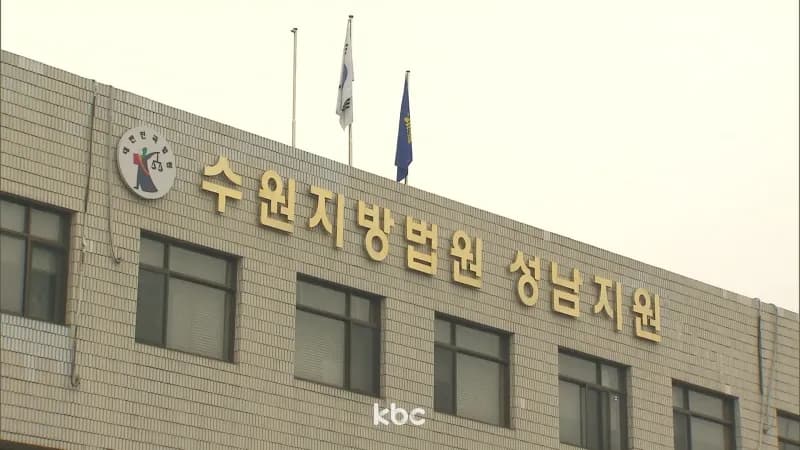
The court ruled that there was no need to compensate a retiree who was sued for damages by the company for leaking key information to a competitor because specific items could not be specified and conditions for business secrecy were not met, so the agreement prohibiting transfers was illegal and could not be raised as an issue. This is because the key information claimed by the company does not constitute a trade secret. On the 20th of last month, the Suwon District Court Seongnam Branch Civil Division 3 (Chief Judge Song In-kwon) ruled that the company filed a lawsuit against retirees A and B, as well as competitors. The plaintiff was ruled to lose in the injunction suit filed against Company C for prohibition of transfer and infringement of trade secrets. Mr. A and Mr. B worked as managers in the sales department at the time of their employment, and left the company in early 2020. Afterwards, they transferred to C Corporation, which was conducting the same business in August of the same year. The plaintiff claimed that defendants A and B, who were in positions with access to information, handed over information assets acquired during their employment to Company C, causing enormous damage to the business, and claimed 200 million won. It requested compensation of about 10 million won. In addition, it was claimed that A and B did not fulfill the agreement even after signing an agreement prohibiting change of job. Under the current law, if an employee who handles the company's trade secrets discloses confidential information to the outside world, he or she may be subject to criminal punishment of up to 15 years in prison or a fine of up to 1.5 billion won. In addition, he or she must also be liable for civil damages. However, the court ruled that the information in the case did not meet the conditions for a trade secret. The court said, “Based on the evidence submitted by the plaintiff, it is difficult to admit that defendants A and B secretly exported information about this case or used it to conduct business.” It continued, “There is no data that shows what kind of information was exported, and it cannot be said that A and B exported information about this company just because some of the companies that company C did business with are consistent with the plaintiff’s business partners.” It also said, “Mrs. A and B are related to this case. They were all indicted on charges of breach of trust and leaking of trade secrets, but in the case of Company C, the prosecution decided not to indict them, saying there were no charges. Attorney Kim Yong-tae of Daeryun Law Firm (Limited), who represented the defendants, said, "The key information claimed by the plaintiff is ambiguous and cannot be identified, and even if it is identified, it does not constitute a trade secret. Even if the prohibition agreement on transfers is an issue, the prohibition period is limited." He explained, “The plaintiff’s claim cannot be established in that the three-year agreement itself is invalid as it violates Article 103 of the Civil Act.” [View full article] - Retired person sued for leaking confidential information to a competitor... Law: “It is not a trade secret” (Shortcut)
Money S
2024-10-21
"딥페이크는 심각한 범죄"… 법조계, 첨단 기술 활용해 총력 대응해야
“Deepfakes are serious crimes”… The legal profession must respond with all its might using cutting-edge technology.
[Interview] Kim In-won, head of the criminal group at Daeryun Law Firm. As the deepfake crime of synthesizing and distributing other people's photos into pornographic material is spreading beyond college campuses to elementary, middle and high schools, the legal community has taken active action by establishing a dedicated organization. Daeryun Law Firm also declared that it will do its best to respond to the recent surge in deepfake crimes. The plan is to use cutting-edge technologies such as digital forensics to investigate evidence. To collect evidence, a cybercrime team linked with the evidence investigation and digital forensics group was formed. We actively utilize the mock investigation room and court system to provide close legal representation in all procedures, from the police investigation stage to the trial. Detective Group Director Kim In-won emphasized the importance of legal assistance in responding to deepfake crimes. The following is a Q&A with Group Director Kim. - Recently, deepfake technology has created an uproar in society. What kind of technology is it and what are the criminal aspects? ▶ Deepfake is a compound word of Deep Learning and Fake, and is a technology that uses AI to create images or videos whose authenticity cannot be confirmed. For example, if you create a video of a famous actor walking by combining the face of a famous actor with the body of a passing citizen, that is a deepfake video. Deepfakes are rarely used in a healthy way, simply as a hobby. Crimes such as defamation by creating a composite video of a famous politician or creating and distributing a sexual crime video by synthesizing the face of an acquaintance are common. -What is the punishment for downloading or distributing deepfake materials? ▶ If you produce, distribute, or edit a deepfake video, you can be punished by up to 5 years in prison or a fine of up to 50 million won in accordance with the Special Act on the Punishment of Sexual Violence Crimes. If you distribute the video for commercial purposes, you may be subject to aggravated punishment of up to 7 years in prison. In fact, in the so-called 'Seoul National University N Room Case', where sexual exploitation was created by combining the faces of female alumni with pornography, one of the defendants was sentenced to five years in prison in the first trial. - Is punishment for simply participating in a chat room where videos are shared? ▶ Currently, there is no punishment provision for simply watching or possessing deepfake videos. However, due to the recent increase in sexual crime cases on Telegram, there are opinions that simple participants should be punished for aiding and abetting, so it is better not to participate in the chat room at all. - What help can lawyers provide to victims of deepfake crimes? ▶ For most cyber sex crimes, including deepfake, securing evidence is the most important thing, but it is somewhat difficult to proceed alone due to the closed distribution channel. At this time, if you get the help of a professional lawyer, collecting evidence to prove damage becomes much easier. In the case of Daeryun, it operates a digital forensics center to support the recovery of deleted data and the collection of legal evidence regarding the status of video distribution. We can even assist with deleting personal or sensitive information and submitting it to investigative agencies. - Advice you can give if you are involved in a cyber sex crime. ▶ Cyber ​​sex crimes have the characteristic of not being limited by time and space. Crimes occur frequently and can be punished with various charges, so we need to respond quickly. If you are a victim, it is recommended that you seek help from a professional to quickly collect evidence, and if you are a perpetrator, it is recommended that you consult with a professional lawyer to secure elements of a reduced sentence. [View full article] - “Deepfake is a serious crime”… The legal profession must respond with all its might using cutting-edge technology (Click here)
Have more questions?
Quick Menu

KakaoTalk