
CONTENTS
- 1. FTA/WTO | Concepts and Regulatory Structure

- - The Concept of an FTA
- - The Concept of the WTO
- - The Relationship Between the FTA and the WTO
- 2. FTA/WTO | Tariff and Application Structure
- - Requirements for Application of FTA Preferential Tariffs
- - The WTO Tariff System
- - The Structure of Optional FTA Application
- 3. FTA/WTO | Key Legal Issues
- - Origin Verification Disputes
- - Non-Tariff Barriers and Trade Regulation
- - Criminal Risks Related to Customs and Origin
- 4. FTA/WTO | Corporate Response Strategy and Management Points
- 5. FTA/WTO | Assistance From Daeryun

1. FTA/WTO | Concepts and Regulatory Structure
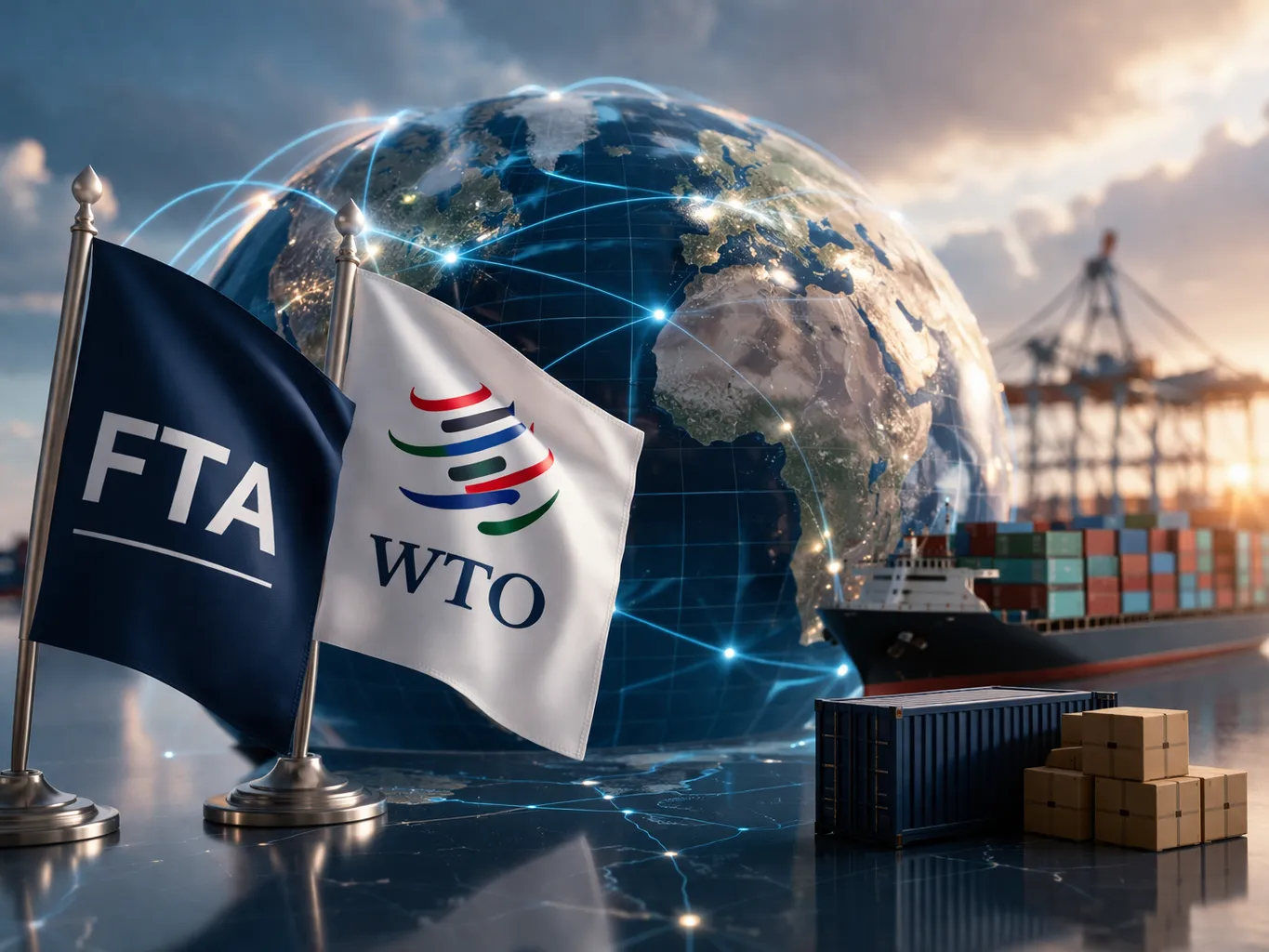
The FTA and the WTO are the principal legal frameworks governing international trade, and they complement each other to shape the global trade order.
 The Concept of an FTA
An FTA is an agreement concluded between specific countries, and it is recognized as an exception under the WTO agreements (GATT Article 24), allowing a higher level of market opening.
An FTA covers not only the elimination of tariffs but also the opening of service markets, investment protection, the strengthening of intellectual property rights, and the regulation of electronic commerce. In recent years, FTAs have come to include digital trade norms and provisions on supply chain stability as well.
Because each FTA differs in its application requirements, rules of origin, and trade norms, the same transaction may produce different legal effects depending on which agreement applies.
The Concept of the WTO
The WTO is an international organization established to create a multilateral trade order, and it operates around the principles of most-favored-nation treatment and national treatment in order to guarantee non-discriminatory transactions among member states.
It secures the fairness and predictability of international trade by restricting the imposition of discriminatory tariffs or the application of unfavorable regulations against a particular country.
The WTO also governs goods, services, and intellectual property rights through the GATT, GATS, and TRIPS agreements, and it sets the basic legal standards of international trade.
GATT Article 1 (most-favored-nation treatment), Article 3 (national treatment), and Article 11 (prohibition of quantitative restrictions) serve as the most central norms in international trade.
The WTO framework also functions as a substantive international normative system, securing legally binding force through a dispute settlement mechanism (DSU) that can resolve trade disputes between states when they arise.
However, because WTO disputes proceed as disputes between states, a company facing foreign import restrictions or discriminatory regulations must respond by organizing the relevant materials and raising the issue with its government.
The Relationship Between the FTA and the WTO
The FTA and the WTO do not substitute for each other but rather coexist, and a company must consider both sets of norms even for the same transaction.
For example, when the requirements of an FTA are satisfied, preferential tariffs may apply, but when they are not, general tariffs based on WTO standards apply.
Therefore, a company needs to make a strategic judgment at the transaction stage about which agreement to apply, and that judgment must weigh the burden of proving origin, the risk of post-clearance verification, transaction stability, and similar factors together.
Concepts and Differences Between the FTA and the WTO
Category | FTA | WTO |
Nature | Multilateral agreementBilateral and multilateral agreement | Multilateral agreement |
Function | Bilateral and multilateral agreement | Establishing the basic trade order |
Application Principle | Selective preference | Centered on most-favored-nation treatment |
Scope of Regulation | Expanded to services, investment, and similar areas | Centered on goods |


2. FTA/WTO | Tariff and Application Structure
Within the FTA/WTO framework, the central issue is the structure that determines under what conditions a specific good may enter a market.
Requirements for Application of FTA Preferential Tariffs
Under an FTA, the core element is the reduction or elimination of tariffs between the parties to the agreement, but these benefits do not apply automatically.
To qualify for preferential tariffs, the goods must satisfy the rules of origin set out in the agreement, which are assessed by considering the production process, the composition of raw materials, value-added criteria, and similar factors together.
In multinational production structures, where some components are supplied from non-party countries, recognition of origin may be denied, and tariff benefits are frequently excluded as a result.
As customs authorities have recently strengthened post-clearance verification of origin, more cases now involve additional duties and penalty taxes imposed retroactively on past transactions.
For this reason, companies must establish systematic management of the entire production process and supply chain, together with internal verification procedures.
Whether an FTA applies is determined not only by origin but also by the HS CODE (commodity classification), and incorrect classification leads directly to errors in tariff rates and the risk of additional collection.
Because the applicable agreement, tariff rate, and rules of origin may differ depending on the HS CODE, prior review is necessary.
Trade remedy measures such as anti-dumping duties and countervailing duties also affect pricing policy and export structure directly, so companies must develop a strategy that accounts for the full scope of customs clearance and trade regulation, not merely the reduction of tariffs.
The WTO Tariff System
Under the WTO framework, each country must operate its tariffs within the ceiling set through its tariff concession schedule.
That is, when a country exceeds its bound tariff or applies tariffs or trade conditions in a discriminatory manner against a particular country, a question of violation of the WTO agreements (such as GATT) may arise, and the matter may develop into a dispute between states.
Import restrictions, quantitative restrictions, discriminatory regulations, and similar measures may likewise be reviewed for violation of the WTO agreements, and such measures may prompt a complaint from a trading partner.
The Structure of Optional FTA Application
A key point is that for the same transaction, a company may choose between FTA preferential tariffs and general tariffs based on WTO standards.
A company should build its application strategy by weighing not only tariff rates but also the burden of proving origin, the risk of post-clearance verification, transaction stability, and similar factors, and in this way it can design an approach that optimizes its tariff position.
When multiple FTAs apply to the same goods, it is useful to compare the tariff rate, rules of origin, and documentation burden of each agreement and to select the most advantageous one.
3. FTA/WTO | Key Legal Issues

Disputes related to the FTA and WTO are closely tied to a company's supply chain structure, contractual terms, and overall regulatory response strategy.
Origin Verification Disputes
The question of origin is the most central issue in an FTA.
Even for the same product, recognition of origin may differ depending on the country where final processing took place, the origin of the components, value-added criteria, and similar factors.
Because the rules of origin differ for each FTA, a separate review is required under each agreement, and overlooking this may result in unexpected tariff burdens.
As customs authorities in various countries have recently strengthened origin verification, more cases now involve the exclusion of preferential tariffs or restrictions on application over a long period.
Errors in origin may lead to retroactive taxation of past transactions, which can significantly affect corporate finances, and when violations recur, the matter may expand to restriction of agreement application, administrative fines, criminal punishment, and similar consequences.
Non-Tariff Barriers and Trade Regulation
In the current international trade environment, non-tariff barriers often function as an even more significant regulatory tool than tariffs.
Countries restrict imports through technical regulations (TBT), sanitary and phytosanitary measures (SPS), safety standards, and similar means, and for these measures the key issue is their consistency with the WTO TBT Agreement and the SPS Agreement.
Anti-dumping duties, countervailing duties, export controls, and economic sanctions are also applied to specific industries or countries and may restrict a company's transactions themselves.
As trade regulation has recently tightened in the fields of semiconductors, batteries, defense, and advanced technology, companies increasingly must review the very feasibility of a transaction in advance, beyond simple customs clearance.
Such regulation can alter the business structure itself, so a strategic response is required.
Criminal Risks Related to Customs and Origin
Violations related to customs and origin may lead to criminal punishment, so caution is required.
Type of Violation | Applicable Law | Legal Risk |
|---|---|---|
False declaration, commodity classification, or fabrication of a certificate of origin | Article 270, Paragraph 1 of the Customs Act | Imprisonment for up to 3 years or a fine of up to five times the evaded tax amount or the value of the goods, whichever is higher |
False marking of origin | Article 53-2 of the Foreign Trade Act | Imprisonment for up to 5 years or a fine of up to 100 million won (may be imposed concurrently) |
4. FTA/WTO | Corporate Response Strategy and Management Points
The FTA/WTO environment calls for systematic management within the company.
Matters Companies Should Note
▶ Establishing an Origin Management System
Because the criteria differ for each agreement, the origin determination criteria for each product must be managed systematically.
▶ Reviewing the Supply Chain Structure
Because whether an FTA applies varies with the component procurement structure, production and the supply chain must be designed in advance.
▶ Establishing a Tariff Strategy for Each Agreement
Even for the same product, when several FTAs apply, the optimal agreement must be selected.
▶ Responding to Trade Regulation
Regulations such as anti-dumping measures, export controls, and economic sanctions must be reviewed in advance to minimize transaction risk.
▶ Establishing Internal Compliance
Origin documentation, transaction records, and verification response materials must be managed systematically.
Establishing an origin management system and a trade regulation response process within the company also serves as a core element for long-term cost reduction and dispute prevention.
5. FTA/WTO | Assistance From Daeryun
The FTA and WTO make up a complex legal area that affects a company's supply chain structure, transaction strategy, and regulatory response.
The Trade Response System a Company Should Prepare
∙ Updating relevant laws and regulations: ongoing awareness of trends in each country's trade measures and economic sanctions
∙ Using a network of specialists: collaboration with attorneys, customs specialist advisors, and trade advisory institutions
∙ Establishing a response system for disputes: WTO dispute response when anti-dumping, countervailing duties, and similar matters arise
Advance counsel should run across the entire process, from the design stage of a trade contract through the review of rules of origin, the establishment of a customs clearance strategy, and the response to export controls and sanctions, and systematic preparation is necessary so that a prompt response is possible when a dispute arises.
Daeryun Law Firm reviews origin, customs clearance, export controls, and sanctions response in advance from the contract stage, and when a problem arises, it builds a response strategy that connects immediate objection procedures, administrative responses, and international arbitration and litigation.
The firm reviews the characteristics and intended use of imported goods and analyzes relevant laws and precedents to prepare, in an organized way, materials that can be used in administrative adjudication, objection procedures, and litigation.
Through collaboration with customs specialist advisors, it provides a comprehensive response strategy so that the company can reduce unnecessary financial burdens and carry out stable import, export, and business operations.
If you have concerns about legal disputes or regulatory matters related to the FTA and WTO, 🔗Schedule a Consultation With a Customs Attorney to receive professional counsel.