CONTENTS
- 1. Claim for Judicial Recognition of Parentage (인지청구) | The Concept of Recognition

- - Types of Recognition
- 2. Claim for Judicial Recognition of Parentage (인지청구) | Claimant and Period
- - Persons Entitled to Claim
- - Time for the Claim
- 3. Claim for Judicial Recognition of Parentage (인지청구) | Procedure of the Claim
- - Preparation of the Complaint
- - Main Evidence
- - Judgment of the Court
- - Objection and Revocation
- 4. Claim for Acknowledgment of Paternity | Method of Reporting After Judgment
- - Person Obligated to Report Acknowledgment
- - Reporting Period
- - Place of Reporting
- - Preparing the Application
- 5. Claim for Acknowledgment of Paternity | Effects of Acknowledgment
- - Formation of the Parent-Child Relationship
- - Legal Effects
- - Retroactive Effect
- 6. Claim for Acknowledgment of Paternity | Checklist
- - Support System of Family Law Attorneys

1. Claim for Judicial Recognition of Parentage (인지청구) | The Concept of Recognition

A claim for judicial recognition of parentage (인지청구) is a procedure for establishing recognition by filing a lawsuit with the court.
Here, recognition refers to the act by which the biological father or biological mother acknowledges a child born out of wedlock as his or her own child (Article 855 of the Civil Act).
 Types of Recognition
Recognition includes 'voluntary recognition,' which is reported by the person's own intention, and 'judicial recognition,' which is determined by the court through litigation or similar means.
Category | Explanation |
Voluntary Recognition | The biological father or biological mother voluntarily recognizes the child. Takes effect through a report of recognition |
Judicial Recognition | Where the biological father or biological mother refuses recognition or it is uncertain, recognition is established compulsorily by filing a lawsuit with the court |


2. Claim for Judicial Recognition of Parentage (인지청구) | Claimant and Period

A claim for judicial recognition of parentage proceeds by a designated person entitled to claim filing a lawsuit with the court so that the child may be legally recognized as a child by the biological parent, and it must be exercised within the period set out under the Civil Act.
Persons Entitled to Claim
Under Article 863 of the Civil Act, a lawsuit for a claim of judicial recognition of parentage may be brought by the following persons.
∙ The lineal descendants of the child
∙ The statutory agent of the child
Here, the opposing party of the claim is the father or the mother.
If the parent has died, the claim may be brought against a prosecutor (Article 864 of the Civil Act).
Time for the Claim
For a lawsuit of a claim of judicial recognition of parentage, the period for the claim differs depending on whether the parent has died.
Situation | Period for the Claim |
While the parent is alive | No separate limitation |
When the parent has died | Within two years from the date of becoming aware of the death |
3. Claim for Judicial Recognition of Parentage (인지청구) | Procedure of the Claim

Judicial recognition may be obtained by filing a lawsuit for recognition, and the following procedure is followed.
② Examination of the facts (genetic testing and the like)
③ Pronouncement of judgment
④ Report of recognition after the judgment becomes final
Preparation of the Complaint
To begin a claim for judicial recognition of parentage, a complaint must first be submitted to the Family Court.
The complaint must include the following matters, and it is important to set out as specifically as possible the facts that can prove the biological relationship.
Main Evidence
To determine whether recognition should be granted, the court places importance on scientific and objective evidence.
The following materials are mainly used.
Type of Evidence | Details |
Results of Genetic Testing | Key evidence that can scientifically prove the existence of the biological relationship |
Birth-Related Materials | Hospital childbirth records, medical records at the time of pregnancy and childbirth, and the like |
Other Testimony and Documents | Statements of the biological mother or a third party, photographs, letters, and other materials showing the relationship |
Under Article 855-2(2) of the Civil Act, the court comprehensively considers scientific methods, including genetic testing, and whether there has been a prolonged period of separation, in reaching its determination.
Judgment of the Court
Based on the evidence presented, the court determines whether to grant acknowledgment of paternity.
When acknowledgment is granted, the judgment must become final following its pronouncement, after which the legal parent-child relationship is established through the report of acknowledgment.
Objection and Revocation
Even where acknowledgment has already been made, an objection may be raised or the acknowledgment may be revoked in the following cases.
Procedure | Standard |
Action of objection (Civil Act Article 862) | An interested party may file within one year from the day on which the party became aware that a report of acknowledgment had been made. |
Claim for revocation (Civil Act Article 861) | Where acknowledgment was made by fraud, duress, or material mistake, a claim may be filed within six months from the day on which that fact became known. |
4. Claim for Acknowledgment of Paternity | Method of Reporting After Judgment
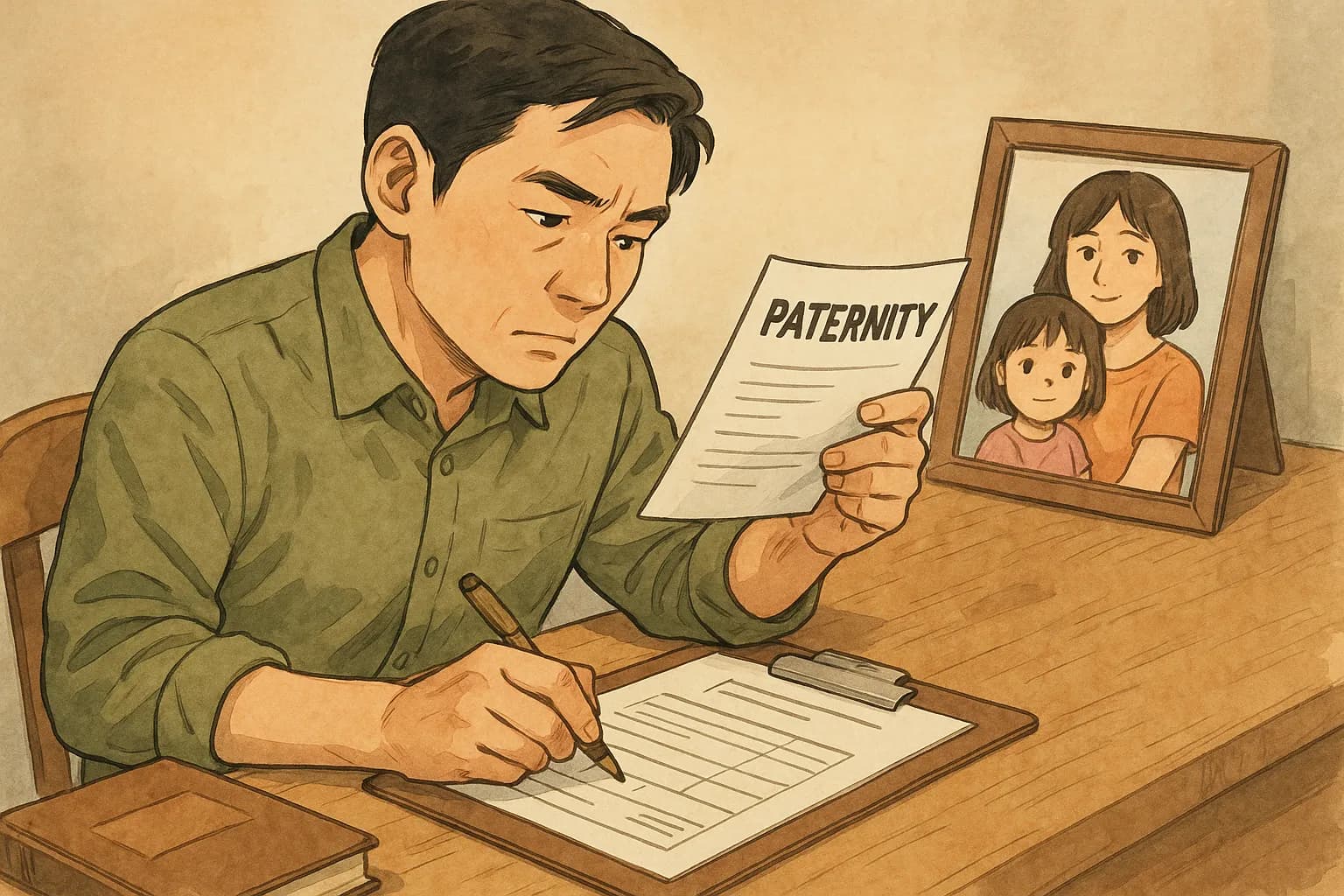
Where a judgment of acknowledgment has been obtained through a claim for acknowledgment (by trial), the report of acknowledgment must be completed for the legal effect to arise.
The report of acknowledgment is not a mere formality, but an important procedure that finalizes the legal status of the child.
Preparation should proceed in sequence according to the items below.
Person Obligated to Report Acknowledgment
In the case of judicial acknowledgment, the person who filed the action for acknowledgment becomes the party obligated to make the report (Act on the Registration of Family Relations, Article 58, Paragraph 1).
The other party (the defendant) may make the report but is not obligated to do so.
The following sets out the person who reports according to the type of acknowledgment.
Type of Acknowledgment | Person Reporting |
Judicial acknowledgment | The person who filed the action for acknowledgment |
Acknowledgment by will | The executor of the will is the person eligible to report |
Acknowledgment of an unborn child | The father or the mother |
Reporting Period
The report of acknowledgment is not completed by the court's judgment alone, and a report within the prescribed period is required.
The following sets out the reporting period according to the type of acknowledgment.
Type of Acknowledgment | Reporting Period |
Judicial acknowledgment | Within one month from the date the judgment becomes final |
Acknowledgment by will | Within one month from the date the executor takes office |
Where the unborn child is stillborn | Within one month from the day on which the fact became known |
In the case of judicial acknowledgment, the report of acknowledgment must be made within one month from the date the judgment of acknowledgment becomes final, and exceeding this period may result in an administrative fine of not more than 50,000 won (Act on the Registration of Family Relations, Article 122).
Place of Reporting
The report of acknowledgment may be made at the city (district), eup, or myeon office with jurisdiction over the registration base address of the person born or over the address or current location of the person reporting (Act on the Registration of Family Relations, Article 20).
A person residing abroad may submit the report at the Family Relations Registration Office for Overseas Koreans.
▷ In principle, the person reporting must visit in person (an agent is not permitted)
Preparing the Application
The report of acknowledgment must state the following matters, and the related documents must be attached.
Matters to Be Stated
(where the child is a foreign national, the name, sex, date of birth, nationality, and foreign resident registration number)
∙ Where the father makes the acknowledgment, the mother's name, registration base address, and resident registration number
∙ Where the child's surname and origin of surname as they were before acknowledgment are to be retained, the purport and content thereof
∙ Where the holder of parental authority has been designated by the family court, the purport and content thereof
Documents to Be Attached
∙ In the case of acknowledgment by trial, a certified copy of the written judgment and a certificate of finality
∙ In the case of acknowledgment by will, a certified copy of the will or a document recording the oral will
5. Claim for Acknowledgment of Paternity | Effects of Acknowledgment
When the court recognizes that acknowledgment has been established in an action for acknowledgment, a parent-child relationship is formed, and various legal effects arise.
Formation of the Parent-Child Relationship
When acknowledgment is completed, a child born out of wedlock comes to have a legal parent-child relationship with the biological father or biological mother who made the acknowledgment.
Unlike a birth report, this is a procedure by which a child born out of wedlock is officially recognized as the legal child of the parent.
∙ The child's surname and origin of surname may be changed
∙ Restoration of the child's legal status
When acknowledgment is established, the child is regarded not merely as a biological child but as a legal 'child born in wedlock'.
Legal Effects
When a parent-child relationship is recognized, the following relationships of rights and obligations arise (Civil Act, Article 864-2).
Item | Explanation |
Right of inheritance | The child becomes a statutory heir of the biological father or biological mother. (Civil Act, Article 1000) |
Duty of support | The parents come to bear a duty of support toward the child, and conversely the child also has a responsibility to support the parents. |
Parental authority and parenting | The exercise of parental authority, the bearing of child support, the right of visitation, and other rights and responsibilities toward the child arise. |
Change of surname and origin | The surname and origin prior to the affiliation may be maintained or changed, and where necessary, a correction of the family relations register is made. |
Retroactive Effect
Under Civil Act Article 860, acknowledgment takes effect retroactively to the time of the child's birth.
That is, the parent-child relationship is recognized not from the time acknowledgment was made but from the time the child was born.
However, the retroactive effect may be limited in the following case.
The rights already acquired by a third party may not be prejudiced
Accordingly, even though the effect is retroactive to the time of birth, the rights of a third party are protected, so care is needed in arranging legal relations after acknowledgment.
6. Claim for Acknowledgment of Paternity | Checklist

To bring a claim for acknowledgment (judicial acknowledgment), sufficient preparation regarding the legal procedure and evidentiary materials is needed.
In particular, when conducting litigation alone, it is important to carefully verify the accuracy of the evidence and the procedural requirements.
Preparation Item | Content |
Preparing the complaint for acknowledgment | State in specific terms the circumstances giving rise to the parent-child relationship, the purport of the claim, and the cause of the claim |
Confirming the court of jurisdiction | Select the family court based on the address of the child or of the biological father or biological mother |
Securing evidentiary materials | Materials proving the relationship, such as genetic test results, birth certificates, hospital records, photographs, and letters |
Preparation after the judgment of acknowledgment becomes final | Secure the final written judgment and the certificate of finality, and prepare the report of acknowledgment |
Preparing the report of acknowledgment | Include the related matters to be stated, such as the child's personal details and the designation of parental authority |
Support System of Family Law Attorneys
This law firm includes a substantial number of attorneys specializing in family law registered with the Korean Bar Association, as well as attorneys with an average of more than 10 years of experience.
In matters relating to claims for acknowledgment, the firm provides comprehensive assistance, from proof of the parent-child relationship and the filing of an acknowledgment action to the finality of judicial acknowledgment and the report of acknowledgment procedure.
Where it is difficult to prepare for litigation alone, the assistance of a family law attorney may help you proceed through the procedure more accurately and promptly.