
CONTENTS
- 1. Severe Disciplinary Action Against Public Officials | Administrative Sanctions for Violations of Law or Duty

- - Grounds for Disciplinary Action Against Public Officials
- - The Relationship with Criminal Punishment
- 2. Severe Disciplinary Action Against Public Officials | Types of Disciplinary Action
- - The Disciplinary Procedure and Flow
- - Grounds for Aggravation and Mitigation of Disciplinary Action
- 3. Severe Disciplinary Action Against Public Officials | How to File an Objection
- - Objecting to an Appeals Review Through Administrative Litigation
- 4. Severe Disciplinary Action Against Public Officials | Disciplinary Response Checklist
- - Seeking Professional Assistance in Cases of Severe Disciplinary Action

1. Severe Disciplinary Action Against Public Officials | Administrative Sanctions for Violations of Law or Duty

Heavy disciplinary action against a public official refers to a severe disciplinary measure, such as removal, dismissal, demotion, or suspension, among the administrative sanctions imposed by the State in its capacity as employer where a State public official or a local public official violates a duty in the performance of official duties.
Because public officials perform public duties on behalf of the State or a local government, they bear various duties prescribed by law in the performance of those duties, such as the duties of diligence, fairness, and integrity.
Where these are violated, the State Public Officials Act and the Local Public Officials Act allow disciplinary action to be taken through certain procedures.
Heavy disciplinary action against a public official deprives the official of part or all of the official's status, or suspends the performance of duties for a certain period, and it has a serious effect not only on the individual official's livelihood but also on the official's future career.
Unlike light disciplinary action, heavy disciplinary action has strict requirements and procedures, so when facing disciplinary action, a person who properly understands the procedures may avoid accepting the disciplinary action defenselessly or suffering disadvantage through an inappropriate response.
 Grounds for Disciplinary Action Against Public Officials
A public official is subject to disciplinary action when they violate laws and orders such as the State Public Officials Act, when they violate or neglect the duties imposed in their capacity as a public official, or when they commit an act that damages their dignity or standing regardless of whether it occurs within or outside the scope of duty (such as drunk driving, prostitution, adultery, or assault).
A ground for disciplinary action may be imposed not only on the person who committed the act, but also on a supervisor where it is found that the supervisor neglected the duty of supervision.
▶The Eight Duties of a Public Official
2. Duty of good faith
3. Duty of obedience
4. Duty of kindness and fairness
5. Duty of religious neutrality
6. Duty of confidentiality
7. Duty of integrity
8. Duty to maintain dignity
▶The Four Prohibitions for a Public Official
2. Prohibition on profit-making business and concurrent positions
3. Prohibition on political campaigning
4. Prohibition on collective action
The Relationship with Criminal Punishment
Because disciplinary action and criminal punishment differ in their underlying basis of authority and their subjects, the imposition of both disciplinary action and criminal punishment for the same misconduct does not violate the principle against double jeopardy.
Accordingly, as long as grounds for discipline are recognized against a public official, disciplinary action is possible even if the related criminal case is not found guilty or is still under investigation by the investigative authorities.
In particular, even an acquittal in a criminal case does not constitute grounds for expunging the record of disciplinary action.
2. Severe Disciplinary Action Against Public Officials | Types of Disciplinary Action
Reprimand | Restriction on promotion and pay raise for 6 months or more (additional 3 months for property crimes and sexual crimes) |
Salary reduction | Reduction of 1/3 of salary for 1 to 3 months, restriction on pay raise, and reduction of various allowances |
Suspension from duty | Retains status for 1 to 3 months but may not engage in duties -Reduction of 2/3 of salary -Restriction on pay raise -Reduction of various allowances |
Demotion | Lowering by one grade for up to 3 months and suspension from duty for 3 months -Retains status but may not engage in duties -Reduction of 2/3 of salary for 3 months -Restriction on pay raise -Reduction of various allowances for 3 months |
Dismissal | Exclusion from public official status and grounds for disqualification from appointment as a public official for 3 years -Full payment of retirement benefits and allowances (25% reduction for those involved in money-and-valuables corruption) |
Removal | Exclusion from public official status and grounds for disqualification from appointment as a public official for 5 years -50% reduction of retirement benefits and allowances |
Disciplinary surcharge | Imposed for money-and-valuables-related misconduct, in addition to disciplinary action, within a range of up to 5 times the amount of money and valuables received -Where one acquires or provides property gain such as money, goods, real estate, or hospitality -Embezzlement, breach of trust, theft, fraud, or misuse of budgets, funds, subsidies, and the like under the National Finance Act and other statutes |
Warning without record | An administrative disposition in cases that warrant a reprimand but are mitigated owing to grounds for mitigation such as meritorious service |
For major disciplinary action against public officials, specific standard tables exist for each case in accordance with the Enforcement Rules of the Decree on Disciplinary Action against Public Officials, established by the Ministry of Personnel Management.
For example, in the case of drunk driving, one may receive disciplinary action ranging from salary reduction to removal depending on factors such as blood alcohol concentration, whether it is a repeat offense, and whether there was property or personal injury.
In this way, the level of disciplinary action is determined by considering various factors together, such as the gravity of the violation, the motive, the result, and the likelihood of recurrence.
The Disciplinary Procedure and Flow
Heavy disciplinary action against a public official is, in principle, conducted in a manner in which the head of the relevant institution requests a disciplinary resolution, the disciplinary committee deliberates and resolves on the matter, and the person with authority over the disposition confirms the disciplinary action.
To secure fairness, the disciplinary committee is composed of a specified number of members, and it deliberates and resolves fairly with the attendance of five or more members and the consent of a majority of the members present.
A resolution must be made within 30 days (60 days for the Central Disciplinary Committee) from the date the request for a disciplinary resolution is received, and where unavoidable, this period may be extended by 30 days (60 days for the Central Disciplinary Committee).
What requires particular attention in the disciplinary procedure is procedural legitimacy.
For example, whether the members of the disciplinary committee were lawfully composed, whether a request for recusal was accepted, and whether the right to make statements and the right of defense were sufficiently guaranteed are the main issues.
If the right of defense was infringed during the disciplinary process or lawful notice was not given, one may contest the action on the ground of a procedural defect.
In addition, where the facts were distorted during the investigation prior to the disciplinary resolution, or only unfavorable materials were adopted, a written explanation and the submission of evidence to rebut them are essential.
In preparation for the disciplinary procedure, it is necessary to secure evidence from the investigation stage, such as notes on the facts, recordings, and the preservation of related emails and messages.


Grounds for Aggravation and Mitigation of Disciplinary Action
Where two or more unrelated acts of misconduct are committed in combination, the disciplinary action is resolved upon one level higher than the disciplinary action corresponding to the more serious misconduct.
For misconduct that occurs while a disciplinary action is in effect, or during the period of restriction on promotion and appointment, a disciplinary action two levels higher may be resolved upon.
In addition, the disciplinary committee may mitigate the disciplinary action by one level where the person for whom a disciplinary resolution has been requested has the following meritorious record.
However, even in such a case, mitigation is excluded for misconduct with a five-year limitation period for grounds of discipline, sexual violence crimes, sexual harassment and prostitution, drunk driving, and misconduct relating to property registration and the sale or trust of stocks.
3. Severe Disciplinary Action Against Public Officials | How to File an Objection
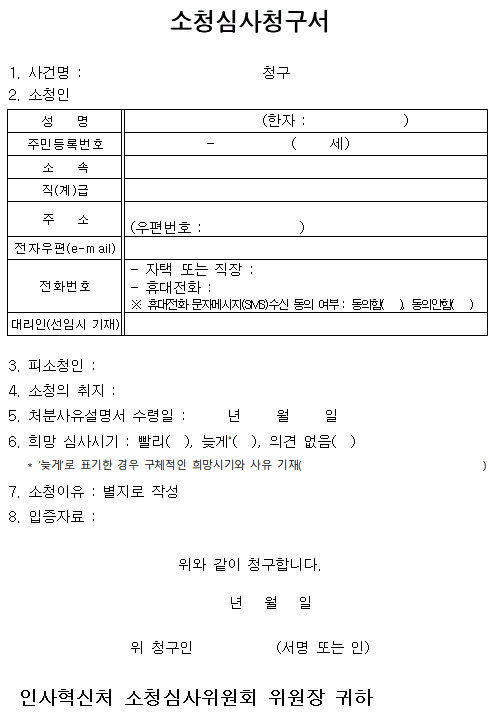
A public official who has received a heavy disciplinary action may first seek relief through an appeals review.
The appeals review is handled by the Appeals Review Committee established in central administrative agencies and local governments, and the request must be filed within 30 days from the date of receiving notice of the disposition.
Because the request for appeals review must set out in detail the illegality or impropriety of the disciplinary action and attach the relevant evidence, it is important to sufficiently explain the actual facts and to point out, item by item, any procedural defects in the disciplinary committee.
Objecting to an Appeals Review Through Administrative Litigation
If you believe that your rights were not remedied through the appeal review either, you may file an administrative litigation within 90 days from the date you receive the decision.
At this stage, the matter proceeds as a lawsuit to revoke or invalidate a disciplinary action, such as revocation of a dismissal disposition, and you must assert and prove all of the factual circumstances at the time of the disposition, procedural unlawfulness, and the unfairness of the level of discipline imposed.
At the administrative litigation stage, the authenticity and lawfulness of evidence are strictly required, so evidence should be carefully prepared from the early stage of the case.
The most significant mistake in an appeal procedure is missing the deadline. If the period for filing the appeal review (30 days) or the period for filing the administrative litigation (90 days) is missed, the possibility of a remedy effectively disappears.
You should therefore pay particular attention to managing the schedule.
See More
4. Severe Disciplinary Action Against Public Officials | Disciplinary Response Checklist
Category | Evidence for responding to disciplinary action |
Evidence of the facts | Work logs, emails, messenger records, CCTV, call records > Proves that the grounds for the discipline differ from the facts |
Materials for mitigation | Family circumstances (illness, dependents, etc.), medical certificates for health problems, counseling records |
Written statements | Statements from supervisors and colleagues > Proves the circumstances in the course of work and ordinary diligence |
Other | Commendation records, documentation of achievements > Materials highlighting work attitude or diligence |
To respond to disciplinary action directly, a public official should first organize a written account of the incident and supporting materials on their own.
It is recommended to minimize emotional expressions, to write centering on objective facts and legal issues, and to find and present similar cases and precedents as grounds.
In addition, you may cite and obtain assistance from official materials of bodies such as the Ministry of Personnel Management and the Anti-Corruption and Civil Rights Commission.
Seeking Professional Assistance in Cases of Severe Disciplinary Action

Severe disciplinary action against a public official is a serious disadvantageous disposition that directly affects the official's career and livelihood, so the facts and legal principles must be sufficiently reviewed before responding.
Where dismissal or removal is expected as a result of severe disciplinary action, where there is significant room for dispute and the facts are complex, or where the outcome of the appeals review is unfavorable and an administrative litigation must be pursued, you may wish to consider the assistance of a labor and administrative law specialist attorney.
This firm has labor law specialist attorneys, as well as specialists in particular fields such as recording and professional evidence investigation experts and labor attorneys, analyze the matter together in order to secure the right of defense.
If you are facing a dispute over severe disciplinary action against a public official, this firm will serve as your partner.