
CONTENTS
- 1. Workplace Harassment | The Concept and Related Statutes

- 2. Workplace Harassment | Legal Basis and Measures When It Occurs
- - Measures When Workplace Harassment Occurs
- - Responding When Sexual Harassment Occurs in the Workplace
- - Examples of Disadvantageous Treatment of Whistleblowers and Affected Workers
- 3. Workplace Harassment | Means of Remedy for the Affected Worker's Rights
- - Petition to the Ministry of Employment and Labor and Application for Remedy to the Labor Relations Commission
- - Civil Litigation and Claim for Damages
- - Filing an Industrial Accident Claim for Workplace Harassment
- - Criminal Complaint Against the Actor Under the Criminal Act
- 4. Workplace Harassment | Preparing Evidence and the Employer's Response
- - The Employer's Practical Response
- - Seeking Assistance from a Labor Law Attorney and a Labor Affairs Consultant

1. Workplace Harassment | The Concept and Related Statutes

Workplace harassment is defined in Article 76-2 of the Labor Standards Act.
The law defines workplace harassment as "an act by which an employer or a worker, using a superior position based on rank or relationship in the workplace, causes physical or mental suffering to another worker beyond the appropriate scope of work, or worsens the working environment."
Unlike mere unkindness or a minor quarrel, repeated verbal abuse, ostracism, or excessive work instructions that exploit a superior position may all constitute workplace harassment.
The main governing laws applied are the Labor Standards Act and the Equal Employment Opportunity Act.
In particular, Article 14 of the Equal Employment Opportunity Act provides for the duty to prevent sexual harassment in the workplace, and because workplace harassment is often combined with sexual harassment, the two are applied together.


2. Workplace Harassment | Legal Basis and Measures When It Occurs
The Labor Standards Act provides that, upon becoming aware of workplace harassment, the employer must immediately investigate the facts, take measures to protect the affected worker, and take appropriate measures against the perpetrator.
Adverse dispositions against the affected worker are prohibited in principle, and a violation may give rise to administrative dispositions such as the imposition of an administrative fine, as well as liability under criminal law.
In addition, the Equal Employment Opportunity Act mandates education to prevent sexual harassment in the workplace, measures upon its occurrence, and grievance handling procedures.
On this basis, a worker affected by workplace harassment may proceed to a claim for damages and even a criminal complaint.
Examples of workplace harassment conduct are as follows. 1. Failing to recognize work ability or performance without justifiable reason
2. Discrimination in promotion, compensation, or everyday treatment without justifiable reason
3. Repeatedly assigning difficult work to a particular worker
4. Assigning menial tasks not specified in the employment contract
5. Preventing the use of leave, sick leave, or various welfare benefits without justifiable reason
6. Repeatedly assigning personal errands and the like
7. Coercing resignation without justifiable reason
8. Spreading rumors about personal matters
9. Physical threats or violence, verbal abuse, or intimidation
10. Engaging in insulting conduct online
11. Coercing participation in drinking, smoking, or company dinners
12. Group ostracism
13.Insults combined with sexual harassment, such as sexual jokes and disparagement of appearance
Such cases tend to recur and become entrenched unless the worker raises the issue, so the in-house grievance handling system should be actively used.
 Measures When Workplace Harassment Occurs
Under the Labor Standards Act, where an employer receives a report of workplace harassment or becomes aware of the fact of its occurrence, the employer must conduct an objective investigation of the parties and take measures.
- Measures to protect the affected employee, such as a change of workplace or an order of paid leave (to the extent not contrary to the victim's wishes)
- Upon confirming the facts regarding the affected employee, measures such as a change of workplace, reassignment, or an order of paid leave
- Disciplinary action against and a change of workplace for the perpetrator (after hearing the victim's views)
- No dismissal of or disadvantageous treatment toward the reporter or the affected employee
- No disclosure of the confidential fact of the harassment
Responding When Sexual Harassment Occurs in the Workplace
Under the Equal Employment Opportunity Act, a business owner must conduct education to prevent sexual harassment in the workplace.
In addition, if sexual harassment occurs in the workplace, a fact-finding investigation and appropriate measures toward the harmed worker and the perpetrator are required.
Harmed worker | Change of workplace, reassignment, an order for paid leave, and similar measures |
Dismissal or unfavorable treatment of the reporter or the harmed worker is prohibited | |
Perpetrator | Disciplinary action, change of workplace (the victim's opinion must be heard) |
Where the perpetrator is the spouse or a relative of the business owner, an administrative fine of not more than 10 million won | |
Business owner | Where no appropriate measures were taken after harassment or sexual harassment occurred, an administrative fine of not more than 5 million won |
Where a secret learned in the course of investigating the occurrence of sexual harassment is disclosed, an administrative fine of not more than 5 million won | |
| Where the reporter or the harmed worker is dismissed or subjected to unfavorable treatment, imprisonment for not more than 3 years or a fine not exceeding 30 million won |
Examples of Disadvantageous Treatment of Whistleblowers and Affected Workers
An employer must not subject a worker who has reported workplace harassment or workplace sexual harassment, or a worker who is a victim, to unfavorable treatment.
- Disadvantages involving loss of status, such as removal from office, dismissal from office, or termination
- Disciplinary action, suspension from duty, reduction of pay, demotion, or restriction of promotion
- Personnel measures, such as withholding of duties or reassignment of duties
- Discrimination in performance evaluation, and discriminatory payment of wages or bonuses
- Restriction of opportunities for vocational ability development, education, and training
- Neglect, such as collective ostracism
3. Workplace Harassment | Means of Remedy for the Affected Worker's Rights

For a workplace with 10 or more regular employees, the employer must specify in the rules of employment matters concerning the prevention of workplace harassment and the measures to be taken when it occurs.
In addition, the workplace must have a grievance handling officer to hear and address employee grievances.
A victimized employee may report workplace harassment, workplace sexual harassment, and similar matters to the in-house grievance handling committee or the human resources officer and request a fact-finding investigation.
However, an exception is recognized allowing workplaces with fewer than 30 regular employees not to have a grievance handling officer.
Petition to the Ministry of Employment and Labor and Application for Remedy to the Labor Relations Commission
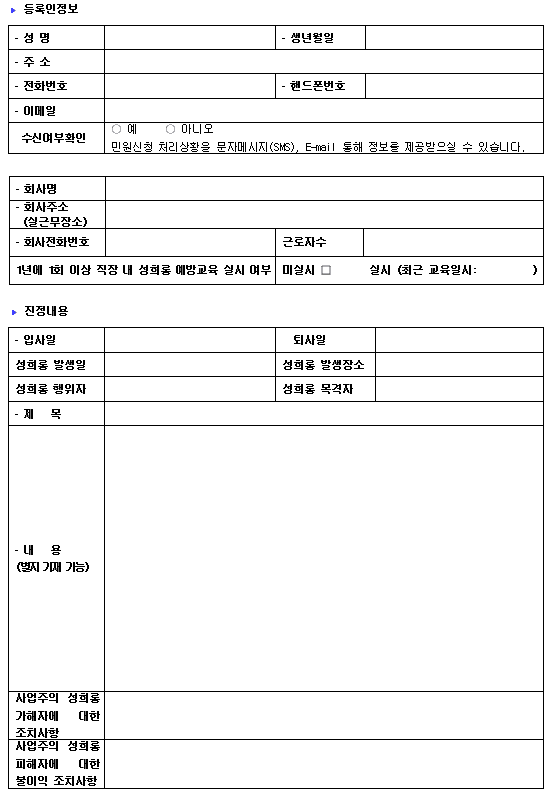
If the internal measures are insufficient and the matter does not proceed voluntarily, you may file a complaint with the local labor office.
When a complaint is filed, a labor inspector may issue a corrective order to the employer along with a confirmation of the facts.
If the corrective order is not followed, administrative sanctions such as the imposition of an administrative fine follow.
The handling of a matter such as workplace sexual harassment by the local labor office basically takes about 25 days.
If unfair dismissal, an unfair transfer, or a disciplinary personnel measure accompanied the workplace harassment, an application for remedy may be filed with the Labor Relations Commission.
The Labor Relations Commission may investigate the case and order restoration to the original state, reinstatement, and payment of wages, among others, and in the event of an objection, the matter may be contested through administrative litigation.
Civil Litigation and Claim for Damages
Where the harassment is severe and gives rise to mental and material harm, a claim for damages is possible.
In particular, where sexual harassment coexists, the consolation money may be increased.
Where the employer has failed to fulfill the obligations to investigate and take measures, liability for damages is also recognized against the employer.
Cheongju District Court, Judgment of May 23, 2024, Case No. 2023 Na 53373
This is a judgment that recognized damages of 20 million won for a plaintiff who was diagnosed with depression caused by workplace harassment arising from being urged to resign and coerced into a job transfer.
It is a case that recognized the liability for damages of both the perpetrator and the corporation.
Filing an Industrial Accident Claim for Workplace Harassment
Under the Industrial Accident Compensation Insurance Act, a disease arising from occupational psychological stress caused by workplace harassment or abusive language from customers is treated as meeting the criteria for recognition as an occupational accident.
Accordingly, a victimized employee may file a claim for industrial accident compensation.
However, in this case the condition must fall under a neuropsychiatric disease as defined in the applicable law (such as post-traumatic stress disorder, adjustment disorder, or a depressive episode).
Criminal Complaint Against the Actor Under the Criminal Act
Where workplace harassment constitutes an offense such as assault, insult, defamation, coercion, sexual assault, or sexual molestation, a complaint may be filed with the Ministry of Employment and Labor for violation of the Labor Standards Act, or a criminal complaint may be filed with the police on the ground of a violation of the Criminal Act or other laws.
Depending on the charges, the perpetrator may be subject to criminal punishment, and a civil action for damages may be pursued in parallel with the criminal proceedings.
4. Workplace Harassment | Preparing Evidence and the Employer's Response

Because in workplace harassment the harmed worker must prove the facts directly, the following materials should be carefully prepared.
Organizing the facts that occurred repeatedly over several occasions in chronological order is also very important.
The Employer's Practical Response
- Clearly include the prevention of workplace harassment and the handling procedures in the rules of employment, and then make all employees aware of them
- When a report is filed, immediately conduct a fact-finding investigation and separate the perpetrator and the victim
- Consider involving a third-party expert so that there is no dispute over bias during the investigation
- Conduct education to prevent recurrence on a regular basis, and record and preserve the handling results
If in-house measures are inadequate and the matter expands into a further dispute, the employer and the corporation may also bear liability for damages, and this may develop into a decline in the company's credibility, so a prompt response may be needed.
Seeking Assistance from a Labor Law Attorney and a Labor Affairs Consultant
Workplace harassment goes beyond a mere internal company issue and is an unlawful act that infringes the fundamental right to a working environment protected by the Labor Standards Act and the Equal Employment Opportunity Act.
Victims should not forget that step-by-step remedies are open to them, from internal reporting to a complaint to the labor office, an application for remedy to the Labor Relations Commission, and civil and criminal procedures.
Employers, too, should organize their rules of employment in advance and thoroughly conduct preventive education and grievance-handling procedures in order to prevent unnecessary disputes and losses.
Rights become effective only when one protects them oneself.
If you need a prompt response regarding workplace harassment, please book a legal consultation with our firm, where a labor law attorney and a certified labor affairs consultant review the matter together and devise a strategy.
See More