




CONTENTS
- 1. Fatal Industrial Accidents | Procedures and Response Measures Employers Must Know

- 2. Fatal Industrial Accidents | Criteria for Recognition as an Accident
- - Presumption of Death
- 3. Fatal Industrial Accidents | Accident Handling Procedure When One Occurs
- - Employer's Obligations When a Fatal Industrial Accident Occurs
- 4. Fatal Industrial Accidents | Criteria for Payment of Survivors' Benefits and Funeral Expenses
- - Scope of Persons Eligible for Survivors' Benefits
- - Special Survivors' Benefits
- - Payment of Funeral Expenses
- 5. Fatal Industrial Accidents | Preventing Concealment and Criminal Liability
- - Sentencing Guidelines for Violation of Safety and Health Measure Obligations
- - Measures to Mitigate Employer Risk in Fatal Industrial Accidents

1. Fatal Industrial Accidents | Procedures and Response Measures Employers Must Know

A fatal industrial accident refers to a case in which a worker dies while performing work at an industrial site.
According to Statistics Korea, Korea's fatality rate per ten thousand workers reached 0.98% in 2024.
We have organized a detailed explanation of the procedures for handling a fatal accident when a fatal industrial accident occurs, as well as the measures an employer should take.
Fatality Rate per Ten Thousand Workers
(Number of industrial accident fatalities ÷ Number of workers subject to industrial accident coverage) × 10,000
-Excludes traffic accidents outside the workplace, sports events, and ordinary commuting fatalities


2. Fatal Industrial Accidents | Criteria for Recognition as an Accident
Under the Occupational Safety and Health Act and the Industrial Accident Compensation Insurance Act, fatal accidents are broadly divided into death by a work-related accident, death by a work-related disease, and special-type death such as death from overwork.
Work-related accident : death from an accident that occurred while a worker was performing work under the employer's supervision and management
-Occurs during a work act under the labor contract
-An accident from a defect or poor management while using facilities provided by the employer
-An accident while participating in or preparing for an event hosted or directed by the employer
-An accident during an act under the employer's control and management during a break
-Not an intentional or self-inflicted act, and a substantial causal relationship exists between the accident and the death
This is death from a sudden physical accident at the workplace, such as a machine accident, a fall, or a collapse.
In this case, concealing the accident through an out-of-pocket settlement or paying costs as a substitute is illegal, and greater civil and criminal liability may arise when an industrial accident claim is later filed.
Work-related disease : refers to a case in which an occupational disease accumulates and leads to death.
Representative examples include exposure to asbestos and organic solvents, occupational cancer, and pneumoconiosis.
Proving the causal relationship between the disease and the work is key, and submitting an epidemiological investigation and a medical opinion is important.
Death from overwork : cases of death from cardiovascular disease and the like due to accumulated stress and fatigue caused by long working hours and heavy workloads
In cases of death from a cerebrovascular or cardiovascular disease caused by night work, shift work, and the like, if work-relatedness is proven through records of working hours, work intensity, and overtime work history, it is recognized as an industrial accident.
Commuting accident : death from an accident that occurred while commuting using transportation provided by the employer and the like, or by an ordinary route and method
Suicide and other special deaths
Suicide may also be recognized as an industrial accident in exceptional cases.
If there is a medical opinion that a worker acquired a mental disorder due to work-related stress and the like and committed suicide in a state in which the capacity for normal judgment was markedly diminished, it is recognized as a work-related accident.
 Presumption of Death
Among fatal industrial accidents, where the life or death of a worker who was aboard a vessel or aircraft in which an accident occurred is unknown, or where the worker has gone missing, death is presumed as follows.
In this case, the provisions on survivors' benefits and funeral expenses apply.
- Life or death unknown for three months due to a crash or loss of a vessel or aircraft
- Aboard a vessel or aircraft in transit but life or death unknown for three months
- A worker's life or death unknown for three months due to a natural disaster, fire, structural collapse, or the like
3. Fatal Industrial Accidents | Accident Handling Procedure When One Occurs
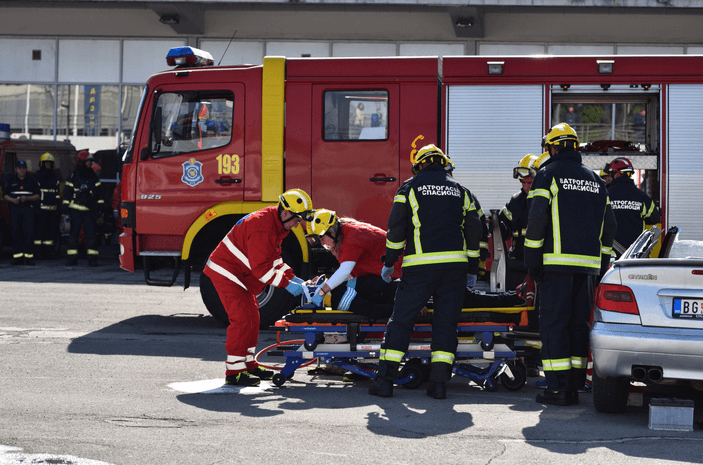
The basic procedure for handling an accident is as follows.
Accident occurs → transport to hospital → preservation of the scene → report of the accident → on-site confirmation and accident investigation →medical certificate issued → medical care application → claim for industrial accident compensation → receipt of compensation → subsequent appearance before the relevant authorities → criminal punishment and administrative disposition in cases of intent or negligence
However, if the injured worker has died in this process, the employer may need to calculate a compensation settlement amount with the bereaved family and reach a settlement, among other steps.
Employer's Obligations When a Fatal Industrial Accident Occurs
When a worker dies, the employer must immediately safely control the scene and preserve the cause of the accident.
① Emergency measures | Immediately carry out emergency measures such as a 119 emergency rescue call and transport to a hospital |
② Reporting obligation | -Report a serious accident immediately and without delay to the competent local employment and labor office by telephone, fax, or other means -Submit the industrial accident investigation report within one month |
③ Cooperation with the on-site investigation | -Respond faithfully to the Ministry of Employment and Labor's on-site investigation and the hearing of statements from relevant persons -Prevent recurrence by immediately inspecting the safety and health management system |
④ Guidance for the bereaved family | -Cooperate with the industrial accident handling procedures and document submission so that the bereaved family can smoothly claim industrial accident compensation |
4. Fatal Industrial Accidents | Criteria for Payment of Survivors' Benefits and Funeral Expenses
Industrial accident insurance pays survivors' benefits to the dependent family when a worker dies for work-related reasons in a fatal industrial accident.
It is basically paid as a 100% annuity (survivors' compensation annuity), but if the survivors so wish, they may choose 50% as an annuity and 50% as a lump sum.
The annuity begins on the first day of the month following the month in which the fatal industrial accident occurred.
[Method of Calculating the Survivors' Compensation Annuity]
Survivors' compensation annuity amount = base amount + additional amount
Scope of Persons Eligible for Survivors' Benefits
- Spouse (including a common-law spouse)
- Parents and grandparents aged 60 or older
- Children under 25 and grandchildren under 19
- Siblings under 19 or aged 60 or older
- In addition to the above, included if the person has a disability of grade 3 or higher
- An unborn child also qualifies as a beneficiary of the survivors' compensation annuity upon birth
Payment is suspended if a beneficiary entitled to receive the survivors' compensation annuity has been missing for three months or more, or dies, or loses eligibility.
If there is no eligible beneficiary to receive the survivors' compensation annuity, a survivors' compensation lump sum is paid in the form of a lump sum.
- The spouse, children, parents, grandchildren, and grandparents who were living in the same household as the worker at the time of death
- The spouse, children, parents, grandchildren, and grandparents who were not living in the same household
- Siblings
In this case, a survivors' lump sum of 1,300 days' worth of the daily average wage is paid as a lump sum.
Special Survivors' Benefits
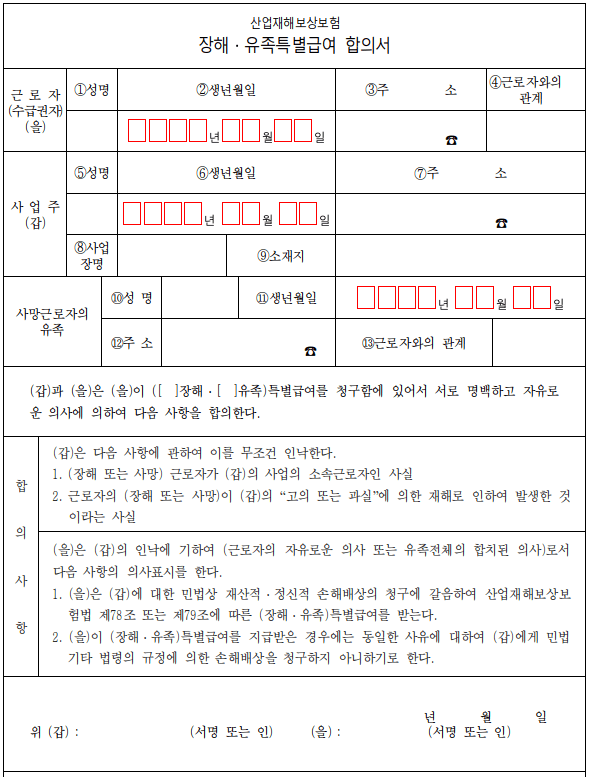
Where a work-related accident occurs due to the employer's intent or negligence and results in a fatal industrial accident, by agreement between the beneficiary and the employer, the beneficiary may claim special survivors' benefits instead of civil damages.
{(30 days' worth of the average wage - the deceased's own living expenses) × the Leibniz coefficient corresponding to the number of employable months} - survivors' compensation lump sum
When the Korea Workers' Compensation and Welfare Service pays special survivors' benefits, it collects the entire benefit amount from the employer.
The employer may pay the amount in four installments per year.
Payment of Funeral Expenses
Funeral expenses are paid to the surviving family and others who carried out the funeral of the worker injured in a fatal industrial accident.
Funeral expenses amount to 120 days' worth of the average wage, and as of 2025, if the amount exceeds the maximum of 18,685,600 won or falls below the minimum of 13,451,380 won, that respective amount is paid as the funeral expenses.
If, even before the funeral is held, the survivors so request, the above minimum amount may be paid in advance.
5. Fatal Industrial Accidents | Preventing Concealment and Criminal Liability

When a fatal industrial accident occurs, it must be reported to the Ministry of Employment and Labor.
If the accident is concealed or falsely reported, the responsible party may be punished under the Occupational Safety and Health Act and the Serious Accidents Punishment Act.
Sentencing Guidelines for Violation of Safety and Health Measure Obligations
Category | Mitigated | Basic | Aggravated |
Death caused by violation of safety and health measure obligations | 6 months ~ 1 year 6 months | 1 year ~ 2 years 6 months | 2 years ~ 5 years |
When a death results from a violation of safety and health measure obligations, the factors that may mitigate or aggravate the employer's sentence are as follows.
Mitigating factors | Aggravating factors |
Circumstances of the accident that warrant consideration (gross negligence of the victim) | Severe degree of violation of safety and health measure obligations |
No desire for punishment and recovery of damage (including deposit) | Repeated occurrence of similar accidents (for cases causing death, where a recurrence happens within 5 years, both the upper and lower limits of the sentencing range are aggravated by 1.5 times) |
Self-reporting, internal whistleblowing, and the like | Inadequate rescue measures after the accident |
Correction of the violation | Concealment of evidence or attempted concealment |
Insurance enrollment | Repeated offense of a different kind, prior conviction of the same kind, and the like |
No prior criminal punishment | Causing harm during settlement attempts |
Measures to Mitigate Employer Risk in Fatal Industrial Accidents
A fatal industrial accident can pose a substantial legal and social risk to a company.
This calls for periodic inspection of the safety and health management system in normal times, prompt and accurate response immediately after an accident, thorough safety management, and an accurate understanding of the criteria for survivor benefits.
If a fatal industrial accident does occur, it is advisable to consult an attorney experienced in industrial accidents promptly and begin with a proper assessment of the matter.
Our firm draws on its experience advising on violations of the Occupational Safety and Health Act and on matters related to serious accident punishment to listen to the concerns of employers facing fatal industrial accidents and to develop appropriate response measures.
Consultations can be received at any time, and the firm operates branch offices in regions across the country, which you may find helpful in arranging a consultation.
See More










