
CONTENTS
- 1. Industrial Accident Reporting | Prompt Action Required by the Employer

- - Obligations When an Industrial Accident Occurs
- - Immediate Measures When an Industrial Accident Occurs
- 2. Industrial Accident Reporting | Accident Investigation and Reporting Procedures
- - Items to Be Entered in the Industrial Accident Investigation Report
- - Fact-Finding Investigation by the Korea Workers' Compensation and Welfare Service and Others
- - Model Example of an Industrial Accident Investigation Report
- 3. Industrial Accident Reporting | The Need for Legal Assistance
- - Criteria for Imposing Administrative Fines
- 4. Industrial Accident Reporting | Public Disclosure of Workplaces Where Industrial Accidents Occurred
- - Submission of the Integrated Industrial Accident Status Report
- - Recommendations for Employers

1. Industrial Accident Reporting | Prompt Action Required by the Employer
Industrial accident reporting is the procedure for reporting any accident that may occur within a workplace to the competent local labor office.
For the employer, the occurrence of an industrial accident is itself a problem, but in many cases the failure to take appropriate legal measures after the accident leads to greater legal liability, such as administrative fines or criminal punishment.
The Occupational Safety and Health Act requires the employer to report the occurrence, preserve the scene, investigate the cause, and prepare measures to prevent recurrence when an industrial accident occurs.
Through industrial accident reporting, the employer must complete the industrial accident investigation report and submit it to the competent local labor office within the deadline.
In particular, a serious accident must be reported immediately as a matter of principle.
With the enforcement of the Serious Accidents Punishment Act, the employer's responsibility for industrial accident reporting and safety management obligations has become considerably heavier.
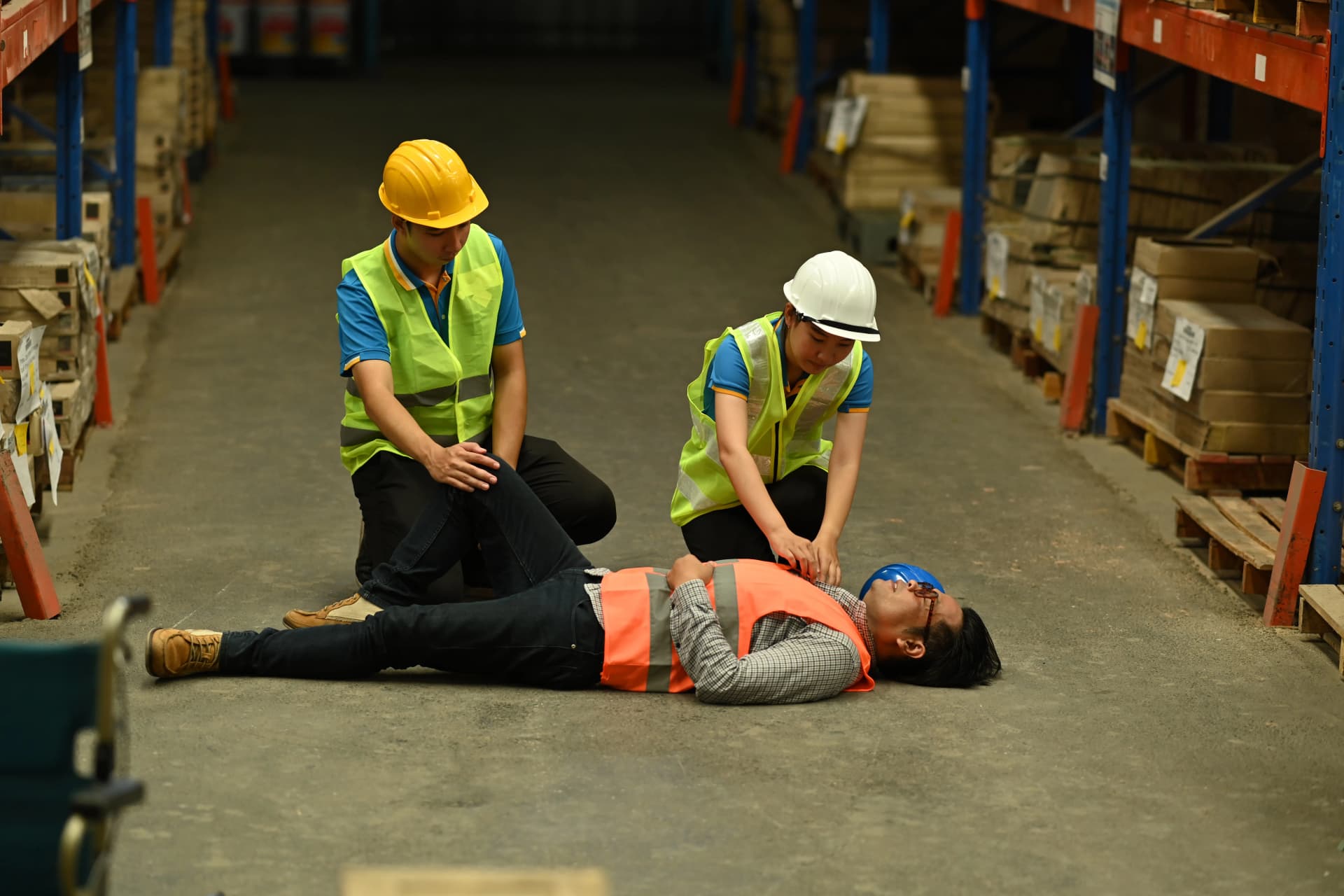
 Obligations When an Industrial Accident Occurs
An industrial accident refers to a case in which a worker dies, is injured, or contracts an occupational disease in connection with work due to structures, machinery, equipment, raw materials, gas, vapor, dust, or similar causes.
Among industrial accidents, a case in which one or more workers die, two or more workers are simultaneously injured requiring medical care for three months or more, or ten or more injured workers or workers with an occupational disease arise at the same time is treated as a ‘serious industrial accident.’


Immediate Measures When an Industrial Accident Occurs
If an accident requiring industrial accident reporting occurs, the employer must first focus on securing the life and safety of the injured person.
When an industrial accident occurs, the principle is to take measures in the following order.
1. Suspend work when an accident occurs
-Prevent additional accidents
-Move the injured person to a safe zone
-Minimum measures by the workplace safety manager
-Call 119 and transport by ambulance
2. Investigate the cause of the accident and report
-Preserve the accident scene for the on-site investigation by the labor inspector
-Record the cause of the accident
-Establish the outline of the occurrence, the cause, the timing of reporting, and a plan to prevent recurrence
-Submit the industrial accident investigation report
2. Industrial Accident Reporting | Accident Investigation and Reporting Procedures
Industrial accident reporting is not a mere administrative procedure.
Article 57 of the Occupational Safety and Health Act requires the employer to accurately record and preserve the facts of the accident, and specifies that an industrial accident investigation report must be prepared and submitted.
The basic principles of industrial accident reporting are as follows.
Items to Be Entered in the Industrial Accident Investigation Report
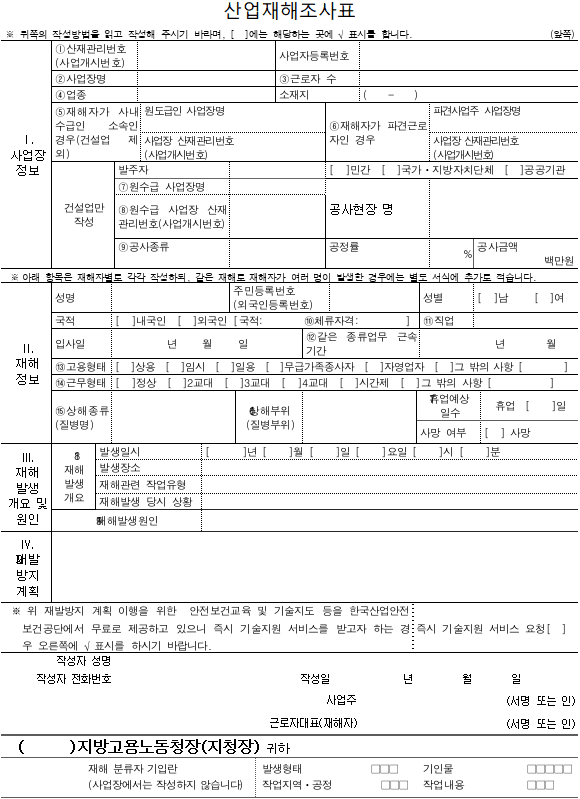
The industrial accident investigation report, which must be submitted when reporting an industrial accident, is prepared according to the form established by the Korea Workers' Compensation and Welfare Service.
It must include the workplace overview, the worker's personal details, the date and place of the accident, the cause and course of the accident, and a plan to prevent recurrence of the accident.
The industrial accident investigation report and related records must be preserved for three years.
In actual industrial accident reporting, the following key items must be entered in the report without omission.
1) Workplace information
- Industrial accident management number (business commencement number):if enrolled in industrial accident insurance, enter the relevant number (if not enrolled, enter the National Tax Service business registration number)
- Workplace name:enter the name of the workplace where the injured person actually concluded an employment contract (for a dispatched worker, enter the name of the using employer's workplace that actually directs and gives orders)
- Number of workers:enter the recent number of workers, including permanent, daily, and trainee workers
- Industry:enter the most detailed classification (5 digits) of the Korean Standard Industrial Classification of Statistics Korea (if unknown, enter the industry name and main products)
- Subcontractor and prime contractor:if the worker belongs to a subcontractor's workplace, enter the prime contractor's workplace name and industrial accident management number as well
- Construction status (construction industry):enter the type of construction, the rate of progress, the construction amount, and similar information on the basis of the prime contractor
2) Injured person information
- Status of stay:for a foreign worker, the status-of-stay code (such as E-9)
- Occupation:the Korean Standard Classification of Occupations (5 digits) or the job title and main duties
- Length of service:the total period worked in the same or similar duties
- Type of employment:permanent, temporary, daily, self-employed, unpaid family worker, and similar
- Work pattern:regular, shift work (two-shift, three-shift, and similar), part-time, and similar
- Type of injury (disease name):a specific injury name such as fracture, contusion, asphyxiation, poisoning, or burn
Fact-Finding Investigation by the Korea Workers' Compensation and Welfare Service and Others
The competent local labor office and the Korea Workers' Compensation and Welfare Service that receive the report of an industrial accident investigate the relevant facts of the industrial accident.
Regarding the medical care benefits applied for by the worker, if the employer disputes the facts, the employer may submit a written opinion.
In this case, the employer must submit the employment contract, attendance records, wage ledger, and similar documents to the Service and cooperate in calculating the average wage.
In particular, since 2018, the ‘employer confirmation system’ has been abolished when applying for medical care benefits, so a worker may apply directly for industrial accident insurance without the company's approval.
Therefore, an employer who attempts to obstruct or conceal an industrial accident insurance application may be subject to separate criminal punishment, so particular care is required.
Model Example of an Industrial Accident Investigation Report
The Ministry of Employment and Labor provides a model example for completing the industrial accident investigation report. Among these, examples for the outline and cause of the accident and the plan to prevent recurrence are introduced.
1. Type of work related to the accident
Installation of solar modules on 21 canopies (simple roofs) in the site parking lot and on the canopy roofs (height 5m) (by the day before the accident, all 21 canopies had been installed and solar modules had been installed on 6 of them)
2. Situation at the time of the accident
1) On that day, a total of 8 people, including the site manager, were divided into two teams (3 people and 5 people) starting at 09:00, set up an extendable ladder (two-stage slide type, stage 1: 4.12m, stage 2 when extended: 7.28m) on a canopy, and began installing solar modules on the roof
2) The injured person belonged to the three-person team that included the site manager and was carrying out steel plate cutting work for solar module installation on the roof of the 7th canopy
3) Around 10:40, due to sudden heavy snow, the corrugated steel plate roof became slippery and work was impossible, so the site manager and fellow workers used the already set-up ladder to withdraw to the ground, and moved and set up the ladder at the work position of the injured person, who could not move because of the slipperiness
4) The moment the injured person stepped on the slide-type ladder extended to the second stage in order to descend, the second stage of the ladder slid into the first stage, and the accident occurred in which the person fell to the ground and suffered a head injury
3. Cause of the accident
-The extendable ladder is a type that is set up and fixed to the roof with an attached safety hook
-Because the safety hook was not fixed to the roof, the ladder folded when the injured person used it, causing the fall accident
-During the work at height, the worker did not wear personal protective equipment such as a safety harness and safety helmet
4. Plan to prevent recurrence
1) When using an ascending and descending ladder, securely fix the ladder so that it does not fold unexpectedly during use
2) When workers work in places with a risk of falling, have them wear personal protective equipment such as a safety harness and safety helmet
3) During work at height, conduct a risk assessment to prevent accidents such as falls, establish an organization for safety management, and provide related education
3. Industrial Accident Reporting | The Need for Legal Assistance

If an employer delays reporting an industrial accident or conceals the facts, the employer becomes subject to criminal liability and administrative disposition under the Occupational Safety and Health Act.
In addition, if the employer conceals the occurrence of an industrial accident, or solicits or conspires to conceal it, even a sentence of imprisonment may be imposed.
Concealment of the occurrence of an industrial accident | Imprisonment for up to one year or a fine of up to 10 million won |
Damaging the scene of a serious accident or obstructing the cause investigation | |
Failure to suspend work when a serious accident occurs | Imprisonment for up to five years or a fine of up to 50 million won |
Failure to report or false reporting of the occurrence of an industrial accident | Administrative fine of up to 15 million won |
Failure to report or false reporting of the occurrence of a serious accident | Administrative fine of up to 30 million won |
Criteria for Imposing Administrative Fines
If the industrial accident investigation report is not completed in good faith or is not reported, an administrative fine of up to 15 million won is imposed.
However, if the size of the workplace or the scale of the construction work is not large, the administrative fine may be reduced by approximately 10 to 30 percent.
The administrative fines for failing to report an industrial accident are as follows. (A false report is subject to 15 million won regardless of the number of offenses.)
- First violation: 7 million won
- Second violation: 10 million won
- Third violation: 15 million won
4. Industrial Accident Reporting | Public Disclosure of Workplaces Where Industrial Accidents Occurred
To prevent industrial accidents, the Ministry of Employment and Labor publicly discloses workplaces in the following cases.
What is the fatality rate per ten thousand?
The annual ratio of fatalities per ten thousand regular workers
-(Number of accident fatalities / number of regular workers) × 10,000
-Rounded at the third decimal place
-Includes disease fatalities caused by abnormal temperatures
-Excludes traffic accidents outside the workplace, sports events, acts of violence, ordinary commuting deaths, and similar
Submission of the Integrated Industrial Accident Status Report
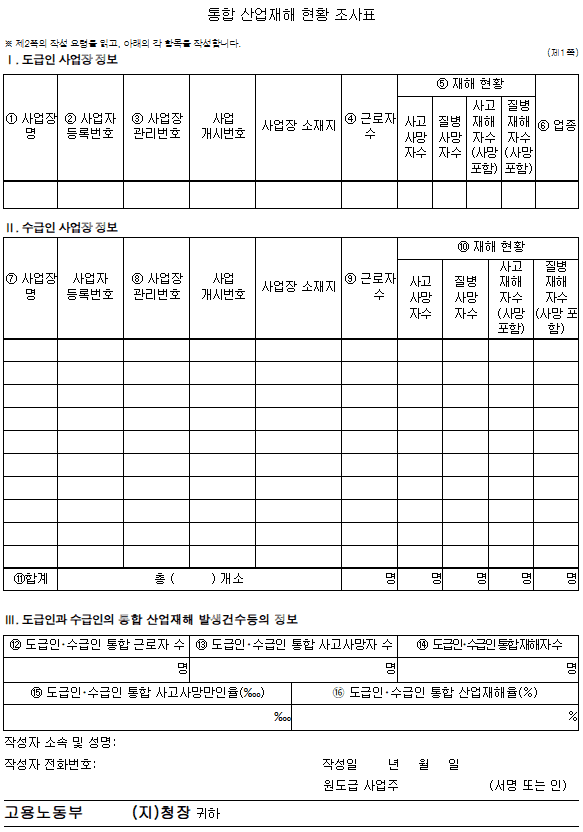
In particular, among workplaces where an industrial accident fatality or a serious industrial accident occurred, if the contractor violated the obligation to take measures to prevent industrial accidents to the workers of the related subcontractor, and the workers of the related subcontractor suffered an industrial accident, the resulting number of industrial accident occurrences is also publicly disclosed.
A workplace in the manufacturing industry, railway and urban railway transport industry, or electric power industry with 500 or more regular workers and an accident fatality rate per ten thousand, calculated to include the workers of the related subcontractor, that is higher than the accident fatality rate per ten thousand of the contractor's own workplace, must prepare and submit an integrated industrial accident status report.
The status of the contractor's and subcontractor's workplaces and the status of industrial accidents must be prepared on the basis of accidents that occurred in the previous year (the report submitted in 2025 is based on accidents in 2024).
The integrated statistical status of prime contractor and subcontractor industrial accidents is scheduled to be publicly disclosed around December each year.
If this is not submitted or is falsely submitted, an administrative fine of up to 10 million won is imposed.
Recommendations for Employers
Reaching a settlement with the worker through private compensation without reporting the occurrence of an industrial accident may appear reasonable at first glance, but it is subsequently an act whose risk far outweighs any savings, given criminal punishment for concealing an industrial accident and additional collection if discovered through the worker's reapplication for industrial accident insurance.
Therefore, all occupational accidents must be formally reported through industrial accident reporting and then handled.
Industrial accident reporting is a means of demonstrating that the company's safety and health management system is actually functioning.
Since the enforcement of the Serious Accidents Punishment Act, in the event of a fatal accident, an employer may be sentenced to imprisonment for a definite term and a fine of up to several billion won depending on whether safety and health obligations were violated.
To avoid severe criminal punishment, conducting routine risk assessments, recording and preserving the causes of accidents, and reporting accidents promptly are necessary.
To prevent industrial accidents in advance, please provide on-site education for safety management personnel and workers, and also obtain advice from experts such as industrial accident attorneys and labor attorneys from time to time so that you can prevent recurring accidents.
Our firm's task force of industrial accident attorneys and labor attorneys can handle, on a one-stop basis, the step-by-step response after industrial accident reporting and disputes under the Industrial Accident Compensation Insurance Act.
See More