
CONTENTS
- 1. Business Combination | Concept

- - Types of Business Combination
- 2. Business Combination | Reasons for Review
- - Review Criteria
- - Review Period
- 3. Business Combination | Pre-Consultation System
- 4. Business Combination | Filing
- - Business Combinations Subject to Filing
- - Filing Targets by Type
- - Documents to Be Submitted
- - Filing Procedure
- 5. Business Combination | Response Strategy
- - Support System of Attorneys for Mergers and Acquisitions

1. Business Combination | Concept

A business combination refers to two or more companies integrating their capital, personnel, and organization through methods such as the acquisition and ownership of shares, interlocking directorates, mergers, the transfer of business, or participation in the establishment of a new company.
 Types of Business Combination
Category | Description |
Acquisition·Ownership of Shares | Acquiring or coming to own shares in another company |
Interlocking Directorate | A case in which an officer or employee of a large-scale company with assets or sales of 2 trillion won or more concurrently serves as an officer of another company |
Merger | A case in which a company merges with another company |
Transfer of Business | A case of acquiring the business of another company |
Participation in Company Establishment | A case of participating in the establishment of a new company |


2. Business Combination | Reasons for Review
A business combination can reduce investment risk through the effect of diversified investment.
It can also be expected to bring cost-saving effects by responding strategically to technological innovation and market changes and by realizing economies of scale.
However, because combinations between competitors are sometimes used as a means of artificially strengthening market power, business combinations that may restrict competition in the market require close review and analysis.
Through this, measures that can effectively correct the harm caused by the restriction of competition must be prepared.
Business combination review is one of the core tasks of the competition authorities in major advanced countries, and Korea, too, introduced a business combination review system with the enforcement of the Monopoly Regulation and Fair Trade Act in 1981 and has operated it to the present.
Review Criteria
To proceed with a business combination, a filing must be made, and beforehand it is important to confirm the business combination review criteria under the Monopoly Regulation and Fair Trade Act.
This is because, depending on the result of the Fair Trade Commission's review, a correction order may be issued, and the approval of the business combination may be decided based on the submission of additional supplementary materials.
Even after corrective measures are decided, response measures must be prepared, and expertise regarding the competition-restricting nature of business combinations is required.
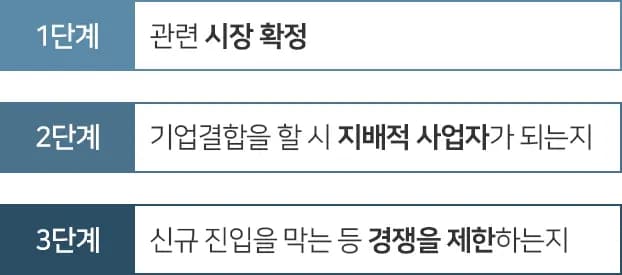
The business combination review criteria are as follows.
▷ Whether the combination would create a dominant business operator
▷ Whether it would restrict competition, such as by blocking new entry
Review Period
In the case of a prior filing, the review is required to be conducted within 30 days of the filing (extendable up to 90 days).
3. Business Combination | Pre-Consultation System

Regarding the business combination pre-consultation system, from August 2024 the Fair Trade Commission introduced a system that allows pre-consultation on core issues such as the transaction structure, the relevant market, and the competition-restricting nature before a business combination filing.
This is a system designed to allow companies to communicate with the Fair Trade Commission from the stage before filing, thereby reducing unnecessary document submissions and minimizing review delays.
Pre-consultation must be requested up to 2 weeks before the formal filing date, and issues such as whether a simplified review applies, the transaction structure, the competition-restricting nature, and the scope of disclosure of sensitive information may be discussed.
4. Business Combination | Filing
A business combination above a certain scale is filed with the Fair Trade Commission and undergoes review.
As a rule, all business combinations that restrict competition are prohibited, but to ease the burden on companies and improve administrative efficiency, the filing obligation is imposed only on business combinations above a certain scale that have a high likelihood of restricting competition.
Business Combinations Subject to Filing
| Filing Company | Assets or sales of 200 billion won or more |
| Counterparty Company | If assets or sales are 20 billion won or more |
Filing Targets by Type
Category | Description |
Acquisition of Shares | A case of acquiring 20% (15% for a listed company) or more of the total number of issued shares of another company (excluding non-voting shares), or becoming the largest shareholder through the additional acquisition of shares |
Interlocking Directorate | A case in which an officer or employee of a large-scale company concurrently serves as an officer of another company |
Merger | A case of merging companies |
Transfer of Business | A case of acquiring a business |
Participation in Company Establishment | A case of becoming the largest shareholder of a newly established company |
Documents to Be Submitted
Common Documents
▷ Status of affiliated companies
In the Case of a Share Acquisition Filing
▷ Shareholder status of the filing company
▷ Shareholder status of the counterparty company
▷ Relevant market conditions, such as supply and demand of major products
▷ Overview of the business combination
▷ Copies of supporting evidence relating to the share acquisition
▷ Plan for interlocking directorates
▷ Certified public accountant's audit reports of the filing party and the counterparty company
▷ In the case of a re-filing, the initial filing date and the equity ratio at the time of the initial filing
▷ Additional documents in the case of a share acquisition by a private equity fund
In the Case of an Interlocking Directorate
▷ Status of shareholders and officers
▷ Relevant market conditions, such as supply and demand of major products
▷ Overview of the business combination
▷ A copy of the minutes of the appointment of the officer
▷ One copy each of the certified public accountant's audit reports of the filing company and the counterparty company
▷ Additional documents in the case of an interlocking directorate by a private equity fund
In the Case of a Merger Filing
▷ Status of shareholders and officers
▷ Relevant market conditions, such as supply and demand of major products
▷ Overview of the business combination
▷ Merger agreement and the certified public accountant's audit reports of the companies party to the merger
In the Case of a Transfer of Business Filing
▷ Shareholder status
▷ Business details of the entire corporate group (where the filing company belongs to a corporate group)
▷ Relevant market conditions regarding supply and demand of major products
▷ Overview of the business combination
▷ Copies of supporting evidence relating to the transfer of business
▷ One copy each of the certified public accountant's audit reports of the filing company and the counterparty company
In the Case of a Filing for the Acquisition of Shares in a Newly Established Company
▷ Shareholder status of the newly established company
▷ Shareholder status of the filing company
▷ Relevant market conditions, such as supply and demand of major products
▷ Overview of the business combination
▷ Copies of supporting evidence relating to the company establishment
▷ Overview of the company that has been or is to be newly established
▷ Plan for interlocking directorates
▷ Certified public accountant's audit reports of the filing company and the counterparty company
▷ Business plan of the newly established company
▷ Additional documents where a private equity fund participates in the establishment of another company
Filing Procedure
① Pre-Consultation
Pre-consultation is conducted with the relevant department of the Fair Trade Commission regarding whether the business combination is subject to filing and the related filing procedure.
② Submission of the Filing Form
After preparing the filing form through the Fair Trade Commission's business combination filing website or Minwon 24, the relevant documents are attached and submitted.
③ Review
Based on the submitted materials, the Fair Trade Commission conducts a review of whether the business combination restricts competition.
④ Notification of the Result
Depending on the result of the review, measures are taken such as the business combination being approved, conditionally approved, or denied, and the result is notified to the filing party.
5. Business Combination | Response Strategy
Because business combinations involve complex issues such as the restriction of competition and market impact, a systematic and strategic response is needed from the outset.
Stage | Response Strategy |
Checking Whether It Is Subject to Filing | - Reviewing whether the combination method (share acquisition, merger, etc.) meets the business combination requirements under the Monopoly Regulation and Fair Trade Act |
Advance Preparation for Review and Organizing Materials | - Securing objective grounds, such as analysis of the competition-restricting nature and market share data |
Developing a Strategy for Responding to the Fair Trade Commission | - Preparing a logical response emphasizing that there is no concern of restricting competition |
Preparing for Correction Requests and Corrective Measures | - Preparing materials in anticipation of correction orders during the review process |
Responding to a Denial or Conditional Approval | - If a denial is decided, reviewing the appeal procedure and setting the direction of the response |
Support System of Attorneys for Mergers and Acquisitions
This firm includes many attorneys with an average of more than 10 years of experience, and we handle cases by forming a TF of 1 to 20 members.
We provide systematic support throughout the entire process, from preliminary consultation before a business combination filing to the preparation of the filing, its submission, and the response to review, and we prepare for the Fair Trade Commission's review through analysis of competitive restraints and assessment of market impact.
We also carefully manage everything from responding to correction orders to implementing remedial measures under a conditional approval, so that the client can complete the business combination smoothly.
After a business combination is approved, we establish a system for post-completion management and legal risk management to provide continued legal support.
If you are experiencing difficulties with a business combination filing, please request a consultation with an attorney for mergers and acquisitions.
See More