
CONTENTS
- 1. Customs Refund | A Core System for Enhancing Price Competitiveness

- - Raw Materials Eligible for Refund
- - Goods with Restricted Customs Refund
- 2. Customs Refund | Definition and Classification by Type
- - Methods of Individual Refund and Simplified Fixed-Amount Refund
- 3. Customs Refund | Refund Procedure and Investigation Method
- - Methods of Calculating the Required Quantity and the Advance Review System
- - Methods of Calculating a Customs Refund
- - Payment of the Refund Amount and Punishment of Customs Offenders
- 4. Customs Refund | Points to Note for Companies Applying for a Refund

1. Customs Refund | A Core System for Enhancing Price Competitiveness

A customs refund is a core system that reduces the cost burden on exporting companies and increases the turnover rate of funds, which in turn enhances price competitiveness.
For manufacturers that use imported raw materials as raw materials for exports and foreign currency earnings, the tax burden, such as customs duties paid, is reflected directly in export costs, so a refund of these duties has a substantial effect on a company's profitability and competitiveness.
As manufacturing costs rise due to instability in global supply chains and exchange rate fluctuations, customs refunds are drawing attention as a means of securing liquidity.
From the government's perspective, promoting exports through refunds also helps earn foreign currency and strengthen national competitiveness.
 Raw Materials Eligible for Refund
The raw materials for which customs duties, etc. can be refunded (raw materials for export) are as follows.
In this case, the required quantity must be objectively calculable.
In addition, where domestically produced raw materials and imported raw materials are identical and can be used interchangeably, the raw materials for export are deemed to have been used.
1. When producing export goods
-Goods physically and chemically combined into the relevant export goods
-Goods input into and consumed in the production process of the relevant export goods (excluding consumable items indirectly input into the production of the export goods0
-Packaging materials for the relevant export goods
2. When exporting in the imported state as is
-The relevant export goods


Goods with Restricted Customs Refund
Not all raw materials are eligible for a customs refund.
Where there is a concern that domestic industry may be harmed or that the growth and development of domestic industry may be substantially delayed, the refund is restricted by a certain ratio under the Customs Act.
- Goods subject to anti-dumping duties
- Goods subject to countervailing duties on subsidies and grants
- Goods subject to retaliatory duties where there is a concern of infringement of trade benefits
2. Customs Refund | Definition and Classification by Type
A customs refund, a system that later refunds customs duties paid on imported raw materials used directly for export, is established under the 「Customs Act」 and the 「Act on Special Cases concerning the Refund of Customs Duties, etc. Levied on Raw Materials for Export」 (hereinafter ‘the Special Act on Customs Refunds’).
A customs refund must be applied for within 5 years from the date the goods were provided for export and the like, and customs duties, etc. (including customs duties, temporary import surtax, and individual consumption tax) on the raw materials for export of the relevant goods that were imported within 2 years (the export fulfillment period), calculated retroactively from the last day of the month in which the goods were provided for export and the like, are refunded.
Customs refunds can be broadly classified as follows.
- Individual refund: A refund settled based on the actual import and export history and the record of raw material use
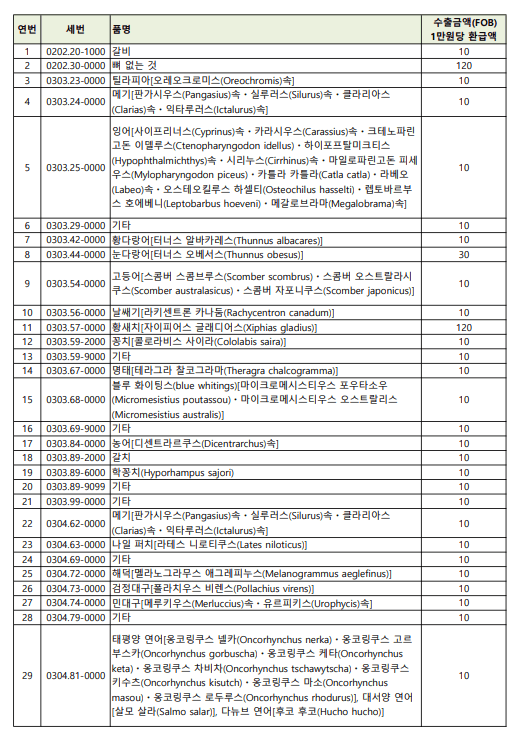
- Simplified fixed-amount refund: A refund calculated by multiplying the export amount by a fixed refund rate (focused on small and medium-sized enterprises)
Methods of Individual Refund and Simplified Fixed-Amount Refund
For an individual refund, the tax amount paid when importing the raw materials used to manufacture the export goods is calculated, and the refund amount is paid.
When an item eligible for the simplified fixed amount is exported, a fixed amount per 10,000 won of the export amount is paid as the refund.
3. Customs Refund | Refund Procedure and Investigation Method
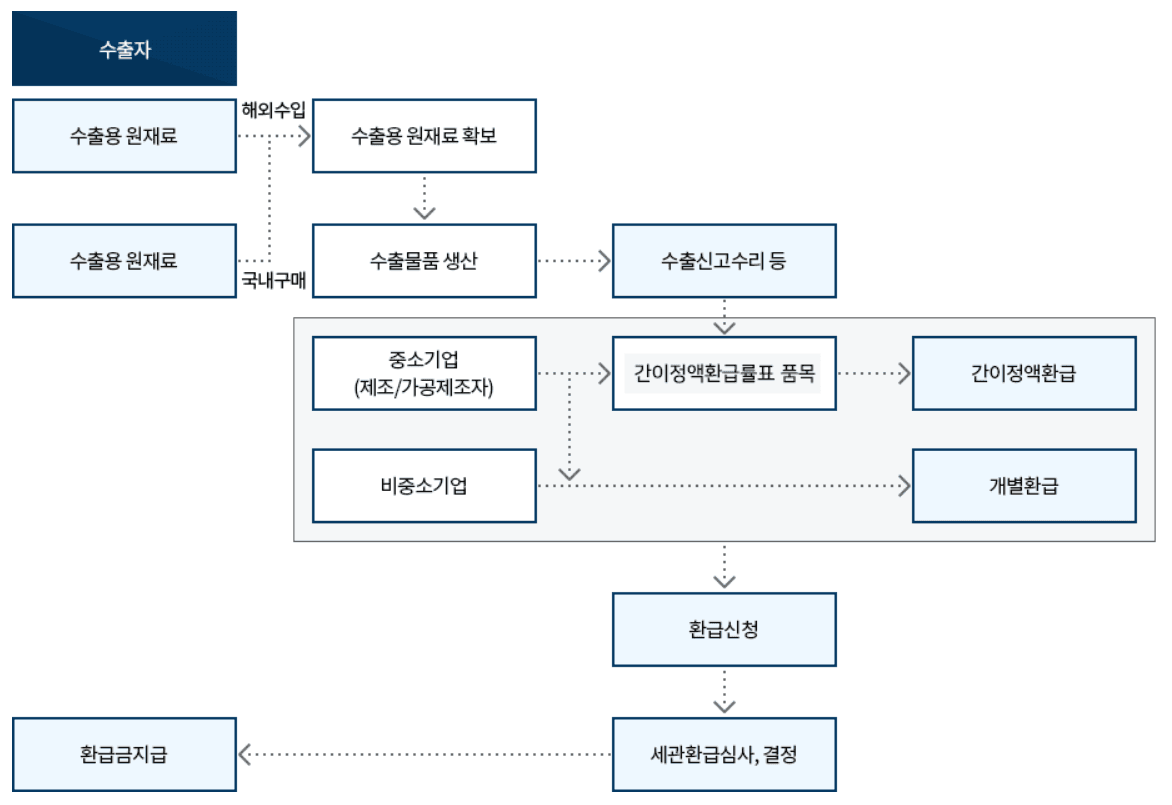
| Import of raw materials (raw materials eligible for refund) → Manufacturing and processing → Product and export (export eligible for refund) → Customs refund application |
The basic flow of a customs refund is as follows. (Based on an individual refund)
Import of raw materials | -Tax amount paid on raw materials imported from abroad -For domestic purchases, proof of the tax amount paid through a certificate of tax payment on basic raw materials, a certificate of import tax amount division, a certificate of average tax amount, and the like |
Manufacture of export goods | -The imported raw materials are physically and chemically combined into the export goods -Goods that are input into and consumed in the production process of the export goods, as well as packaging materials for the export goods, are also included as raw materials eligible for refund |
Calculation of the required quantity | -Calculation of the required quantity for producing the export goods according to the self-assessed required quantity, the standard required quantity, and the like |
Refund application | -Refund application within 5 years from the date of provision for export and the like |
Payment of the refund amount | -Review of the validity of the submitted materials and determination of the refund amount |
Post review | -Remittance to the designated account -After the refund amount is paid, its accuracy may be reviewed |
Methods of Calculating the Required Quantity and the Advance Review System
Where the calculation does not cover the total required quantity for the relevant case, the required quantity is calculated as follows.
Required quantity = Quantity of export goods × unit actual quantity (unit design required quantity, unit required quantity per certain period, unit required quantity per fiscal year, and the like)
Before applying for a refund, a company can have the head of customs confirm in advance whether the required-quantity calculation is appropriate, and the like.
This can resolve difficulties in the complex required-quantity calculation process, such as whether raw materials are eligible for refund and how to calculate by-products, and it can also prevent subsequent collection or under-refund caused by an erroneous required-quantity calculation.
The period of validity of the result of the advance review of the required quantity is 1 year from the date the notice is received.
In addition, if there is no change to the facts from the previous application, a renewal application can be made up to 2 months before the period of validity expires.
An advance review of the required quantity can be requested, together with an explanation of the applied-for goods, the applied-for raw materials, the manufacturing process, and the like, and in this case the following documents must be submitted.
Methods of Calculating a Customs Refund
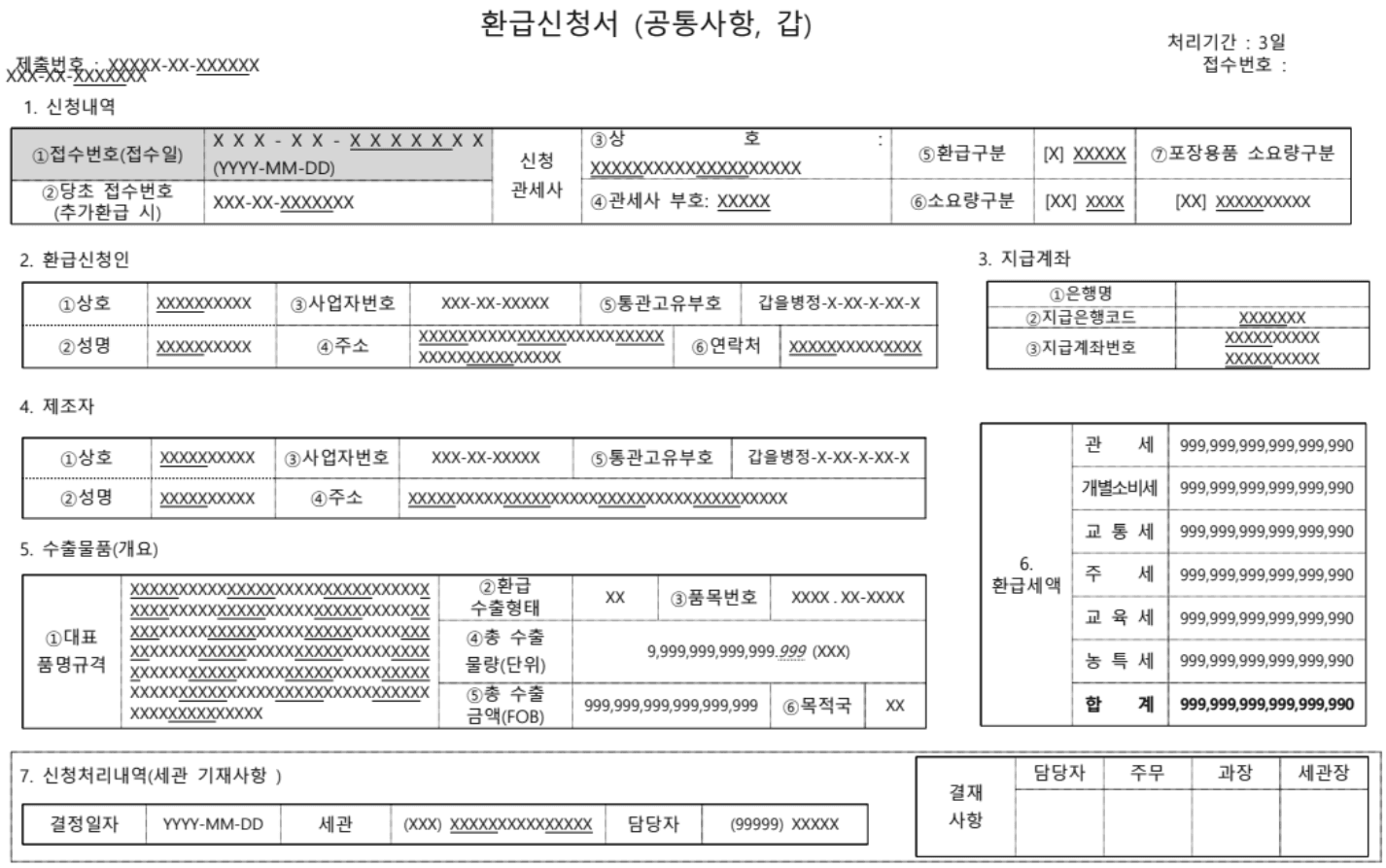
The refund applicant prepares the documents for calculating the required quantity of raw materials for the export goods, and the refund amount is calculated based on that required-quantity calculation statement.
Where two or more goods are produced using raw materials for export, the customs duties and other charges are refunded based on the price of the goods produced.
Also, where raw materials for export may be over- or under-refunded because of changes in the customs rate or import price, the application of two or more customs rates, or similar factors, the refund is adjusted by setting a short period of validity or by setting a refund quantity.
Payment of the Refund Amount and Punishment of Customs Offenders
Once the customs refund amount and related charges are settled, the head of customs refunds the customs duties and other charges on the raw materials for export of the relevant goods imported within 2 years, calculated retroactively.
The refund amount is paid by deposit into the account designated by the refund applicant.
If a refund is denied even though a taxpayer meets the requirements for it, the taxpayer can request written notice or contest the decision through an objection or a similar remedy.
- Objection: Filed with customs (within 90 days)
- Request for review or review by the Board of Audit and Inspection: National Tax Service or the Board of Audit and Inspection (within 90 days)
- Administrative litigation: Filed with the administrative court (within 90 days)
However, where an excess refund arises from a false required-quantity calculation, duplicate refunds, or the falsification of a raw material tax payment certificate, it is collected separately through measures such as the imposition of a penalty tax.
Also, if a person is treated as a customs offender, the likelihood of receiving the following punishments increases, depending on the investigation and disposition by customs officials.
Customs refund by false or improper means | Imprisonment for up to 3 years or a fine of up to 5 times the refunded tax amount, with attempts also punishable |
False preparation of a required-quantity calculation statement, improper issuance of a certificate of tax payment on basic raw materials, and the like | Imprisonment for up to 3 years or a fine of up to 20 million won |
Inadequate retention of customs refund documents (5-year retention period) | A fine of up to 20 million won |
Failure to submit customs refund documents | A fine of up to 10 million won |
4. Customs Refund | Points to Note for Companies Applying for a Refund

For a customs refund, import declarations, export declarations, raw material purchase records, product shipment details, tax payment certificates, raw material warehouse release details, process diagrams, and similar items are subject to mandatory review.
In this case, the head of customs reviews the overall validity of the refund amount, the appropriateness of the simplified fixed-amount refund application, and the reliability of the company's refund history, among other factors.
A customs refund is a legitimate right guaranteed by law, and it is also a system that can create serious legal risk if it is misused intentionally or negligently.
A company should therefore regularly review the required quantity and use systems such as advance review to keep transparent electronic records when preparing for a refund.
This firm provides customs refund consulting through a task force of customs attorneys and customs specialist advisors.
| ▶ Advice on building an automatic import–production–export history linkage system |
| ▶ Blocking errors in advance and managing risk through regular internal audits and expert consulting |
| ▶ Selecting a suitable method, such as the self-assessed required quantity or the standard required quantity |
▶ Assistance in simplifying procedures where the simplified fixed-amount refund can be used |
See More