
CONTENTS
- 1. Religious and Special Immigration (EB-4) | Guide to the Special Immigration Procedure

- 2. Religious and Special Immigration (EB-4) | Religious Worker Immigration
- - Requirements for the Employing Organization
- - Petition Procedure and Supporting Evidence
- - Site Inspection and Request for Premium Processing
- 3. Religious and Special Immigration (EB-4) | Special Immigrant Juvenile (SIJ)
- 4. Religious and Special Immigration (EB-4) | Journalists at Certain Broadcasters
- 5. Religious and Special Immigration (EB-4) | Application Procedure and Points of Caution
- - Points of Caution for Religious Worker Applications
- 6. Religious and Special Immigration (EB-4) | Scope of an Immigration Attorney's Assistance

1. Religious and Special Immigration (EB-4) | Guide to the Special Immigration Procedure
Religious and special immigration (EB-4) refers to eligibility to apply for an immigrant visa in the fourth preference among employment-based immigration categories.
U.S. immigration law provides legal immigration opportunities to foreign nationals of diverse backgrounds and qualifications.
Among these, religious and special immigration (EB-4, Employment-Based Fourth Preference) is an immigrant visa for religious workers, special immigrant juveniles, and broadcasting personnel such as those at the U.S. Agency for Global Media, Radio Free Asia (RFA), and Radio Free Europe, among others.
The special immigrant category is a distinct immigration path for specific groups that promote the public interest of U.S. society or meet humanitarian needs.
Among Koreans, those who mainly serve at religious organizations or work as clergy are pursuing immigration through religious worker special immigration, and minors in the United States who need protection may also obtain permanent residency through Special Immigrant Juvenile (SIJ) status.
Religious and special immigration (EB-4) has more specific eligibility requirements than other employment-based immigration categories and a smaller backlog of demand, so it can be a very effective option for Korean religious workers and protected juveniles who are able to prepare for immigration.
However, the eligibility requirements, document requirements, and review standards are precisely structured, so thorough preparation and a strategic approach in advance are required.



2. Religious and Special Immigration (EB-4) | Religious Worker Immigration
Religious and special immigration (EB-4) for religious workers, that is, clergy such as pastors and non-clergy, is an immigration path through which one applies to perform religious activity for at least 35 hours per week at a nonprofit religious organization in the United States while carrying out religious duties.
The applicant must have been a member of the relevant denomination for at least 2 years immediately before filing the petition (I-360) and have a record of continuous religious activity.
However, note that from September 30, 2025, onward, non-clergy religious workers may be unable to apply in this category (pastors and the like are excluded).
If immigration eligibility is obtained through religious and special immigration (EB-4), a spouse and unmarried children under 21 may also enter the United States together.
 Requirements for the Employing Organization
The religious employing organization must be a religious organization recognized by the IRS as a tax-exempt organization, or a nonprofit organization affiliated with a religious denomination.
The organization's religious character must be clearly proven through its articles of association, brochures, official website, and the like, and a tax-exemption determination letter and an organization certificate must also be submitted.
Petition Procedure and Supporting Evidence
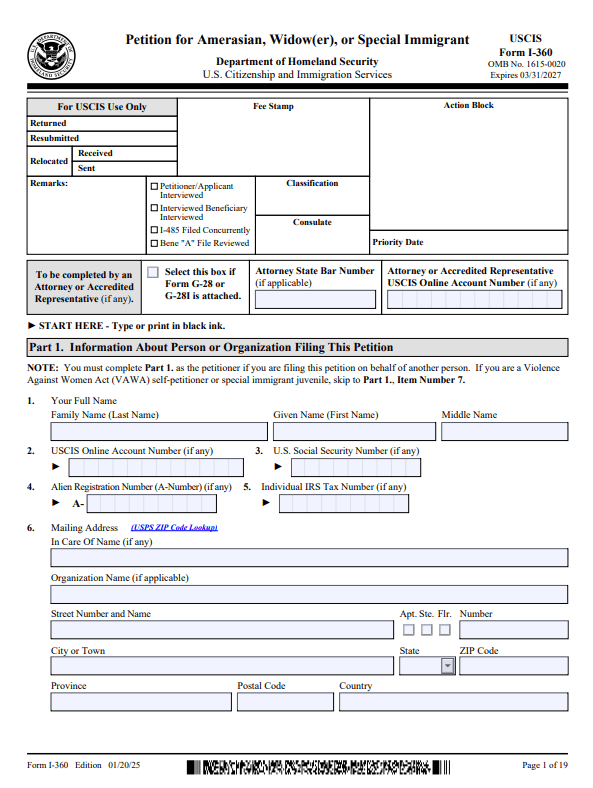
The petition is filed using Form I-360, and the following must be proven.
• Proof of denomination membership (for at least the most recent 2 years)
• Employment contract with the religious organization and a plan for salary or in-kind compensation
• Proof of qualification to perform religious duties (pastor's certificate, theological course completion certificate, and the like)
• Detailed materials on past religious activity (W-2, tax returns, service records, and the like)
Even where the form of compensation is not a salary, the provision of room and board, self-funded means of subsistence, and similar details must be clearly stated, and if the legitimacy of the means of subsistence cannot be proven, the petition may be denied.
Site Inspection and Request for Premium Processing

USCIS confirms the substance of the employing organization and whether religious activity is taking place through a site visit to the denomination.
The On-Site Inspection of churches, which was previously mandatory, was suspended as a matter of policy from March 2023, but note that random site inspections may still be conducted.
Grounds such as a mismatch between the place of employment and the address, an insufficient labor cost budget, and unclear duties may have a negative effect, so consistency between the submitted documents and the actual situation is important.
In addition, for urgent religious and social purposes, a request for premium processing may be made to USCIS.
In this case, the likelihood of approval is higher if the urgency is explained around the beneficiary's need to make a social contribution, rather than simply citing a shortage of on-site personnel.
A point to note is that after EB-4 permanent residency is approved, changing the sponsoring organization or planting a new church is not possible as a general rule.
See More
3. Religious and Special Immigration (EB-4) | Special Immigrant Juvenile (SIJ)
Religious and special immigration (EB-4) includes the Special Immigrant Juvenile (SIJ), an immigration classification given to unmarried foreign juveniles under 21 who are in the United States and have suffered abuse, abandonment, or neglect by a parent.
To apply for SIJ, there must be a valid juvenile court order from a state court stating the following.
• The juvenile is under the protection of the court or the jurisdiction of a protective agency
• Reunification with one or both parents is not possible
• Return to the country of origin is not in the juvenile's best interest
These requirements have a humanitarian character in that they are not merely a means of immigration but serve to provide relief to juveniles who need protection in the United States.
4. Religious and Special Immigration (EB-4) | Journalists at Certain Broadcasters
The Religious and Special Immigration (EB-4) category provides immigration eligibility to employees of certain broadcasters.
Among Korean nationals working in broadcasting, a person who is hired by the U.S. Agency for Global Media (USAGM) or its grantee organizations (RFA Radio Free Asia, Radio Free Europe, and others) and performs duties in news broadcasting roles may immigrate through the Religious and Special Immigration (EB-4) program by means of a sponsor's petition. (Technical support staff excluded)
[Broadcasting Roles]
- News Broadcast Reporters
- Writers and Translators
- Editors and Producers
- Announcers
- Hosts of News Broadcasts, Analysis, and Similar Programs
5. Religious and Special Immigration (EB-4) | Application Procedure and Points of Caution
Religious and Special Immigration (EB-4) uses Form I-360.
The I-360 petition must be prepared systematically and consistently across each section.
If there is any contradiction between the employer's statement and the applicant's career history, even a minor inconsistency may become grounds for denial.
Points of Caution for Religious Worker Applications
1) Proof of Tax-Exempt Organization Status
The religious organization must have received a 501(c)(3) tax-exemption determination from the IRS, and the tax-exemption letter must be valid as of the petition date.
If the tax-exempt status of a parent organization, rather than the individual organization, is relied upon, separate documents proving this (such as an organizational chart and website captures) must also be submitted.
2) Supporting Materials and Establishing Credibility
Both religious workers and SIJ youth must prove the legitimacy of carrying out the relevant position and the credibility of the applicant.
The organization's budget proposal, financial materials, history of past activities, and proof of denominational affiliation are all key materials that convey objectivity and authenticity to the U.S. Citizenship and Immigration Services officer.
6. Religious and Special Immigration (EB-4) | Scope of an Immigration Attorney's Assistance

Religious and Special Immigration (EB-4) is a program that embodies the values of religion, welfare, and youth protection recognized by U.S. society.
From the perspective of Korean applicants, most may use this program based on their religious calling and activities; however, the process up to approval is complex and involves strict review.
• Legal review in advance of whether the applicant meets the eligibility requirements
• Proof of the religious organization's legal status and religious character
• Document preparation grounded in credibility and authenticity
• Formal requirements of Form I-360 and preparation for site investigation
We invite you to prepare for the Religious and Special Immigration (EB-4) process strategically together with an immigration attorney.
See More