
CONTENTS
- 1. Specialty Occupation Visa (H-1B) | Issuance Guidelines

- 2. Specialty Occupation Visa (H-1B) | Basic Eligibility Requirements
- - Educational Requirements for the Specialty Occupation Visa
- - Employer (Sponsor) Requirements
- 3. Specialty Occupation Visa (H-1B) | Subcategories of the H-1B Visa
- - Period of Stay and Extension
- 4. Specialty Occupation Visa (H-1B) | Application Procedure
- - LCA Review and Subsequent Procedures
- 5. Specialty Occupation Visa (H-1B) | Points to Note When Applying
- - Responding to RFEs and Denials
- - Connection with Employment-Based Immigration
- 6. Specialty Occupation Visa (H-1B) | The Need for Professional Assistance
- - Working Together with Immigration Attorneys, Including Foreign Attorneys Advising on U.S. Law (U.S.)

1. Specialty Occupation Visa (H-1B) | Issuance Guidelines
The specialty occupation visa (H-1B) is a representative nonimmigrant work visa that, under U.S. immigration law, allows a U.S. employer to hire foreign specialized personnel for a set period.
It is widely used mainly in fields that require a high degree of expertise, such as IT, engineering, finance, healthcare, and research and development.
Each year, many foreign workers from around the world join U.S. companies through the H-1B.
The H-1B is also a major route through which one may later apply for a green card via employment-based immigration (EB-2, EB-3) or family immigration.
In this case, once employment is secured, the green card process can proceed alongside it, and the wage offered may be at or above the average level.
However, the specialty occupation visa (H-1B) is difficult to obtain at all without an employer willing to act as a sponsor. (Under current law, the basic cap is 65,000, with an additional 20,000 quota allocated to holders of advanced degrees from U.S. institutions.)
Because the procedure is complex and the number of visas allocated is small, even with a sponsor, employment may become impossible if the allocated visas have all been exhausted.


2. Specialty Occupation Visa (H-1B) | Basic Eligibility Requirements
The core of the specialty occupation visa (H-1B) is that one must be able to prove that the position is a ‘Specialty Occupation’.
A ‘specialty occupation’ means a position that involves the theoretical and practical application of a body of highly specialized knowledge and requires, as the minimum condition for entering that occupation in the United States, a bachelor's degree or higher in the relevant specialty.
In other words, it can be defined as an occupation that requires, at a minimum, a bachelor's degree or its equivalent in order to perform a particular role.
That said, fashion models of distinguished merit and ability may also be hired temporarily as workers, and issuance of the specialty occupation visa (H-1B) is permitted for them as well.
 Educational Requirements for the Specialty Occupation Visa
As a general rule, an applicant must hold a four-year bachelor's degree or higher directly related to the position.
The major must closely match the position applied for.
For example, a computer engineer role calls for a degree related to computer engineering, software engineering, or information technology (IT).
In some cases, even without a bachelor's degree, experience in the relevant field may substitute for the degree.
Generally, 1 year of study may be treated as 3 years of relevant experience, so a person who holds an associate degree and has 6 or more years of practical experience meets the eligibility for the specialty occupation visa (H-1B).
That said, substituting experience requires very demanding supporting documents, so in practice most applicants are degree holders.
Employer (Sponsor) Requirements
For the specialty occupation visa (H-1B), a U.S. employer must actually exist and there must be genuine demand for the position.
The U.S. employer must submit a Labor Condition Application (LCA) to the Department of Labor and obtain approval.
The employer must also guarantee payment of at least the prevailing wage for the area to the foreign worker hired through the specialty occupation visa (H-1B).
3. Specialty Occupation Visa (H-1B) | Subcategories of the H-1B Visa
The specialty occupation visa (H-1B) is broadly divided into three subtypes.
Category | Main Targets | Notes |
H-1B (Specialty Occupations) | General specialty occupations | LCA required |
H-1B2 | Participants in cooperative research and development projects with the Department of Defense | LCA not required |
H-1B3 | Prominent fashion models | LCA required |
The H-1B2 applies to foreign specialized personnel participating in research and development projects in cooperation with the U.S. Department of Defense, and a separate LCA submission is exempted.
The H-1B3 applies only to fashion models who are internationally renowned and can prove distinguished ability.
Period of Stay and Extension
The H-1B visa is initially valid for 3 years and may be extended for an additional 3 years, allowing a stay of up to 6 years.
Even after an extension, one may, if necessary, proceed with the green card application process to lawfully continue their status of stay.
There is also the option of staying outside the United States for 1 year or more after an extension, and then applying again for the specialty occupation visa (H-1B).
Related News
4. Specialty Occupation Visa (H-1B) | Application Procedure
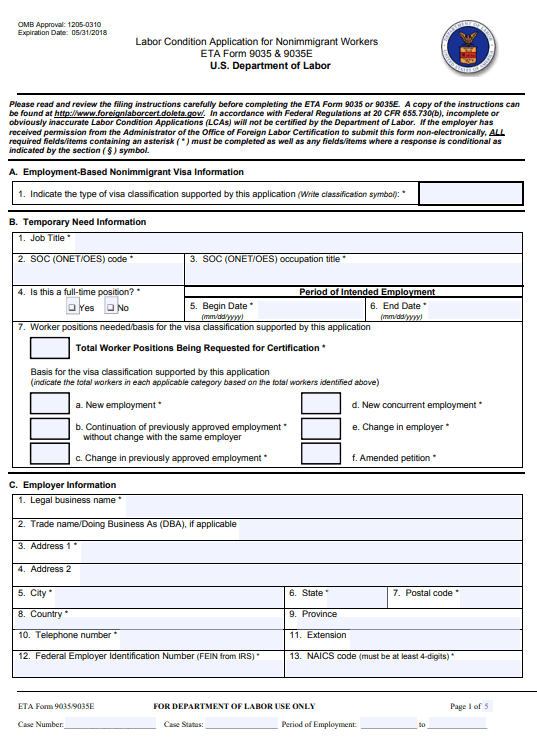
Determining the Prevailing Wage
The employer must first submit an LCA to the U.S. Department of Labor and obtain approval.
To do so, the prevailing wage must be determined beforehand.
The LCA is a mechanism confirming that the employer will pay the worker the prevailing wage for the area.
- Actual wage : the wage paid to other workers in the same occupation with the same experience and qualifications
- Prevailing wage : the average wage generally paid to those in the same occupation within the intended area of employment
If a higher wage is required under federal, state, or local law, it must be met accordingly.
Online LCA Submission (Cap Registration)
Around March each year, USCIS (the immigration service) announces the H-1B registration period. (For 2025, March 7 to March 24, Eastern Standard Time.)
Based on the approved LCA, the employer proceeds with electronic registration online.
Selection is made by random lottery among the registered applications.
- General quota of approximately 65,000
- An additional quota of 20,000 for holders of a master's degree or higher from a U.S. institution
If one is not selected in the lottery, application is not possible for that year, so early preparation each year is indispensable.
Note that the LCA may be submitted no earlier than 6 months before the start date of employment.
LCA Review and Subsequent Procedures
LCA Review and Subsequent Procedures
The Department of Labor reviews the submitted LCA within 7 working (business) days, checking matters such as whether it is accepted and whether there are any entry errors.
The employer can check the processing status through the FLAG system (Foreign Labor Application Gateway) and can also directly verify the approved LCA.
If the LCA is approved, the employer applies for the specialty occupation visa through the immigration service and the Department of State based on this LCA.
Filing the I-129 Petition
An applicant selected in the specialty occupation visa lottery files a visa petition (I-129 Petition for Nonimmigrant Worker) with the U.S. immigration service.
Attached to the petition are documents such as the employment contract, the job description, evidence of education and experience, and the employer's financial records.
[Main Documents to Submit]
5. Specialty Occupation Visa (H-1B) | Points to Note When Applying
Recently, the U.S. immigration service has been pursuing an America-first policy ‘in a direction that serves U.S. national interests,’ and it strictly reviews the connection between a foreign national's visa position and their major.
For example, a business administration major in an IT role may be judged to lack sufficient connection.
Accordingly, if the position and the major differ in part, the following supplementary materials should be prepared.
- Past work history and a detailed description of the role
- The fullest possible list of coursework relevant to the major
- Expert Opinion Letter
- Information and documents on the project to be handled in the United States
Responding to RFEs and Denials
Recently, Requests for Evidence (RFEs) and denials have been increasing in H-1B visa review.
The main reasons are as follows.
- Mismatch between the position and the major
- Insufficient financial standing of the employer
- Wage below the prevailing wage
- Cases where the difficulty of the role is hard to regard as a specialty occupation
If an RFE is received, additional materials must be submitted within the deadline, and if the materials submitted are insufficient, the petition is denied.
For this reason, from the earliest stage one should thoroughly document the explanation of experience, the analysis of the position's connection to the role, a review of the employer's financial standing, and the need for the applicant in question.
Connection with Employment-Based Immigration
Many foreign workers work in the United States through the H-1B and aim for employment-based immigration (Employment-Based Green Card).
In particular, the EB-2 (holders of a master's degree or higher, or persons of advanced skill) and EB-3 (specialty occupations) categories have requirements similar to those of the H-1B, so they connect naturally.
If you are planning employment-based immigration, you must proceed with the PERM (labor certification) and I-140 (immigrant petition) procedures within the H-1B period to convert to permanent resident status.
6. Specialty Occupation Visa (H-1B) | The Need for Professional Assistance
Because the specialty occupation visa has a set quota each year, preparation should begin no later than the start of the year.
The following disputes may arise, in particular, in the course of preparing the specialty occupation visa.
1. Employer reliability: a false petition through a sham employer or a paper company becomes a major risk at the later green card stage.
2. RFE and denial risk: because review by the U.S. immigration service is being strengthened, documents should be structured as specifically and consistently as possible.
3. Long-term strategy: if there is a plan to obtain a green card, it is advisable to consult an immigration attorney from the earliest stage and to complete the I-140 approval before the H-1B ends.
Working Together with Immigration Attorneys, Including Foreign Attorneys Advising on U.S. Law (U.S.)
The specialty occupation visa (H-1B) is more than a visa to work in the United States; it serves as a gateway to long-term stay and a green card. Because competition is high each year and review is being strengthened, thorough advance preparation is indispensable.
Above all, assembling materials that can prove the reliability of the employer and the applicant, developing the logic for the connection between the position and the major, and guaranteeing payment of the prevailing wage must all be accompanied by legal review.
Daeryun Law Firm can assemble an immigration attorney task force with extensive experience, including numerous foreign attorneys advising on U.S. law (U.S.) and attorneys holding U.S. CPA credentials.
We provide one-stop support across the entire process, from reviewing the connection between the applicant's major and position, to checking the employer's eligibility, handling the LCA application, the I-129 petition, RFE responses, and later immigration strategy.
If you are preparing a U.S. specialty occupation visa (H-1B), please consult an immigration attorney at any time.
See More