
CONTENTS
- 1. Employment-Based Immigration (EB-3) | Third-Preference Immigrant Visa Program

- 2. Employment-Based Immigration (EB-3) | Eligible Applicants and Essential Requirements
- - Employer and Labor Certification (LC)
- - Schedule A Designated Occupations
- 3. Employment-Based Immigration (EB-3) | Employment Immigration Procedure
- - Filing the Petition (I-140)
- - Completing the DS-260
- - Visa Interview and Medical Examination
- - Accompanying Family Immigrant Visas
- 4. Employment-Based Immigration (EB-3) | Points to Note After Approval
- - Grounds of Ineligibility and Misrepresentation
- - An Immigration Attorney's Tips for Preparing Employment-Based Immigration

1. Employment-Based Immigration (EB-3) | Third-Preference Immigrant Visa Program
Employment-based immigration (EB-3) is an employment-based immigrant visa program through which the United States grants permanent residence to foreign workers.
Employment-based immigration (EB-3) covers a relatively broad scope and includes skilled workers, professionals, and other unskilled workers.
The following provides a detailed explanation centered on the main eligibility requirements, petition procedure, required supporting documents, processing stages, and points to note for employment-based immigration (EB-3).


2. Employment-Based Immigration (EB-3) | Eligible Applicants and Essential Requirements
The employment-based immigration (EB-3) immigrant visa is divided into the following three subcategories.
1) Professionals
Holds a U.S. bachelor's degree or an equivalent foreign degree
A bachelor's degree is a basic requirement for performing the relevant work
The education requirement cannot be substituted with work experience
A full-time job offer is required
Examples : IT developers, engineers, marketers, and others
2) Skilled Workers
A minimum of 2 years of education, training, or work experience is required
Temporary or seasonal positions do not qualify, and a full-time job offer is required
Completion of a relevant associate degree program or higher is also recognized as training
Examples : cooks, welders, electricians, and others
3) Unskilled Workers
Unskilled workers who can perform work requiring less than 2 years of training or experience
Temporary and seasonal positions are excluded, and a full-time job offer is required
Examples : farm workers, cleaners, and others
 Employer and Labor Certification (LC)
Employment-based immigration (EB-3) cannot proceed based on the applicant's intent alone.
A job offer from a U.S. employer and a Labor Certification are required.
A labor certification is a procedure in which a U.S. employer demonstrates that no qualified U.S. worker is available for the position it seeks to fill, and that employing a foreign worker will not have an adverse effect on the U.S. labor market.
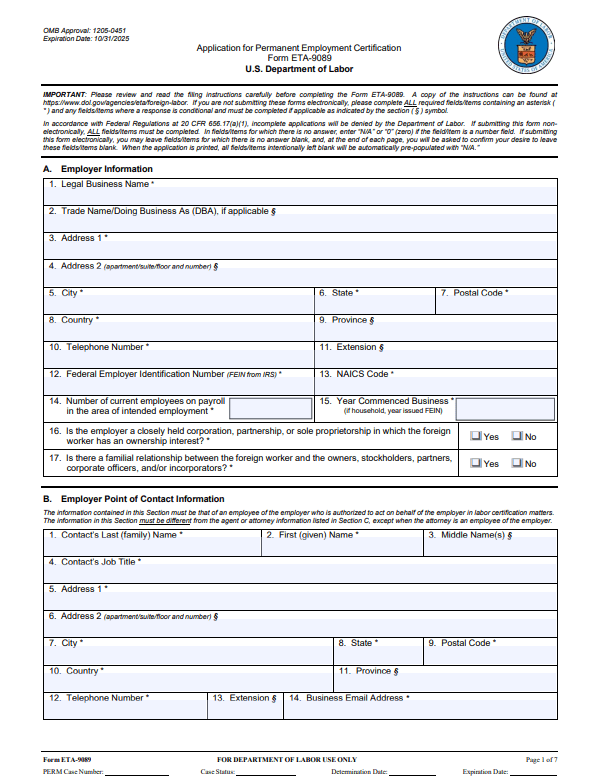
Labor certification is issued by the U.S. Department of Labor (DOL), and the ETA-9089 form (PERM Certification, an application for permanent employment certification) must be submitted.
In addition, as of June 1, 2023, filing and approval are conducted online through the DOL's FLAG system.
The approved ETA-9089 form is filed together with the EB-3 petition (I-140).
Schedule A Designated Occupations
Unlike the general employment-based immigration (EB-3) procedure, certain occupations are exempt from labor certification.
These are called Schedule A occupations, because the U.S. Department of Labor has already recognized that there are not enough U.S. workers for these occupations.
The current Schedule A occupations are as follows.
- Group I : professional nurses and physical therapists
- Group II : individuals of exceptional ability in the sciences or arts, performing arts professionals, and others
If Schedule A applies, the applicant completes the ETA-9089 form and attaches it to the I-140 petition; rather than an 'approved labor certification,' a 'completed but unapproved ETA-9089 form' is submitted.
A valid Prevailing Wage tracking number must also be included.
3. Employment-Based Immigration (EB-3) | Employment Immigration Procedure
The procedure for employment-based immigration (EB-3) is as follows.
| Preparation of supporting documents by eligibility requirement > Filing of the employer's petition > Approval of the petition > Payment of fees and visa application > Visa interview > Medical examination and vaccination > Visa issuance and entry into the United States |
The basic supporting documents for each subcategory are as follows.
1) Professionals
- A U.S. bachelor's degree or a certificate of an equivalent foreign degree
- It must be demonstrated that the relevant work generally requires a bachelor's degree
- The education requirement cannot be substituted with work experience
- Relevant transcripts, copies of the diploma, a certificate of work experience, and similar documents
2) Skilled Workers
- Documents proving a minimum of 2 years of education, training, or work experience
- Examples: a degree certificate, an academic transcript, and an employer's confirmation of work experience
3) Unskilled Workers
- Proof that the work can be performed with less than 2 years of education or experience
- The employer's job offer, a job description, and similar documents
For all employment-based immigration (EB-3) applicants, documents proving the financial soundness of the U.S. employer (sponsor), such as financial statements and tax returns, are also required.
Filing the Petition (I-140)
After obtaining labor certification (or, if Schedule A applies, a prepared ETA-9089), the U.S. employer must file an immigrant petition (I-140 Petition for Alien Worker) with U.S. Citizenship and Immigration Services (USCIS) on behalf of the foreign worker.
After the petition is approved, it is transferred to the National Visa Center (NVC), which assigns a case number to the petition.
The applicant must wait according to the priority date (the date the ETA-9089 was received).
In the case of employment-based immigration (EB-3), a waiting period arises depending on the per-country and per-category quotas.
In particular, because employment-based immigration (EB-3) sees high application demand, waiting several years is also common.
Completing the DS-260
If the NVC notifies the applicant that the priority date has become current, the applicant must complete and submit the choice of address and agent form (DS-261).
If the applicant already has a legal representative, this step is omitted.
Next, the applicant completes the immigrant visa application (DS-260) and pays the visa fee, various translation and copying costs, the medical examination fee, and other charges.
In this case, the fees are non-refundable, and payment must be made according to the separate payment instructions designated by the NVC.
Visa Interview and Medical Examination
Once all required documents are submitted and the fees are paid, the NVC schedules the visa interview at the U.S. embassy or consulate.
Before the interview, the applicant must undergo a medical examination at an embassy-authorized hospital, and complete the vaccinations required by age.
In Korea, the embassy-authorized hospitals are Gangnam Severance Hospital, Sinchon Yonsei Severance Hospital, Yeouido St. Mary's Hospital, and Busan Haeundae Paik Hospital.
On the day of the interview, the applicant must bring a valid passport with at least 6 months remaining before expiration, the DS-260 confirmation, original civil documents such as birth and marriage records, their translations, financial support documents, the job offer, and similar items.
Accompanying Family Immigrant Visas
Once the employment-based immigration (EB-3) petition is approved, the principal applicant's spouse and unmarried children under 21 may also apply for immigrant visas.
Family members must likewise complete the DS-260, pay the fees, and undergo the medical examination and interview.
4. Employment-Based Immigration (EB-3) | Points to Note After Approval

Once the immigrant visa is issued, the embassy delivers to the applicant a passport with the visa affixed and a sealed envelope of documents.
The envelope must never be opened, and it must be submitted to a Customs and Border Protection (CBP) officer upon entry into the United States.
Only after the Immigrant Fee is paid to U.S. Citizenship and Immigration Services following entry is the permanent resident card (I-551, Green Card) mailed out.
Grounds of Ineligibility and Misrepresentation
If the submission of false documents, concealment of facts, overstaying a prior visa, or a criminal record (particularly drug offenses or felonies) is confirmed, the visa may be denied.
Because misrepresentation or fraud may result in permanent inadmissibility in the future, the petition must be prepared strictly on the basis of facts.
An Immigration Attorney's Tips for Preparing Employment-Based Immigration
For EB-3, the waiting period varies depending on the annual quota and the per-country allocation.
From document preparation, labor certification approval, I-140 approval, NVC pre-processing, and the waiting period after the visa interview, the process can take as long as 4 to 5 years, so thorough advance review and strategy planning with an immigration attorney are critical.
In addition, until the visa is issued, the applicant should not make changes to their status, such as hastily changing jobs or disposing of property to relocate.
Because an immigrant visa is valid for 6 months from the date of issuance, it is advisable to check the visa and residence status and renew them in a timely manner.
EB-3 employment-based immigration is a program open to a wide range of workers according to their education and experience requirements.
That said, the employer's active cooperation, a lawful labor certification, and thorough preparation of supporting documents are key to a successful outcome.
By preparing step by step with advice from a foreign attorney qualified in U.S. law and an immigration attorney with extensive experience in employment immigration consultation and practice, applicants can move one step closer to obtaining U.S. permanent residence.