
CONTENTS
- 1. Interference with Business | Case Details

- 2. Interference with Business | Assistance Provided by the Criminal Law Specialist Attorney
- - Reinterpretation of the 'Scope of Duties' of the Acting Officeholder
- - Presentation of Grounds for Freedom of Worship Through Precedent
- - Emphasis on the Practical Necessity Within the Church
- - Pointing Out the Misunderstanding of Legal Principles
- 3. Interference with Business | Case Result
- - Concept and Elements of Interference with Business
- 4. Interference with Business | Concept and Effect of Appeal
- - Key Points in Responding to Interference with Business

1. Interference with Business | Case Details
This is the account of a client who came to our firm stating that he was at risk of having a criminal record for interference with business.
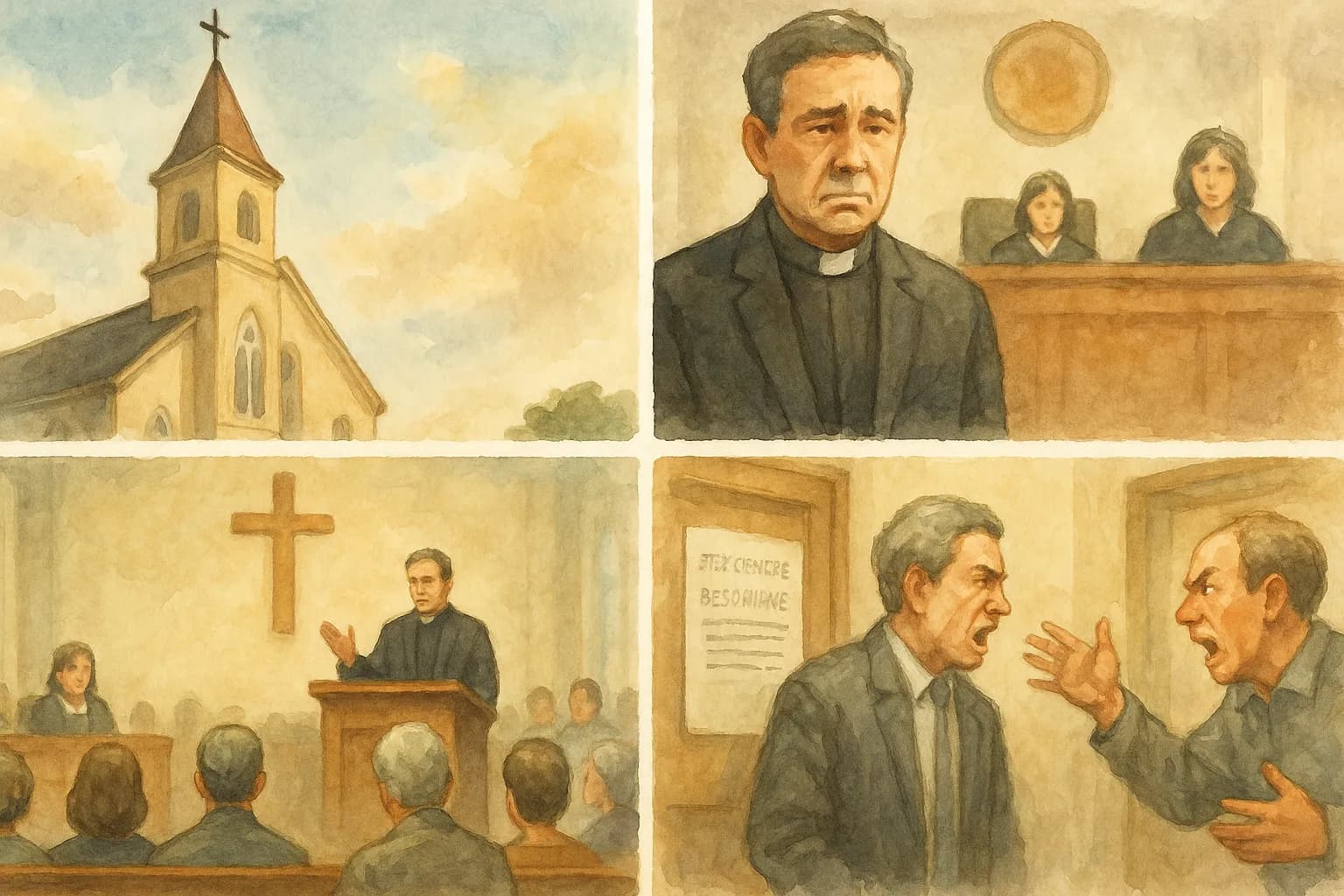
The client had been serving as the senior pastor of a church.
However, as conflicts with some opposing members of the church deepened, a lawsuit seeking the dismissal of the senior pastor was filed, and the court issued a provisional injunction to suspend performance of duties, ruling that the client must not perform the duties of senior pastor until the judgment on the dismissal claim became final.
However, there were still members within the church who supported the client.
Accordingly, the client conducted a separate worship service with the supporting members in the main sanctuary on the third floor of the church, and posted a "statement urging the normalization of the church" next to the entrance of the worship venue.
The opposing members and the acting officeholder filed a complaint for interference with business, claiming that the client had interfered with their normal worship service, and in the original trial the client was given a suspended sentence.
Feeling that this was unjust, the client filed an appeal and sought the assistance of a criminal law specialist attorney.
2. Interference with Business | Assistance Provided by the Criminal Law Specialist Attorney
The criminal law specialist attorney intensively contested the facts and the errors in the interpretation of legal principles that had been overlooked in the original trial, responding to the appellate proceedings with the following reasoning.
 Reinterpretation of the 'Scope of Duties' of the Acting Officeholder
The original trial determined that the duties of the acting officeholder were "the overall management of church operations, including presiding over worship, church administrative management, and convening the session."
However, on the basis that the church was already in a state of separate worship, the criminal law specialist attorney emphasized that the client's act of conducting worship in the main sanctuary on the third floor did not interfere with the acting officeholder's worship but merely constituted a separate religious activity.
Presentation of Grounds for Freedom of Worship Through Precedent
The criminal law specialist attorney submitted the judgment in the "case for confirmation of nullity of the expulsion and excommunication disposition," which had been rendered after the provisional injunction to suspend performance of duties, and presented as grounds the point that the court had ruled that "even if the subject of worship differs, separate worship should be permitted as long as the act of faith itself does not directly interfere with the other party's duties."
In other words, the attorney argued that the client's act of worship was not interference with business but conduct within the scope of religious freedom.
Emphasis on the Practical Necessity Within the Church
At the time, the church was split into a supporting faction and an opposing faction, and the confrontation was severe enough that physical clashes occurred.
The criminal law specialist attorney argued, "The separate worship was an unavoidable measure to minimize confrontation and to guarantee freedom of faith, and this constitutes a justifiable act under generally accepted social norms."
Pointing Out the Misunderstanding of Legal Principles
The criminal law specialist attorney pointed out that the original trial's interpretation of the acting officeholder's 'authority over the duties of senior pastor' was excessively comprehensive, and that viewing all of the client's worship activities as interference with business was a misunderstanding of the legal principles regarding the scope of duties.
The purport was that the worship on the third floor of the church was entirely different in time and place from the acting officeholder's sermon, and therefore could not be regarded as infringing upon freedom of worship or interfering with duties.
Finally, the criminal law specialist attorney argued, "The client's act of merely posting a statement cannot be regarded as having suppressed the other party's performance of duties by force."
The attorney established in detail that expressing a position or conveying the opinions of members falls within the realm of freedom of expression, and that no physical force or coercive act was involved.


3. Interference with Business | Case Result
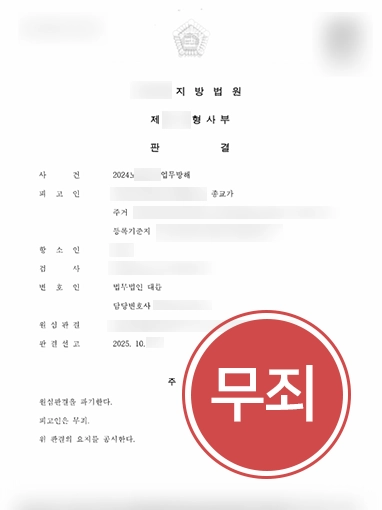
The appellate court accepted the criminal law specialist attorney's arguments.
The court determined that "the client's conduct of worship was a religious activity with some of the church's congregants, and it is difficult to regard it as having substantially interfered with the acting officeholder's worship."
The court also ruled that the act of posting the statement constituted a nonviolent expression of intent, and that it could not in itself be regarded as satisfying the 'exercise of force' element of interference with business.
In the end, the court reversed the original judgment and pronounced an acquittal of the client.
Concept and Elements of Interference with Business
Interference with business is established when a person commits an act that interferes with, or risks interfering with, another person's business.
· Elements of the Offense
② Act of interference: It must be an act that makes the performance of business difficult, such as assault, intimidation, physical intrusion, or the exercise of force
③ Intent: There must be an intent or awareness to interfere with the business
Under the Criminal Act, interference with business may be punished by imprisonment for not more than 5 years or a fine of not more than 15 million won.
If it is combined with the spreading of false facts or intimidation, defamation or intimidation may also be applied, so a sound response is necessary.
4. Interference with Business | Concept and Effect of Appeal

An appeal is a procedure for seeking a renewed judgment from a higher court by contesting the judgment of the court of first instance.
An appeal is filed when there is an error in the finding of facts or a mistake in the interpretation of legal principles, and once an appeal is filed, the appellate court re-examines both the facts and the law.
Through an appeal, the factual findings of the original trial can be corrected by means of the submission of new evidence, witness examination, and applications for expert appraisal.
As in this case, where an unjust judgment has been received, it is possible to obtain an acquittal by pointing out the misunderstanding of legal principles and clearly proving the facts through an appeal.
Key Points in Responding to Interference with Business
When you have been wrongfully accused of interference with business, you should keep the following points in mind.
· Confirming the Scope of 'Business'
It is necessary to closely examine whether the business asserted by the other party is in fact subject to legal protection.
· Analyzing the Substance of the 'Act of Interference'
If there was no active act of interference, such as physical force, the exercise of force, or intimidation, it is difficult to establish interference with business.
· Preparing an Appeal Strategy
If an unfavorable judgment was received at the first instance, an appeal should be actively considered on the grounds of a reassessment of the facts, the misunderstanding of legal principles, and the evidence.
In this case, the client was at risk of having a criminal record because the separate worship conducted amid conflict within the church was mistaken for 'interference with business.'
However, through a professional review of the legal principles at the appellate stage, it was recognized that the client's conduct had not directly interfered with the business of the acting senior pastor, and an acquittal was ultimately pronounced.
If you need legal assistance in a situation similar to that of the client, please consider proceeding with a 🔗Legal Consultation Reservation with a Daeryun Law Firm criminal law specialist attorney.
This content is based on actual case studies of Daeryun Law LLC with some adaptations, and the copyright belongs to our firm.
Unauthorized reproduction, duplication, or distribution and other copyright infringements may result in legal action under applicable laws.