
CONTENTS
- 1. The Client Reported for a Medical Service Act Violation

- - The Circumstances of the Involvement in the Medical Service Act Case
- 2. Establishing a Strategy to Respond to the Report of a Medical Service Act Violation
- - Identifying the Legal Issues Through Relevant Precedents
- - The Act of Taking the X-Ray and Whether It Was Under the Physician's Direction
- - Securing Additional Sentencing Materials
- 3. Result of the Reported Medical Service Act Violation Case: “Suspension of Sentencing”
- 4. Reviewing the Reported Medical Service Act Violation Case
- - Representative Types of Unlicensed Medical Practice
- - How to Respond
- - Medical Service Act Violation FAQ

1. The Client Reported for a Medical Service Act Violation
The client, who had been reported for a violation of the Medical Service Act, was at risk of receiving a criminal punishment for the violation and being forced to leave her position as a nurse, but with the assistance of a criminal defense attorney, she received a judgment of suspension of sentencing in the Medical Service Act violation case and was able to conclude the matter.
 The Circumstances of the Involvement in the Medical Service Act Case
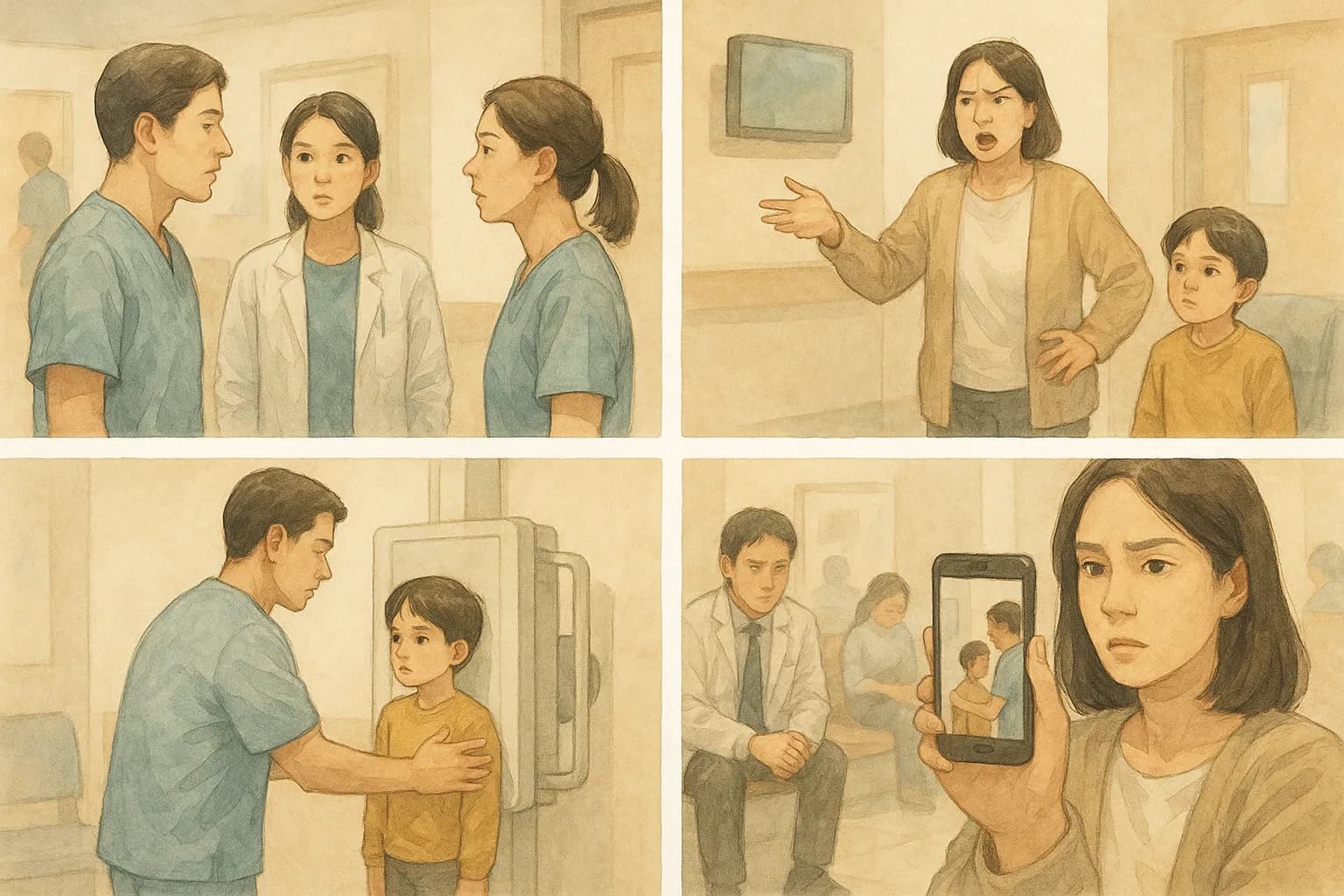
On the day of the incident, the client was working at the hospital together with the staff.
Afterward, a child who needed an X-ray came in, but because the waiting time grew long, the guardian began to raise complaints.
Judging that she had to handle the work quickly amid the busy situation, the client came to take the X-ray.
One of the staff members who observed this, however, secretly recorded a video and proceeded to file a report of a violation of the Medical Service Act.
The client, stating that “I took the X-ray because there were numerous complaints about the delay in the work,” feared that she would be punished and dismissed from the hospital, and she requested the assistance of a criminal defense attorney in responding to the report of the Medical Service Act violation.


2. Establishing a Strategy to Respond to the Report of a Medical Service Act Violation

We identified the issues of the case so that the client, who had been reported for a violation of the Medical Service Act, could receive the greatest possible leniency.
· Was the imaging carried out under the guidance and supervision of a physician?
· Is there a possibility of leniency in light of the client’s record of criminal punishment, her attitude of remorse, and the sentencing materials?
Identifying the Legal Issues Through Relevant Precedents
Under the provisions of the Medical Service Act, there is room to perform such tasks if they are carried out under the direction or supervision of a physician.
In fact, a court recently ruled as follows in a case similar to this one.
Seoul Administrative Court, Judgment of December 19, 2024, Case No. 2024Guhap60794
If a nursing assistant falls within the scope of “assisting with medical treatment” under the Medical Service Act, it is reasonable to find that the assistant may perform the duties of a medical technician and the like under the direction and supervision of a physician.
Accordingly, the court found that a nursing assistant may likewise perform the duties of a medical technician and the like under the direction or supervision of a physician.
The criminal defense attorney emphasized that taking an X-ray is a task that can be performed with only basic knowledge, and argued that there is room to perform such a task when the direction or supervision of a physician is present.
The Act of Taking the X-Ray and Whether It Was Under the Physician's Direction
While treatment was underway within the clinic, the client, taking into account that the physician was busy, on the client's own initiative took the patient's guardian to the X-ray room and conducted the imaging in the prescribed manner.
Afterward, an analysis of the in-clinic CCTV footage that was obtained indicated that the physician had also reviewed the X-ray taken by the client and used it directly in the patient's treatment.
On this basis, the criminal defense attorney emphasized that the client's conduct could be regarded as having taken place within the physician's area of management and that it was, as a result, carried out under the physician's direction.
Securing Additional Sentencing Materials
The criminal defense attorney secured sentencing materials so that the client could receive leniency in this case.
The client has no prior criminal record, actively cooperated during the investigation, and showed a sincere attitude of remorse.
Accordingly, the attorney submitted the following materials so that they could be reflected in sentencing.
· School records
· Certificate of completion of community service
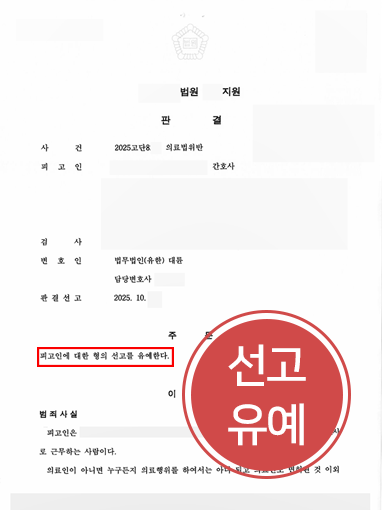
3. Result of the Reported Medical Service Act Violation Case: “Suspension of Sentencing”

The criminal defense attorney prepared various sentencing materials to demonstrate that the client had no prior criminal record and had actively cooperated during the investigation while showing an attitude of remorse.
Together with this, the attorney emphasized that the X-ray imaging had been carried out under the physician's direction and argued that the client's conduct involved a low degree of intent with respect to the Medical Service Act violation.
Accordingly, the court, comprehensively considering the client's sincerity and the circumstances of the case, rendered a judgment of suspension of sentencing that deferred criminal punishment.
A suspension of sentencing means that, even where guilt is found, the pronouncement of the sentence is deferred for a certain period.
In general, it is a judgment under which the sentence itself may be exempted if the person faithfully complies with the specific conditions set by the court for two years.
4. Reviewing the Reported Medical Service Act Violation Case
The client, who was the subject of a report for a Medical Service Act violation, became involved in a Medical Service Act case on suspicion of having engaged in unlicensed medical practice.
Unlicensed medical practice refers to a case in which a person who is not a medical professional performs a medical act, or in which a medical professional performs a medical act that exceeds the scope of that professional's license.
If a person is subject to criminal punishment for unlicensed medical practice, the punishment may be severe, as follows.
In addition, not only criminal punishment but also administrative sanctions, such as suspension of the operation of the medical institution and revocation of the license, may follow.
Level of Punishment
| Medical Service Act, Article 87-2, Paragraph 2 | Imprisonment for up to five years or a fine of up to 50 million won |
Representative Types of Unlicensed Medical Practice
The representative types of unlicensed medical practice are as follows.
Each type involves a person without a license performing a medical act, or conduct that exceeds the scope of a license.
Therefore, if a person is the subject of a report for a Medical Service Act violation involving unlicensed medical practice, a response strategy should be prepared promptly.
2. Medical acts exceeding the scope of a license
3. Treatment by proxy or lending of one's name
4. Illegal medical procedures
How to Respond
At Daeryun LLC, attorneys with extensive expertise in medical cases carefully review whether unlicensed medical practice occurred and examine the related evidence from the early stage of the case.
Where necessary, they obtain and analyze materials such as CCTV footage, medical records, and witness statements in order to establish whether the client acted with intent.
In addition, through the preparation of sentencing materials and the development of a legal argument strategy, they work to minimize criminal punishment and to maximize the possibility of leniency.
If you have been the subject of a report for a Medical Service Act violation in a situation such as the above, please promptly request assistance through the 🔗legal consultation booking service.
Medical Service Act Violation FAQ
A. Criminal punishment does not necessarily follow.FAQ on Reported Medical Service Act Violations #1
Q. If a person is reported for unlicensed medical practice, will that person necessarily be subject to criminal punishment?
Whether criminal punishment is imposed is determined by comprehensively considering factors such as the intent behind the conduct, the scope of the medical act, whether there was direction and supervision by a physician, whether harm occurred, and whether there is a prior record.
A. In a Medical Service Act case, intent serves as a key criterion for criminal liability.FAQ on Reported Medical Service Act Violations #2
Q. Why is intent important in a Medical Service Act case?
If intent is found, the court is likely to conclude that the actor performed the medical act deliberately while aware that the actor was not in a position to do so, and to impose a heavy sentence such as imprisonment or a fine.
Conversely, in circumstances where intent is low or can be denied, there is a possibility that a lighter punishment, such as a suspension of sentencing, a reduction of sentence, or a fine, will be imposed.
See More


Watch related video content
for this case study.

🏥Complicated and difficult medical litigation👨⚕️ What is your success strategy?
This content is based on actual case studies of Daeryun Law LLC with some adaptations, and the copyright belongs to our firm.
Unauthorized reproduction, duplication, or distribution and other copyright infringements may result in legal action under applicable laws.