
CONTENTS
- 1. Details of the Person-Accused-of-Child-Abuse Case

- - Assistance Provided by the Criminal Law Attorney
- 2. Result of the Person-Accused-of-Child-Abuse Case
- - The Concept of Child Abuse and Types of Conduct
- - Key Points for Responding to a Child Abuse Case
- 3. Procedure Following a Report Against an Alleged Child Abuse Offender
- - Matters in Which Daeryun Law Firm Can Provide Assistance

1. Details of the Person-Accused-of-Child-Abuse Case
This is the story of a client who came to this firm stating that he had been identified as a person accused of child abuse and was facing the risk of punishment.
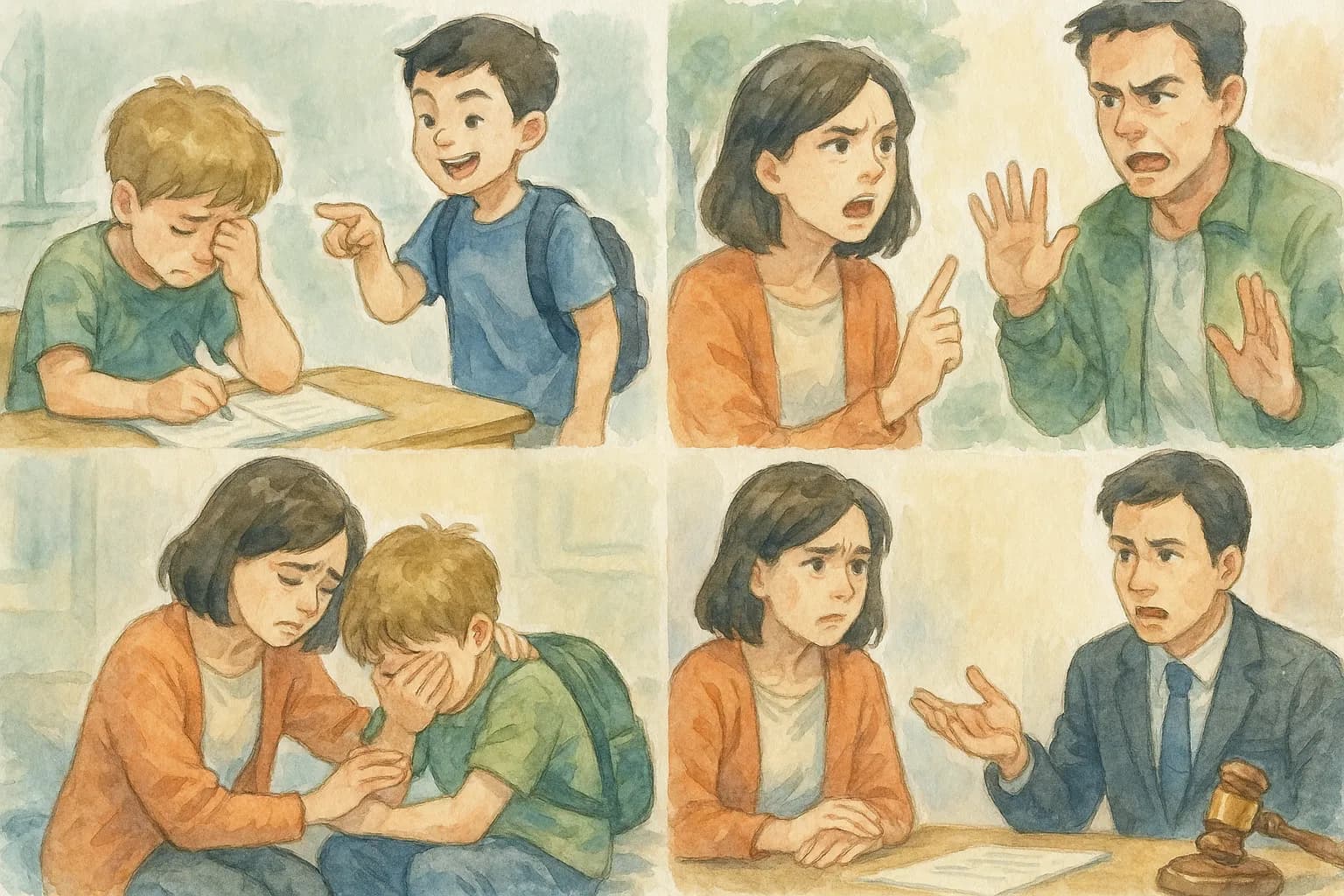
The client is a parent of an elementary school child, and the child had repeatedly been subjected to insulting remarks from a classmate.
The other child had continuously used demeaning expressions toward the client's child, such as "pig," "ugly," and "loser," and the child's psychological stress became so severe that the child even exhibited symptoms of refusing to eat.
In response, the client merely told the other child to refrain from making insulting remarks in the future, but a few days later the other child's parents argued that this conduct was an act of emotional abuse, identified the client as a person accused of child abuse, and filed a criminal complaint.
As the situation moved beyond simple guidance or caution into a criminal procedure, an accurate response strategy was needed.
 Assistance Provided by the Criminal Law Attorney
From the early stage of the case, the criminal law attorney focused on the fact that whether emotional abuse was established was the key issue, and proceeded with the response in the following manner.
1. Organizing the purpose of the conduct and the manner of its delivery
The attorney reflected in the structure of the statement that the remark the client made to the other child was not an insult, threat, or creation of fear, but a minimal verbal warning to protect the client's own child.
2. Analyzing the standard for emotional abuse through Supreme Court precedent
The Child Welfare Act prohibits acts of emotional abuse that harm mental health and development, and Supreme Court Decision 2015Do13488 presents the following standards.
· It can be established regardless of whether physical force is exercised.
· It includes not only actual harm but also the risk or possibility of harm occurring.
· Intent to abuse is not necessarily required, and it can be established with only conditional awareness.
On the premise of this legal principle, the attorney explained that the conduct in question was not a remark made for the purpose of emotional abuse or with an awareness of the risk.
3. Securing and submitting a witness's written confirmation of facts
The attorney obtained and submitted a written confirmation of facts from a parent who was present at the scene where the situation occurred, thereby objectively proving that there had been no shouting, threats, or coercive words or conduct.
4. Confirming the actual harm suffered by the child through medical records
The criminal law attorney submitted the psychiatric diagnosis and counseling records of the client's child, and through this confirmed that it was the client's child who was the party that suffered continuous harm.
2. Result of the Person-Accused-of-Child-Abuse Case
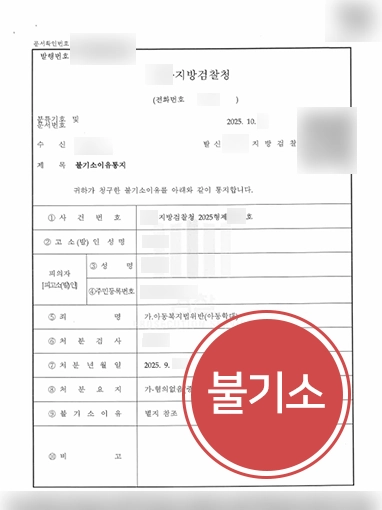
As a result of a comprehensive review of the submitted materials and statements, the prosecution determined that the client's conduct appeared to be a legitimate intervention to protect his own child and did not constitute an act of emotional abuse.
Accordingly, the case was concluded at the prosecution stage with a non-prosecution disposition (no suspicion of crime).
This result was made possible because attorney assistance centered on setting the direction of the statement at the early stage of the investigation and securing objective evidence was applied.
The Concept of Child Abuse and Types of Conduct
Child abuse refers to a guardian or a third party inflicting physical, mental, or sexual suffering on a child, or neglecting the child, and it may also include a risk or possibility at the stage before the result occurs.
The main types of child abuse crimes include physical abuse, emotional abuse, neglect, and sexual abuse.
Where a charge is found established against a person accused of child abuse, punishment at the levels below is imposed depending on the conduct.
Classification | Result | Sentence |
Killing after abuse | Death | Death penalty, life imprisonment, or imprisonment for at least 7 years |
Death following abuse | Result occurs | Life imprisonment or imprisonment for at least 5 years |
Causing serious danger to life or health | Risk of disability or incurable disease | Imprisonment for at least 3 years |
Sexual abuse | Sexual violation or exploitation | Imprisonment for not more than 10 years or a fine not exceeding 100 million won |
General abuse | Emotional, physical, or neglectful conduct | Imprisonment for not more than 5 years or a fine not exceeding 50 million won |
Habitual offender | Repeated or continuous | Aggravation by one-half of the sentence |
Key Points for Responding to a Child Abuse Case
The key points in responding to a child abuse case are as follows.
1. Organizing the facts is a priority over emotional explanations.
2. The situation, content, and tone of the remarks, as well as the other party's reaction, must be recorded specifically.
3. Where possible, it is necessary to secure third-party witness materials or recordings.
4. Because the structure of the harm may change, it is important to confirm medical and psychological counseling records.
5. Before the police investigation, it is necessary to determine the direction of the statement after consulting with an expert.


3. Procedure Following a Report Against an Alleged Child Abuse Offender

Once a report of child abuse is made, the matter generally proceeds along the following course.
1. Initial Police Response
When a report is received through 112 or a specialized child protection agency, the agency in charge conducts an on-site assessment, interviews with the child and the guardian, and an investigation of the home environment.
2. Formal Police Investigation
The police station gathers statements from reference witnesses, the school, and persons in the surrounding circle, conducts interviews with the child, examines the guardian, and collects related materials such as recordings, text messages, photographs, video, and medical records. When necessary, the process may be carried out jointly with a specialized child protection agency.
3. Decision on Referral to the Prosecution
Based on the results of the investigation, the police decide whether to issue a non-referral decision (in the sense of no suspicion of crime) or to refer the case to the prosecution with an opinion to indict.
4. Determination at the Prosecution Stage
Through the case records and any additional investigation, the prosecutor decides whether to issue a non-indictment (no suspicion of crime, suspension of indictment, and the like) or to institute a public prosecution. If a public prosecution is instituted, the matter advances to the formal trial stage, in which the defense structure becomes considerably more complex.
Because the content of statements, the materials submitted, the attitude shown, and the response strategy adopted at the early stage are carried through the entire process, it is necessary to prepare systematically from the moment the report is made.
Matters in Which Daeryun Law Firm Can Provide Assistance
In cases involving an alleged child abuse offender, Daeryun Law Firm can provide the following one-stop response services.
1. Early analysis of the case and guidance on statements
2. Attendance at the investigative agency and accompaniment during questioning
3. Assistance in preparing witness statements and written confirmations of facts
4. Securing medical and counseling records and designing the direction for their submission
5. Response at the prosecution stage and construction of the reasoning for non-indictment
6. Capacity to extend to subsequent responses to defamation and false accusation
Because child abuse cases can significantly affect a child's future, strict punishment is being imposed.
If you have been wrongly identified as a child abuse offender and face the risk of punishment, it is important to retain an attorney specializing in criminal matters as quickly as possible and respond accordingly.
If you need a response to a child abuse case, you are encouraged to proceed right away with a Daeryun Law Firm 🔗legal consultation reservation in order to clear the alleged child abuse charges.
This content is based on actual case studies of Daeryun Law LLC with some adaptations, and the copyright belongs to our firm.
Unauthorized reproduction, duplication, or distribution and other copyright infringements may result in legal action under applicable laws.